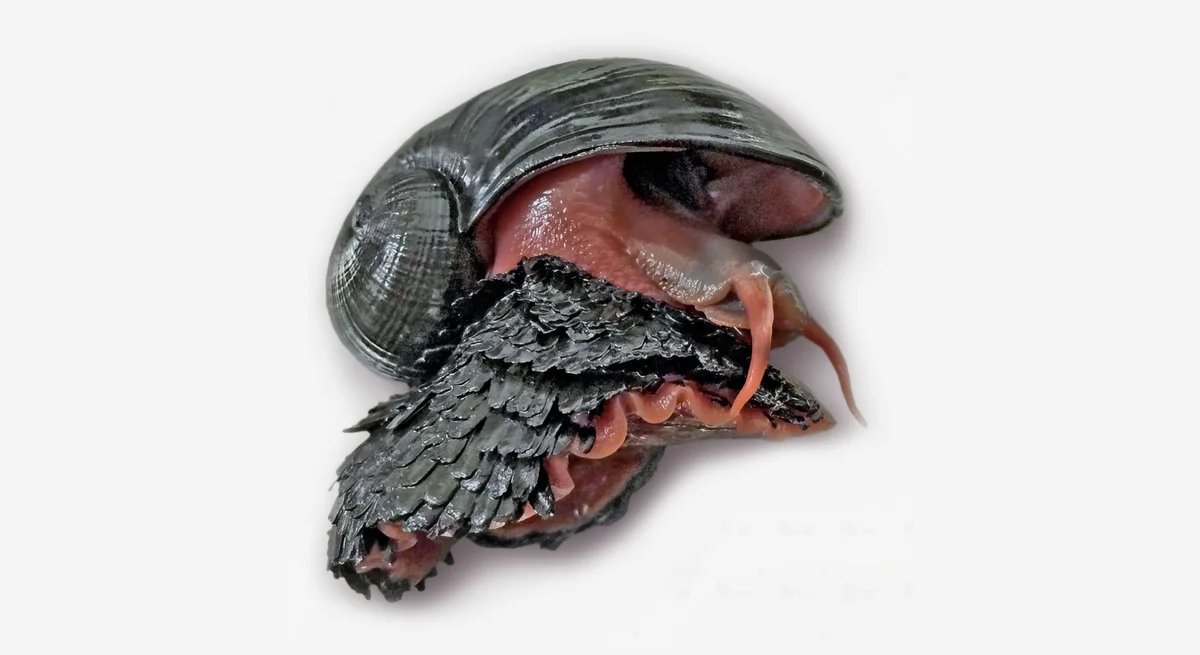
Almost two miles beneath the waves of the Indian Ocean, a hydrothermal vent spews sulfur into the inky black waters. On its lip, a small snail is not only basking in the poison but converting it into a shell that is part iron. This gastropod is the scaly-foot snail (Chrysomallon squamiferum), perhaps the world’s most metal animal.
Despite being so hardcore, the species has a precarious future. In 2019 the snail became the first species that lives on hydrothermal vents to be classified as endangered by the International Union for the Conservation of Nature (IUCN) Red List of Threatened Species—thanks to the threat of deep-sea mining companies that have been interested in harvesting the minerals at the vents that the snails call home.
For a long time, scientists presumed that the intense pressure and toxic compounds that erupt from Earth’s crust through hydrothermal vents would make these structures and the water around them incompatible with life. But in 2001 researchers found the snails living happily among a myriad of other creatures that thrive in these unforgiving environments. The snails’ iron-rich shell is a vital part of their survival strategy—but not as a protective armor, says Chong Chen, a senior scientist at the Japan Agency for Marine-Earth Science and Technology and a leading expert on the scaly-foot snail, who led the effort to map its genome. Rather, the shell is almost like the human liver in that it helps remove toxins from the snails’ body, he explains.
On supporting science journalism
If you’re enjoying this article, consider supporting our award-winning journalism by subscribing. By purchasing a subscription you are helping to ensure the future of impactful stories about the discoveries and ideas shaping our world today.
The reason why has to do with how the snail gets its nutrients. This creature doesn’t eat in a conventional sense. Instead, like other species that live on hydrothermal vents, the snail is home to bacteria that feast on hydrogen sulfide, oxygen, and carbon dioxide and convert those chemicals into sugar. In exchange for providing the bacteria a home in its gut, the snail uses that sugar for energy. The bacteria’s digestion produces toxic sulfur as a by-product, however. To protect itself, the snail excretes the sulfur, which mixes with iron in the vent water. The end result is a shell that’s literally, albeit partially, made of metal, along with the tough scales that give the snail its name.
“The ‘iron armor’ is not for defense, as people thought for many years; instead it is for symbiosis. The snail is totally happy without the iron armor, which is a by-product formed by the hot vent environment,” Chen says.
The snail, which is less than two inches long, has already inspired some technological innovations. The U.S. Army, for instance, has studied the snail’s scales for inspiration in designing new armor, and its chemical composition has sparked new ideas on how to make the pyrite nanoparticles found in solar panels.
Not only is the snail the single animal known to incorporate iron sulfide into its shell, but it also has evolved to only exist on eight sulfur-rich hydrothermal vents in the world. The amount of space on Earth that can be inhabited by the snail is so small that it amounts to roughly half the size of Disney World, says Jon Copley, a marine biologist at the University of Southampton in England.
The very same environment in which the snail evolved its signature feature is also what has made its future uncertain. Underwater hydrothermal vents form at the edges of Earth’s tectonic plates, where seawater is able to trickle down through the crust. That water is heated by magma below and shoots back upward, bringing with it precious minerals such as copper, zinc and gold, along with the iron and sulfur found in the snail’s shell.
Those minerals have caught the attention of mining companies. Copper is particularly in demand because of its use in artificial intelligence data centers and green energy production. Although no deep-sea mining is yet underway in these areas, at least two of the vents that the snails live on have been considered for possible operations, according to the IUCN.
“There are rising concerns that if mining is permitted, the habitat could be severely reduced or destroyed,” the organization wrote in its Red List entry. The best way to protect the vents—and the snails—is to “just not mine active hydrothermal vents, period,” Chen says.
Instead mining companies could target inactive vents, he says. “There are, for example, many inactive hydrothermal massive sulfide deposits in the Indian Ocean. These inactive vents no longer host the scaly-foot snail, and therefore mining these sites would not impact the snails,” Chen says. Still, such vents are no panacea, he adds. “We currently know very little about how unique the inactive vents themselves are in terms of biodiversity,” Chen says. “Ongoing research has found at least some animal groups that seem to be unique to inactive vents, so mining there might impact those animals.”
Aside from the snail’s contributions to modern armor and material sciences, Copley says, there are philosophical reasons to preserve the future of a creature that lives in an environment as alien and inaccessible to humans as any ecosystem on our planet. Few people will ever see a scaly-foot gastropod, but that doesn’t change their preciousness.
Chen is more pragmatic. The snail by itself may not affect humans, but its native ecosystem, while remote, is proving to play a larger role than previously suspected in the overall health of the ocean. The vents pump carbon and other nutrients into the water, and those nutrients sustain the beauty humans admire and the food they eat.
“We are now starting to understand that hydrothermal vents play key roles in regulating the supply of such elements to the ocean and therefore contributing significantly to the global biogeochemical cycles that we all rely on,” Chen says. “The world is one connected planet, more than one might realize. We are now living in the consequences of deforestation’s impacts on the climate, which we did not realize when it began. Mining hot spots like hydrothermal vents may lead to a similar impact.”