The cult of the great man, common in the US given our love of glorifying the individual, has lately reached depressing extremes. Elon Musk, fancying himself a modern Midas, wreaked massive chaos on the federal government last year with his band of Doge hacks. Donald Trump, meanwhile, has instituted an unofficial cult of personality in DC, and recently posted – then deleted – an image of himself as a Christ-like figure. Less malevolently, we tend to think of great scientists, authors and philosophers as working in splendid isolation, assuming that their accomplishments are a function of their solitude and individual gifts.
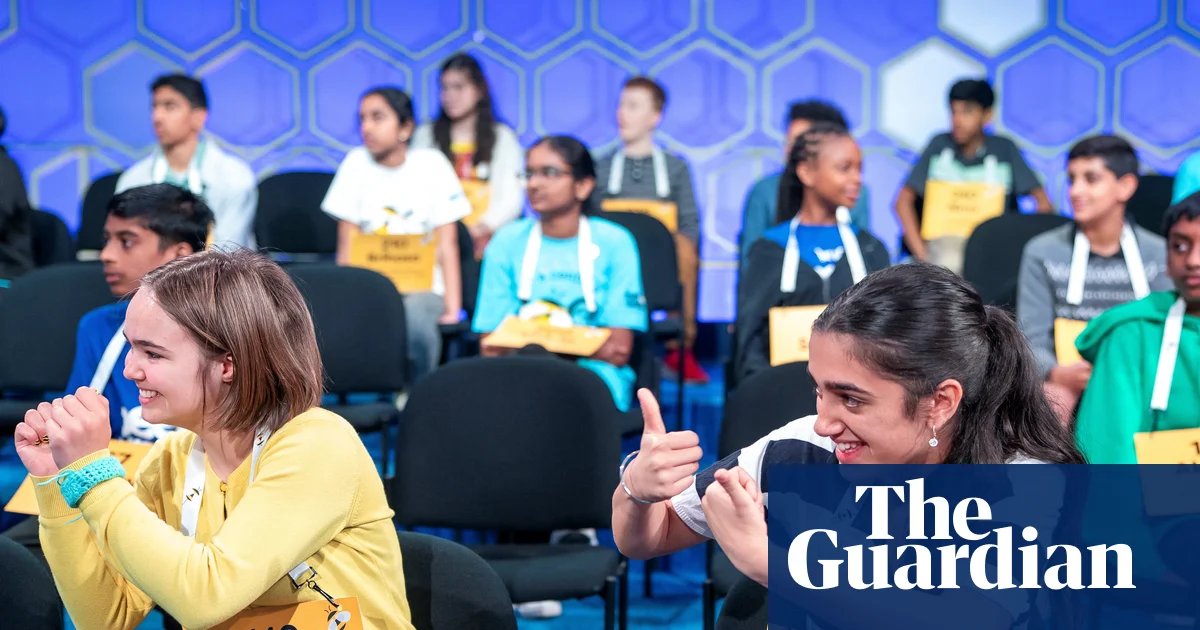
When some people witness the crowning moment of the Scripps National Spelling Bee – the champion, standing alone, hoisting the trophy as the confetti falls – they may understandably assume that competitive spelling works the same way. But, as with so much in life, success in competitive spelling is a function of community – an important lesson for us all to remember in an age of atomization, AI alienation and Trumpist individualism.
The term “spelling bee” itself attests to the communal nature of spelling. While the etymology of bee in this sense of the word is murky, dating back to the colonists’ husking, quilting and spelling bees, Merriam-Webster theorizes that it comes from the English dialect word been, meaning “voluntary help given by neighbors”. And if the word bee is an allusion to the insect, as many assume, bees are highly social. (I celebrate this fact by naming the group spelling classes I teach after highly intelligent and social creatures like dolphins, bonobos, ants and bees.)
Holding a spelling bee is a herculean undertaking, requiring a team of people to publicize and run the competition. It is committee work par excellence. It would be impossible for me to hold my annual Words of Wisdom Online Spelling Bee, now in its sixth year, without at least three other people serving as head judge, timekeeper and tech liaison. And every bee – at the classroom, state or national level – requires an immense amount of work: composing and double-checking word lists, coordinating logistics, spreading the buzz to the media and public, answering inquiries, adjudicating appeals during the competition and distributing prizes, among other tasks. Bees also need sponsors: it costs money to book venues and remunerate judges and pronouncers for their labor.
The Scripps National Spelling Bee, which has had to adapt during Covid, expand its sponsorship program and maintain its international reach, is a year-round enterprise headed by an executive director. It employs a team of full-time staff to deal with the many logistical details that go into producing a bee with about 230 contestants. In addition to the Bee’s full-time employees, Bee Week features a tech and events crew; an army of college students who run activities and get parents and spellers where they need to be; and, of course, Scripps’ revered team of pronouncers, word panellists, and judges.
On the individual level, successful spellers have supportive coaches, teachers, friends, siblings and parents who help them on their journey. If you’ve ever had the pleasure of watching Akeelah and the Bee, Spellbound, or The 25th Annual Putnam County Spelling Bee (now off-Broadway!), what jumps out is the way that human interaction is instrumental in motivating spellers to achieve great things.
Every year, as a professional spelling bee tutor, I have the privilege of getting to know my students. I learn about their personalities and their quirks. We share many hours analyzing the intricacies of the languages that appear at the bee, discussing rules and exceptions, and honing their ability to ask about Latin and Greek roots and painstakingly piece together spellings using clues in the definition and etymology. The relationship that we build undergirds the intensive work that we do to turn them into champions. Tutoring is about mentorship, friendship and human connection. I have found this to be just as true in my group classes, where spellers learn from one another, as in my one-on-one classes.
Many spellers also participate in a “minor league” circuit of online and in-person spelling bees throughout the school year, including my bee, the South Asian Spelling Bee, and the North South Foundation Bee. They make new friends, developing networks of spelling buddies across the country who inspire and challenge each other, turning the solitary work of studying into sociability. The National Spelling Bee thus becomes a joyous reunion. One of the cliches about the Bee, oft repeated but true, is that it’s every speller against the dictionary. Unlike similarly prestigious, high-octane competitions, the Bee is blessedly comradely, perhaps reflecting the happiness they feel at being among other spellers when competitive spelling is often viewed as eccentric by other kids.
Spelling bee participation inculcates pride in being different. Likewise, the National Spelling Bee recognizes that diversity is strength: it makes accommodations for differently abled spellers and spellers from diverse communities around the world. In a world of bogus culture wars and artificial outrage, the Bee is an opportunity for word nerds to meet up in real life, find their people and join in an innocent, genuine celebration of language. It is a vindication of difference and community: two bedrocks of democracy under threat today and, now more than ever, well worth defending.