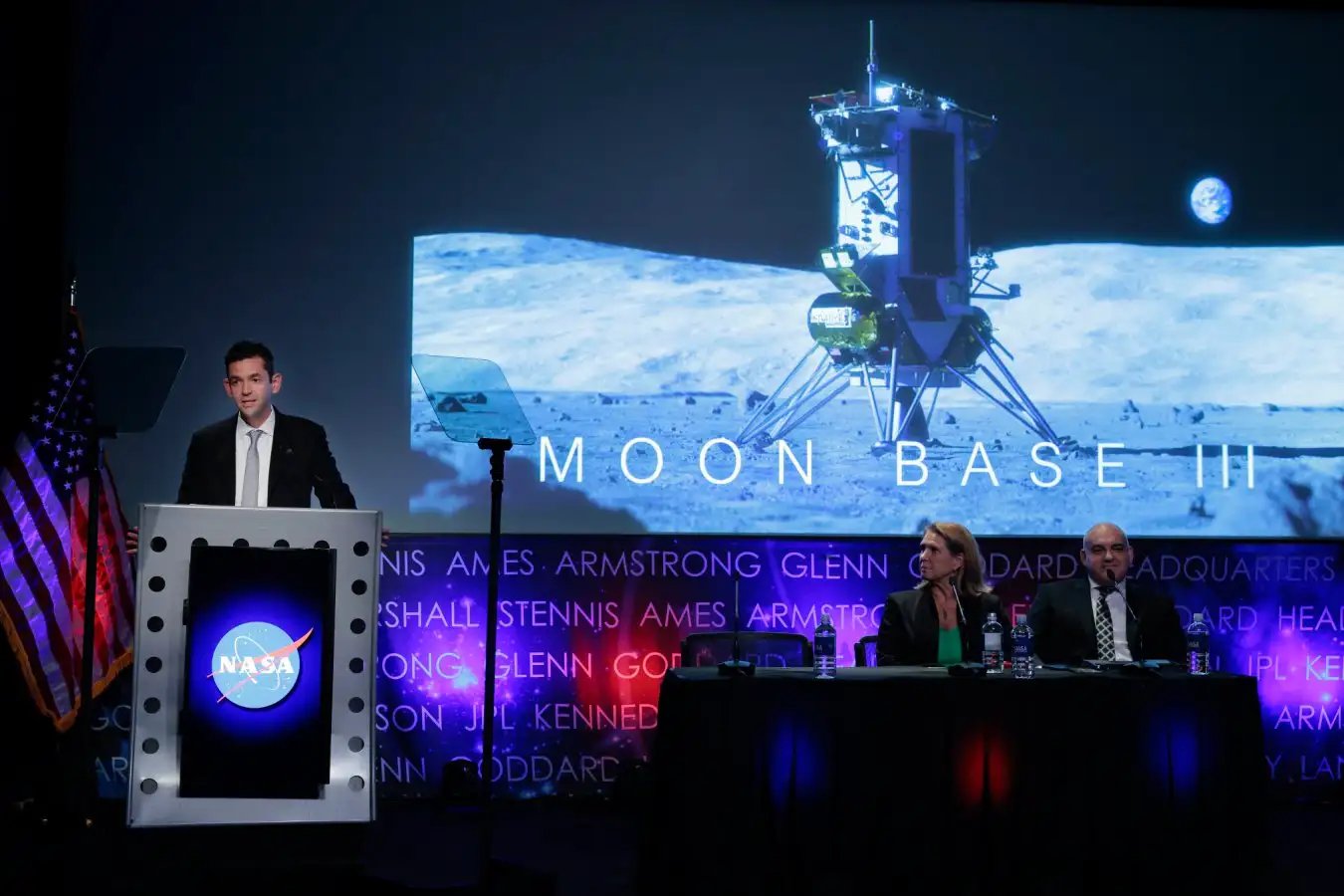
NASA administrator Jared Isaacman (left) announced plans to establish a permanent presence on the moon during a press conference at the agency’s headquarters in Washington DC on 26 May
Chip Somodevilla/Getty Images
NASA has revealed details of its plans to build a permanent base on the moon. Initially, this will see autonomous rovers and hopping drones scouting out the lunar surface. Down the line, the plan is for astronauts to build a future lunar home, slated to be hundreds of square kilometres in size.
Plans for a lunar base have been part of NASA’s Artemis programme for years, but its main focus has been landing astronauts on the moon for the first time since the 1970s. The human space-flight part of the project has been successful so far, with the Artemis II mission sending four astronauts on a path around the moon and back to Earth in April this year. But until recently, NASA had released fewer concrete details about a timeline for building a moon base.
On 26 May, it announced that the first three missions to build a lunar base will be targeted for this year, with at least a further nine to be announced before 2027. The overall programme will consist of three phases, with the first lasting until 2029 to “secure reliable access” to the moon’s surface. The second will last until 2032 for “initial moon base operating capability”, and the actual base itself is to be built near the lunar south pole in the third and final phase, lasting up to 2036.

An artist’s illustration depicting astronauts, rovers, power systems and cargo operations at the planned base
NASA
This year’s missions won’t be crewed and will look to study the lunar surface in detail in order to reduce the risks for future landing missions, as well as to test out autonomous rovers to help guide the design of future moon vehicles. The first of these missions, Moon Base I, will launch towards the end of this year and will feature a lander built by Jeff Bezos’s space company Blue Origin, which hasn’t yet tested a lunar lander.
Moon Base II and III are also planned for launch this year, though with no launch window yet, and each will involve a lander from two different private companies: Astrobotic, which will launch its Griffin lander and an autonomous rover, and Intuitive Machines, which has already attempted two lunar landings, neither of which were fully successful.
As well as these upcoming missions, NASA has also announced that two companies, Astrolab and Lunar Outpost, will each be given more than $200 million dollars to develop future lunar-terrain vehicles, as part of the agency’s Commercial Lunar Payload Services programme. Astrolab’s will be a bulkier, human-operated design, capable of carrying nearly 1000 kilograms and travelling at nearly 10 kilometres per hour. Lunar Outpost’s design will be nimbler, travelling at more than 14 km/h, and will be capable of moving autonomously.
NASA has also given further details of its MoonFall mission, which will see four drones make short hopping journeys across the lunar surface in 2028, taking high-resolution pictures to find suitable landing sites for future Artemis missions. While NASA will make the drones in house at its Jet Propulsion Laboratory in California, the company Firefly Aerospace will build the spacecraft that takes the drones from Earth to the moon.
However, there are still scant details of crucial elements of a future moon base, such as how it might be powered, constructed and shielded from the harsh radiation in outer space. Previous NASA administrator Sean Duffy had announced that a nuclear fission reactor would be built on the lunar surface by 2030, but there were no updates about this in the most recent announcement from NASA, which is now led by Jared Isaacman.
Topics: