
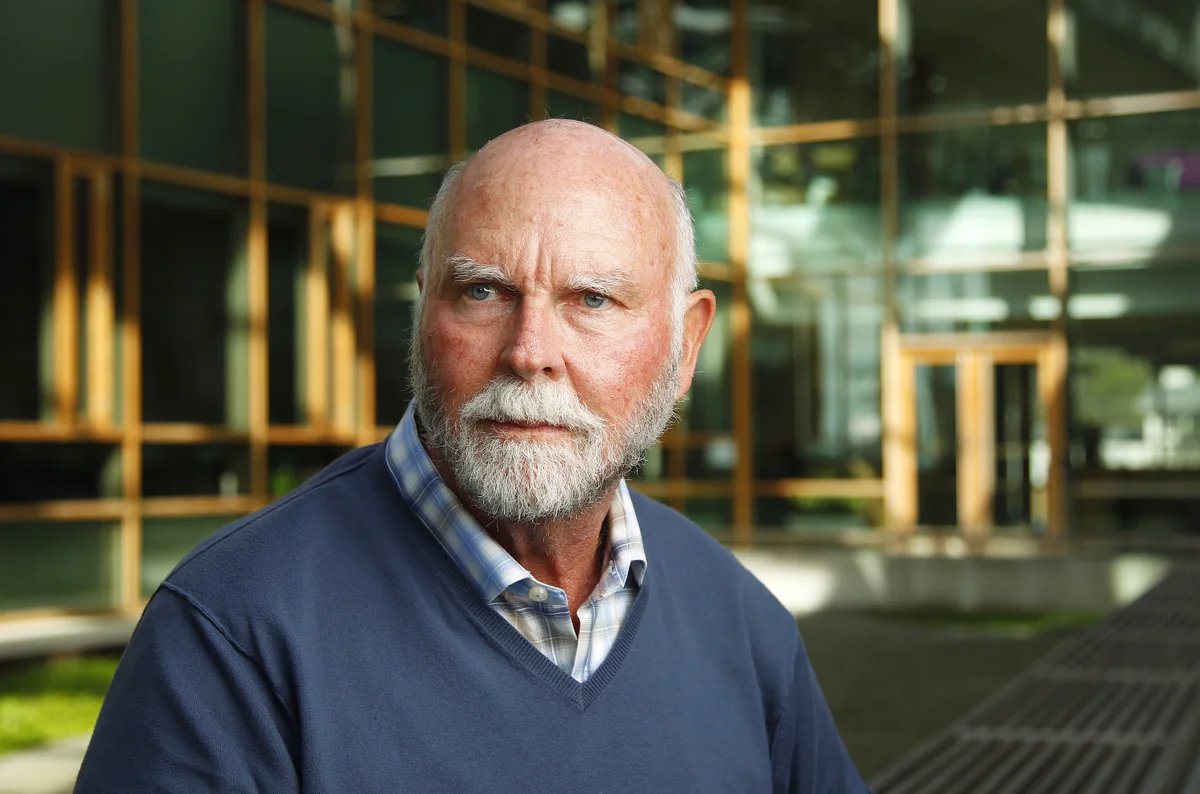
Human genome decoder J. Craig Venter dies at 79
Scientist and medtech entrepreneur J. Craig Venter published the first bacterial genome ever decoded in 1995. The result heralded a new age of discovery for genetics
Geneticist J. Craig Venter in a photo from 2015.
K.C. Alfred/ The San Diego Union-Tribune via Getty Image
J. Craig Venter, the scientist who raced to decode the human genome, has died at 79.
Venter rose to fame in the field for publishing the first bacterial genome ever decoded, along with a list on gene annotations, in 1995. The achievement kicked off an age of discovery in genetics, with researchers racing to decode the genomes of other pathogens—and eventually, animals.
As the founder of Celera Genomics in 1998, Venter honed his method of decoding—whole genome shotgun sequencing—which can rapidly sequence different parts of the genome at the same time and then uses machine learning to reassemble them in the right order. The technique allowed him to enter the race to decode the human genome late.
On supporting science journalism
If you’re enjoying this article, consider supporting our award-winning journalism by subscribing. By purchasing a subscription you are helping to ensure the future of impactful stories about the discoveries and ideas shaping our world today.
Celera went up against an international, U.S. government-backed research group known as The Human Genome Project in a competition that spurred each side on until Venter agreed to a draw with the group. The Project was declared complete in 2003 with 92 percent of the human genome decoded; the majority of the remaining genome was sequenced by 2021. Venter wrote about the effort in an article for Scientific American, which can be read here.
Venter also led an effort to explore the world’s oceans and trace the genetics of marine microbial communities. The first Global Ocean Sampling Expedition, which used Venter’s own yacht, circumnavigated the globe between 2005 and 2006.
Venter began his academic career in 1969 at a California community college, College of San Mateo, before transferring to the University of California, San Diego. Then-President Barack Obama awarded Venter the National Medal of Science in 2008 for his genetic work. Afterward, he reflected in the piece for Scientific American that the achievement came “after years of never-ending work, criticism (from the outside world and even internally at my company), intervention by top science journal editors and even President [Bill] Clinton.”
“To be standing where history was being made that day was a very emotional and fulfilling experience,” he wrote.
The J. Craig Venter Institute, a nonprofit research group founded by Venter, said in a statement to media that he had been hospitalized after complications tied to cancer treatment. He died on Wednesday, April 29.
Editor’s note: This is a developing story and will be updated.
It’s Time to Stand Up for Science
If you enjoyed this article, I’d like to ask for your support. Scientific American has served as an advocate for science and industry for 180 years, and right now may be the most critical moment in that two-century history.
I’ve been a Scientific American subscriber since I was 12 years old, and it helped shape the way I look at the world. SciAm always educates and delights me, and inspires a sense of awe for our vast, beautiful universe. I hope it does that for you, too.
If you subscribe to Scientific American, you help ensure that our coverage is centered on meaningful research and discovery; that we have the resources to report on the decisions that threaten labs across the U.S.; and that we support both budding and working scientists at a time when the value of science itself too often goes unrecognized.
In return, you get essential news, captivating podcasts, brilliant infographics, can’t-miss newsletters, must-watch videos, challenging games, and the science world’s best writing and reporting. You can even gift someone a subscription.
There has never been a more important time for us to stand up and show why science matters. I hope you’ll support us in that mission.


