Astronomers puzzle over early origins of mysterious ‘red monster’ galaxy
Researchers are perplexed by a galaxy that seems too large and too dusty for its place in cosmic history, less than a half-billion years after the big bang
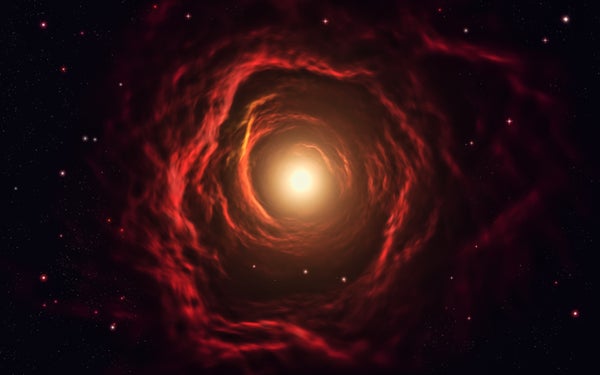
Astronomers studying the early universe with NASA’s James Webb Space Telescope (JWST) have found what seems to be a time traveler from the future: a large galaxy so chock-full of dust that the light from its bountiful blue stars has turned a crimson hue. Such heavy loads of dust are generally thought to arise much later in cosmic history than circa 400 million years after the big bang, the epoch at which this newfound galaxy appears.
Although the work has yet to be peer-reviewed, a preprint study that analyzed this “red monster” galaxy, officially called EGS-z11-R0, is already making waves in the astronomical community. “It’s astonishing to think about how short these timescales are,” says Pieter van Dokkum, an astrophysicist at Yale University, who was not involved in the study. “Sharks and turtles have been around for about that long.”
For perspective, seeing such a big, dusty galaxy less than a half-billion years into the universe’s 13.8-billion-year history is a bit like finding a redwood tree towering over saplings in a recently plowed field; it’s hard to explain how something so giant reached maturity so quickly, in a cosmic blink of an eye. Clues could come from studying other behemoths lurking in the galactic vicinity—“blue monster” galaxies, also uncovered by JWST but lacking the red-inducing buildup of dust. (Red monsters shouldn’t be conflated with JWST’s “little red dots,” an entirely different but no less mysterious type of object that the observatory has spied in the early universe and that are now thought to indicate still-forming supermassive black holes.)
On supporting science journalism
If you’re enjoying this article, consider supporting our award-winning journalism by subscribing. By purchasing a subscription you are helping to ensure the future of impactful stories about the discoveries and ideas shaping our world today.
Giulia Rodighiero, the study’s lead author and an astronomer at the University of Padua in Italy, had wondered whether other large objects, perhaps obscured by their own dust, might be dwelling among JWST’s blue monsters. So she and her colleagues scoured through the Dawn JWST Archive—a repository of public JWST galaxy data—for possible contenders. EGS-z11-R0 was the sole clear candidate that emerged.
The telltale signature of abundant dust lies within the galaxy’s continuum of ultraviolet light, which has a relatively flat slope as a result of absorption from the dust. Rodighiero notes that while the researchers’ analysis indicates that the reddening effect comes primarily from dust, they’re still after more direct evidence because light emanating from clumps of ionized gas within the galaxy may also be involved. By obtaining a spectrum from EGS-z11-R0—that is, by gathering and parsing its light into constituent colors, or wavelengths—the team also found evidence of carbon as another sign of galactic maturity. “There’s a whole cycle that has to happen before you get to a very dust-obscured, red galaxy like this,” van Dokkum says. “It’s surprising this happened so fast and so early.” The study is a “tour de force” in extracting such indicative signatures, he adds.
The new red monster is just one of a growing group, with others usually spotted at times closer to about a billion years after the big bang. Such galaxies had already surprised astronomers because of their surprising maturity. But with its placement at just 400 million years into the universe’s history, the new monster is a sort of anomaly among anomalies. Still, JWST’s keen gaze can peer back even further into the past. So far, the telescope has managed to spot galaxies as early as about 280 million years after the big bang. The new finding, however, seems to push the universe’s earliest epochs of galaxy formation even further back than astronomers had once thought. Given the time it takes for stars to churn out such atoms and dust, van Dokkum says, EGS-z11-R0’s existence suggests astronomers could spot galaxies as early as 200 million years after the big bang.
As the new class of ancient red monsters emerges, so do some key questions: How does the dust build up so fast, and why do only some galaxies have it? Finding answers will likely entail assembling a larger sample of these early-onset red monsters, as well as observing them through different instruments onboard JWST, which can detect shorter and longer infrared wavelengths, says Callum Donnan, an expert on galactic evolution at the National Science Foundation’s National Optical-Infrared Astronomy Research Laboratory, who did not partake in the study.
Rodighiero and her team already have their suspicions about how the red and blue monsters can coexist in the early universe—perhaps the blue galaxies are in fact born from the red ones as the dust disperses. “We think that they are connected by the same evolutionary story,” she says. “It’s just that we catch galaxies in different periods, and it’s much easier to detect a blue monster.” She and her team hope that discovering more objects might help astronomers understand these galactic phases, and they also plan to look at a larger range of infrared light to fully confirm that EGS-z11-R0’s redness comes from its dust.
It’s Time to Stand Up for Science
If you enjoyed this article, I’d like to ask for your support. Scientific American has served as an advocate for science and industry for 180 years, and right now may be the most critical moment in that two-century history.
I’ve been a Scientific American subscriber since I was 12 years old, and it helped shape the way I look at the world. SciAm always educates and delights me, and inspires a sense of awe for our vast, beautiful universe. I hope it does that for you, too.
If you subscribe to Scientific American, you help ensure that our coverage is centered on meaningful research and discovery; that we have the resources to report on the decisions that threaten labs across the U.S.; and that we support both budding and working scientists at a time when the value of science itself too often goes unrecognized.
In return, you get essential news, captivating podcasts, brilliant infographics, can’t-miss newsletters, must-watch videos, challenging games, and the science world’s best writing and reporting. You can even gift someone a subscription.
There has never been a more important time for us to stand up and show why science matters. I hope you’ll support us in that mission.