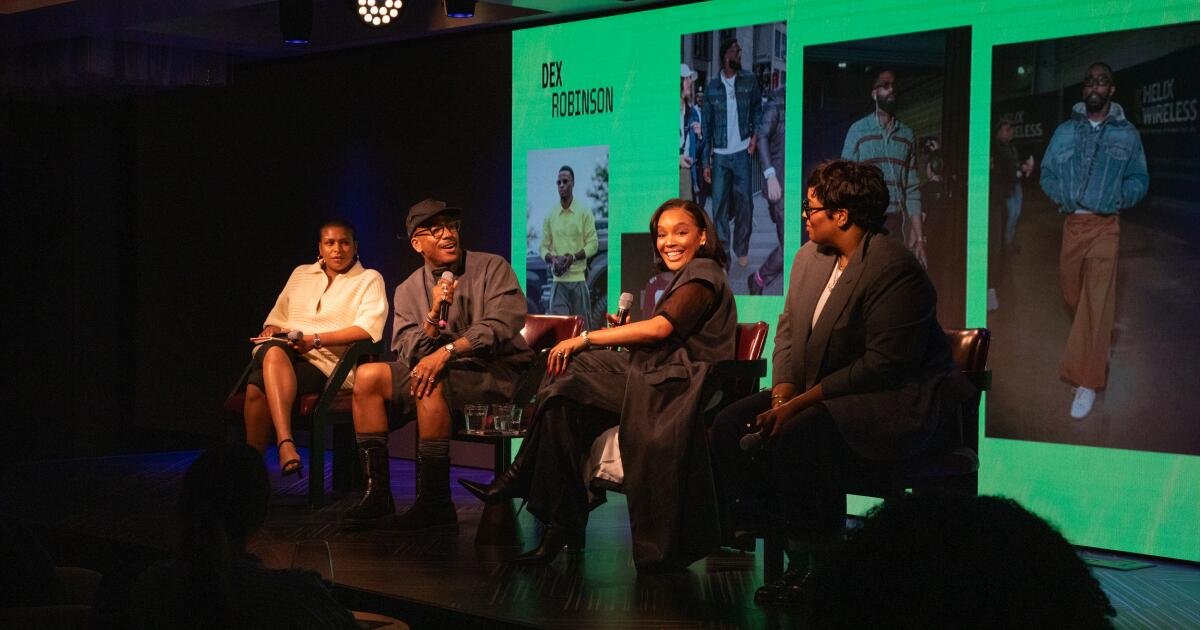
Over the last five years, there has been a significant shift in how fashion and sports intersect, both on and off the court, with athletes’ influence extending beyond the court and into culture at large. Why now? And how has athlete style evolved?
These were some of the questions that three prominent athlete stylists — Brittany Hampton, Courtney Mays and Dex Robinson — unpacked last week at the panel “Game Changers: Where Sport Meets Style.” Moderated by Image contributor Darian Symoné Harvin and co-organized with the Only Agency, the event took place at the private members club Gravitas, a hub for folks at the intersection of sports, business and luxury in Beverly Hills. Gathered in the swanky yet intimate upstairs bar and events room, guests sat in plush chairs and sipped pink vodka cocktails and flipped through Image’s May sports and arts issue ahead of it hitting the newsstands. An also-plush takeaway? Stress balls in the shape of footballs, courtesy of the Only Agency.
The evening could’ve kept going — Hampton, Mays and Robinson had so much to say about an industry that is still widely misunderstood and filled with gatekeeping. The below edited version of the conversation gives you a glimpse into the demanding yet deeply fulfilling world of styling athletes.
Darian Symoné Harvin: Athletes often are not sample size. How do you source clothes and work with brands? Are they supportive? Anything you would tell brands if you could?
Courtney Mays: Size inclusivity is a huge thing. Because, especially when you’re talking about the W[NBA], you’re talking about women who are sometimes a men’s size 13 shoe, who are sometimes a 36-inch inseam. And although we’re using this platform to talk about larger issues, sometimes the larger issue is: I’m here and I’m a plus-size woman. Sometimes you have to use your presence to talk about those things, if you’re not verbally saying that, [and] you have to get the brands to stand behind you.

“We’re making sure that that Old Navy looks like Bottega,” said Courtney Mays, “so that at the end of the day you feel like the superstar that you are. We’re really curating the moment.”
Brittany Hampton: It’s also important for everyone that’s in the room to know that stylists can’t always get the ask that you guys may be asking for. If I have a seven-foot athlete, which I do have on my roster, and he’s, you know, he’s massive — he wears a 16-and-a-half shoe. There may only be a few brands [with his size]. There are going to be certain things that I may even have to pull out of his own closet. And then it still means, “Well, why do we have to give you that budget for that?” And it’s like, well, because I had to have an assistant go get that piece from his closet, have it dry-cleaned, have it picked up, then have it delivered to set. It’s still a process, there’s value in the work that we put in. We’re trying our hardest.
DSH: From a tunnel walk to a press run to a campaign, how do you break down your budget and your fee?
Dex Robinson: Each stylist approaches fees and pricing a different way, right? Also depends on how you were groomed or how you came into the situation. I was an assistant for years before I ever said I was a stylist, and even then I kind of treaded lightly before I was like, “I am a lead stylist.” I was someone’s assistant, and that’s when I asked all the questions that I needed to ask about what my fees would be. I knew the structures, I knew the things, so I wasn’t asking my peers, “Oh, how do I charge for this?”
BH: I do want to jump in and state for the people in the room that may or may not know we’re speaking in terms of expenses. The current budgets that they are talking about are particular to clothing expenses. That does not allot to our fees. We have labor that is very imperative, labor that goes into us doing market research, that goes into us having assistance across cities most of the time. I live in Los Angeles. None of my clients live in Los Angeles. So let’s say my client is currently in the playoffs and lives in Cleveland, but I’m pulling from both New York and Los Angeles, then we’re meeting in Cleveland to have a fitting with him, and that all takes a tailor of this, of that, etc. Now, having tunnel looks is one thing, but then also having a campaign is something completely different. We also then have to be very strategic about brands that we’re pulling from. And we are using our own cards!
CM: A lot of times, we are giving our own money down to say, “I’m taking this half a million dollars’ worth of wardrobe out of your store, and I’m promising you that I’m going to bring it back in a certain amount of time.”
DR: It’s a more lengthy exercise to get people to let you borrow clothes versus [when] the [clients] just pay for this stuff and I don’t have to worry about it after. I would much rather let them have it in their wardrobe and I figure out what to do with it after. And I’m not like, “Oh, you wore this one time,” and just throw this out. No, we gonna cut the arms off of this. We gonna turn this into some shorts.

When asked for one piece of advice for aspiring stylists, Dax Robinson encouraged people to first do their research. “Being fashionable does not make you a stylist … it takes years of perfecting a craft to become a stylist.”
But then to pull from a [showroom], that’s a whole ‘nother situation. That’s not really a money exchange, that’s more of a publicity exchange. And again, it’s still based off your name or your client.
CM: That’s when it’s important to get the shot. We live in a social media world. When we work with brands and we work with designers, we work with PR firms — what they’re looking for is that image. Not only the tunnel walk, but maybe it’s the walk out of the hotel or that paparazzi shot.
So we’re also partnering with photographers, saying, “Hey, our clients are going to the opening of LACMA. We need to capture the moments before.” Just like all the celebrities, they go to the SAG Awards, whatever, and they have these beautiful editorial shots before they even hit the red carpet. Why? Because they invested in a photographer to come to their home, to their hotel room, and say, “Let’s use 15 minutes before you walk out the door, get this BTS, get this shot, and we’re going to make it look beautiful.” Because we want to build the relationships with the brands of the clothing that we’re wearing.
DSH: What I love about what you’re saying is that it’s not only the tunnel, it’s not only the press run, it’s not only the campaign. It’s like, how are you creating this world around who the athlete is? To me, that’s exciting. It’s when you get into the creativity.
Let’s say that you receive a cold email from someone who wants to work with you. What kinds of questions do they ask that lets you know that they’re informed or they mean business? What lets you know, “Oh, they’ve done their homework a little bit, and they’re not just going to toss me around as a possibility”?
BH: We are brand architects, and because you guys are reaching out to us about a particular client, our job is not to just create a character, right? We don’t just create characters. We work with athletes. We understand that we have to know that athlete before they even walk in the room, and we have to understand their identity, understand their brand, and then build that with you [the brands] before we can even do the job right. There’s nothing more that I love than being on a call with a full production team for a full hour for a commercial. Because we actually want to know: One, what’s going into that player. Two, what they look like. Three, what they’re going to be doing, if there’s a double or if they’re going to be active — our talent is very performative, they’re performance-based first, and so we have to remember that when we’re dressing them.

Brittany Hampton on the role stylists play beyond the tunnel walk: “We’re not just bringing them a rack of clothes. We’re truly there to help build their identity and then who they’re about to become.”
CM: I feel like those conversations need to happen at the onset of working with a new client, with the agent, with the manager, with the assistant so that you can understand what the broader goal is for that client. A lot of times when people hire stylists, whether it’s per project or for a longer stint, a season, I think it’s like, “Oh, they just need clothes.” Like, I just had a job. [Her team] was like, “It’s the opening of the WNBA season. She needs clothes tomorrow.” Like an idiot, I took it: I really want to work with this girl. I’m gonna just send her a box. And I knew that was the dumbest thing I could have ever done, because I’ve never met her in person. I didn’t have the right sizes, and I think it ruined the relationship, because I didn’t have any context. So the fact that I couldn’t execute in 24 hours is sticking with me. I should have said no, because that is not my job — to go shop for you at the mall. My job is to really have a conversation about what your goals are, what your fit is, what brands do you love, what do you want to do when this basketball thing is over? I think that part and those conversations are important.
BH: It’s also important to have emotional intelligence. As we are the people that work with athletes on a consistent basis, we have to understand their bodies, but we also have to understand that they win games, they lose games. And half the time we are picking up their energy. We’re not just bringing them a rack of clothes. We’re truly there to help build their identity and then who they’re about to become. Sometimes you don’t get that lucky and get to have someone for that long, but the relationship building and creating that trust is something that’s so important, which is why those factors matter, like hiring someone maybe a month in advance and setting up those calls between the client and the stylist. Even if we just get on the call and we just want to shoot the shit and we’re like, “What colors do you like? What size do you like? What are brands that you love? Who do you look up to in terms of fashion?” Because some of these kids like it, and some of them absolutely don’t know.
DR: Well, that [direct relationship] might not be the reality depending on how big your client is sometimes, too. I’ve worked with people where they had to have that middleman for a little bit until they felt comfortable. So it wasn’t a situation where you could do that direct situation until they were ready. It’s also a different situation for me as a male, because guys don’t like being around other guys, so that’s why [women] dominated [the styling landscape] for years. Think about it. Like, as a guy, your mom is your first stylist. And then when you get a shorty you may say, “Yo, babe, I look nice. I’m good.” Guys really feel confident with a woman saying, “You look nice.” Not, “Yo, bro.” And then, even for me, a lot of the bigger guys I worked with, it was really their wives that was like, “You know what? My man can’t dress. I need you to come in.”
CM: That’s still the case. It’s somebody’s girlfriend or wife or agent. Like, “Please help.”
DSH: I want to talk about the people who you all work with when you are on set. I’m thinking particularly about glam. I’m curious about the makeup, hairstyle and grooming conversation that you are having, and why it matters.

“What you’re saying is that there’s a level of love that you have to put into it, and it’s not just about the clothes, but about the person,” reflected moderator Darian Symoné Harvin. “What do you like off the court? Where do you want to be? Where do you want to show up, right?”
CM: I feel like the stylist always becomes the creative director. We’re the hype man. We’re the one that’s talking to the hairstylist to say, “OK, she’s wearing this dress, we got to do XYZ, LMNOP.” We’re talking to the hairstylist. We’re talking to the photographer. We’re saying, “OK, we need a green backdrop instead of a yellow.” And I feel like that’s why we’re asking for certain rates; it’s not just me going to Old Navy to get y’all some jeans. And even if I am, because sometimes [Old Navy is] cute, we’re tailoring it. We’re making sure that that Old Navy looks like Bottega, so that at the end of the day you feel like the superstar that you are. We’re really curating the moment.
DSH: What advice would you give if you were sitting across a coffee table with a stylist who says, “I want to get into styling athletes”? What’s the one honest piece of advice you would give them?
BH: We can’t do everything. There are hundreds and hundreds of athletes across the board, and although we all came from a world of gatekeeping, it’s just not that anymore. Like we all have to share relationships. We have to continue to boost one another up. There’s been jobs where I’m like, “I can’t take that. Can you take that? Would you want that? This could be a good girl for you.”
DR: I think that a lot of people think because they’re fashionable, that means they should be a stylist. And I think being fashionable is just that. Being fashionable does not make you a stylist. I think it takes a sharpened eye. I think it takes understanding skill and proportion. I think it takes years of perfecting a craft to become a stylist. I think that people should just do research. I think that people should assist people. I think that when you come into a space and you don’t assist people, [maybe] you can easily attain a client, but retaining them is going to be hard, and I think that’s a difference, right? I wish a lot of the younger people that came into the space were more open to being a student first and not trying to become a professor.
CM: I also think that what we do is such an intimate thing. We’re getting people dressed. We’re in their homes, we’re in their hotel rooms. We’re with their families. Come as your authentic self and know that you have to do your best professionally — but also there’s a level of love that you have to put into it, and it’s not just about the clothes, but about the person, and about their goals and their aspirations. Make sure that you become a part of those conversations in a real, authentic way.
BH: It’s not just transactional. This is truly our passion. And we want to continue to work and just push for every person that comes after us.