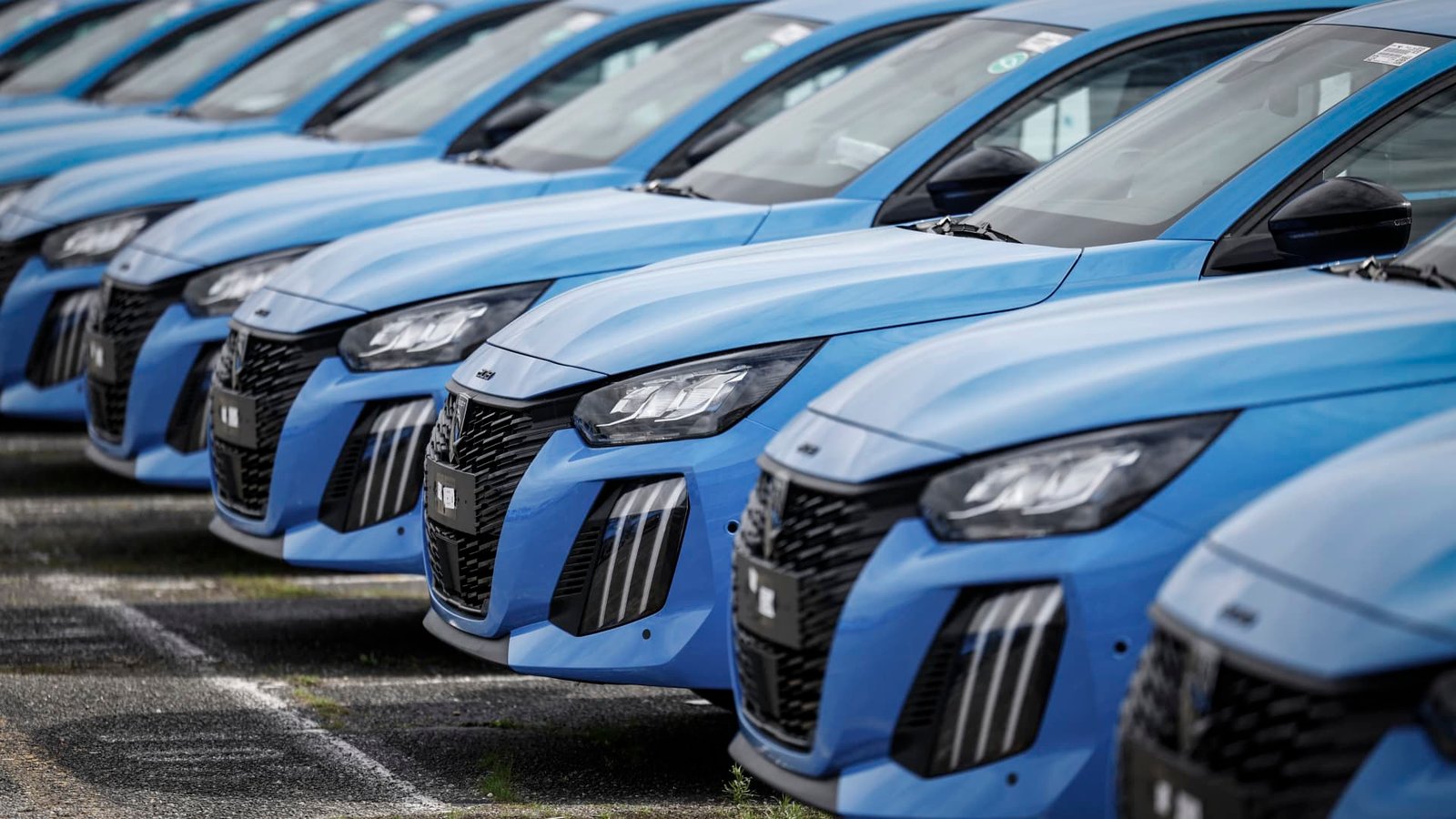
Eric Haan, director of the Stellantis Poissy plant, poses for a portrait next to cars at the Stellantis multinational car manufacturer’s plant in Poissy, west of Paris, on April 15, 2026.
Simon Wohlfahrt | Afp | Getty Images
LONDON — A recent tie-up between Jeep maker Stellantis and China’s Leapmotor is seen as a watershed moment for the future of European carmaking.
In a deal announced late last week, Stellantis said it will expand its strategic partnership with Leapmotor, paving the way for the latter to start production of a model for sale in the European market in 2028.
Leapmotor will also work with the multinational conglomerate, which owns household names including Jeep, Dodge, Fiat and Chrysler, to jointly develop an electric SUV under the Opel brand, with production set to take place at Stellantis’ plant in Zaragoza, Spain.
The move appears to be designed to shore up Stellantis’ European operations, while providing Leapmotor with a platform to sidestep the European Union’s “Made in Europe” manufacturing targets, as well as avoiding tariffs on electric vehicles imported from China.
Stellantis is not alone in exploring the prospect of tie-ups with Chinese automakers. U.S. carmaker Ford is reportedly in talks with China’s Geely to create a European partnership and Germany’s Volkswagen has said it is open to sharing under-utilized European factories with Chinese car brands as part of a push to cut costs.
The concept of such partnerships should not only be Chinese, Stellantis CEO Antonio Filosa said at the FT Future of the Car summit on Tuesday. His comments came in response to a question about whether Western carmarkers partnering up with Chinese car brands could serve as the industry playbook.
“Obviously, Chinese OEMs are strong players that are coming with a lot of power to Europe … but also we might look at others,” Filosa said at the London summit.
“Leapmotor is a Chinese partner that we have — and we really appreciate that partnership. That’s why we took it [to] the next level but there are many things that can be done.”
CNBC has contacted Ford and Volkswagen and is awaiting a response.
The burgeoning trend comes as Western car giants battle crises on multiple fronts.
Top original equipment manufacturers are caught in a perfect storm as they face headwinds from rising production costs, U.S. tariffs, intense competition, supply chain disruptions and regulatory pressures, as well as a bumpy electric vehicle transition.
Stellantis was one of the first Western carmakers to sign a partnership agreement with a Chinese manufacturer when it acquired an approximately 21% stake in Leapmotor in 2023.
Leapmotor CEO Zhu Jiangming on Friday described the company’s technology know-how, combined with Stellantis’ global reach, regional roots and brand recognition, as “a uniquely powerful partnership.”
‘A point of no return’
Auto analysts have said that while partnerships between European and Chinese car brands can serve as a win-win in the short-term, legacy auto giants will need to be wary about some of the longer-term risks.
For Western carmakers, especially those lagging on electrification and software, these partnerships are seen as practically the only option “to stay in the game in Europe,” according to Julia Poliscanova, senior director for vehicles and e-mobility supply chains at the campaign group Transport & Environment.
Employees work at a Leap Energy factory owned by Chinese automobile manufacturer Leapmotor in Huzhou, China’s Zhejiang province on April 26, 2026.
Adek Berry | Afp | Getty Images
“In the short-term, European carmakers need to optimize their factories and Chinese automakers want to enter the market, so it makes sense. But I do worry about what that actually means long-term,” Poliscanova told CNBC.
“Once they help the Chinese brands get that brand awareness and once people get the car and see that it’s not such a bad car, I think it can be a point of no return,” Poliscanova said.
“So, there is a real risk, and I think as much as it is a good short-term strategy, I think it is just really important for European carmakers that still want to be in business in 2030 to not let their foot off the gas on developing those electric models in parallel.”