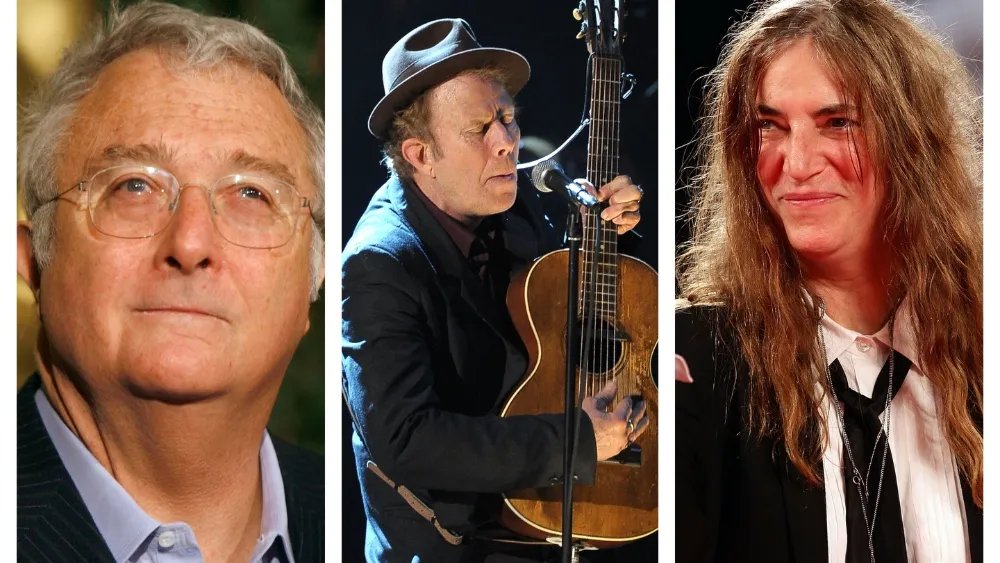
“Who’s Madeline?” is still the year’s preeminent pop-music question. But coming up close behind that: “Where the eff is Randy Newman on the New York Times’ list of the 30 greatest living American songwriters?” Or, you can fill in that blank with some other name of your chagrined choosing, like Tom Waits, Patti Smith, Billy Joel, Jimmy Webb, Jackson Browne, Stephen Schwartz, Beyonce or James Taylor.
There are several likely answers to that. One is that lists like this exist as rage-bait, deliberately or otherwise. (We here at Variety are inveterate listmakers… we are not unfamiliar with a good backlash.) Another is that representation is important, and lists like this easily drift toward whatever the opposite of recency bias is, if their curators aren’t careful. A list comprised almost entirely of 1970s veterans would earn more groans, justifiably, than this one is. So if a few white men over 70 have to be sacrificed to include a Bad Bunny or Mariah, so be it.
But still… Randy fucking Newman is the guy you knock out to free up a slot? The mind boggles. The spirit withers. The faith in humanity disintegrates (which Newman would probably approve of, being no big believer in humanity).
There is a good answer to “Where’s Randy Newman,” though, that is not nearly so frustrating. The answer is: He’s all over the lists sent in to the Times by his songwriting peers, as are a lot of the other names you or I are upset about. These “experts” — people like Aimee Mann, Berry Gordy, David Byrne, Justins Tranter and Vernon, etc. — were invited to contribute their suggestions, on the way to their votes either counting or not counting as the Times’ in-house panel of five made the final selections on their own.
I don’t mean to discount the NYTs’ own ultimate list; it’s actually fine, as these things go, if you are willing to accept that some head-scratchers are a deliberate part of the equation and give into it as a conversation-starter. (And any list with Valerie Simpson on it is inherently not a bad idea.) But the most fun, and maybe greatest gratification, will come in taking a peek at who Jeff Tweedy or Jermaine Dupri voted for.
The Times ran a list of 36 ballots from music insiders; you can look it over here. If you’re prone to counting, you can wonder how some of the world’s most revered songwriters could have gotten so much support from a jury of their peers and still lost out when it came to the Times’ smoke-filled room.
Doing that informal count, you can come up with a hell of a list of honorable mentions, let’s say. Out of 36 actual songwriters’ submissions, Newman was named on nine of them — fully a fourth of those ballots. (Newman appeared in the ranked No. 1 position for two of the celebrity voters, Bonnie Raitt and David Byrne.)
The top vote-getter who did not make it onto the Times’ critic-curated list was Tom Waits with 10. The great Jimmy Webb tied with Newman for nine votes among the songwriting contemporaries. (Plenty of people would say “Wichita Lineman” alone should have propelled him to the top of the NYTs’ writers’ list.) Billy Joel got seven of those songwriter/artist votes. Patti Smith and James Taylor got six each. The Times-excluded candidates who got five votes from their peers on this page: Stevie Nicks, Gillian Welch, Phoebe Bridgers, David Byrne and Jackson Browne.
Of course, there were plenty of writers who did make the Times’ list who scored very high among their peers. Carole King was tops, being named by exactly half of the surveyed songwriters — 18 out of 36. Bob Dylan was close behind with 17, followed by Stevie Wonder with 16, Paul Simon with 14, Dolly Parton with 13, Kendrick Lamar and Smokey Robinson with nine votes each, and Bruce Springsteen with eight.
Seeing those names that all fared so well with both the songwriting community and the Times’ critics, you could almost start to imagine — faintly — that agreeing on at least part of a pantheon might be possible.
And then there are the names that the Times’ critics’ panel went out a bit more on their own limb with. Like Lana Del Rey and Fiona Apple, who both made it onto their list of the 30 greatest living songwriters despite getting only two votes from the 36 pros whose ballots were listed. That was better than Stephin Merritt, who made it onto one, or Bad Bunny, The-Dream, Young Thug or Romeo Santos, who didn’t make it onto any of the sampled ballots. That’s not to say that the critics didn’t get it right and the songwriters got it wrong by not mentioning these writers. It’s not the artists’ job to make sure that different demographics and eras get the same weight that the canons associated with prior generations do; it is the newspaper’s.
So, you can appreciate that the Times had a careful balancing act to pull off here… and still say: No, seriously, Randy Newman — WT actual F.
While we’re glancing at the votes the songwriters and artists contributed, a few things stand out:
Some pro voters put in bids for more than a dozen of their favorite songwriters. But God bless Dua Lipa, who picked only one: Patti Smith. Who saw that coming?
(In fairness, it’s possible Dua may have cast a vote for someone else besiees Patti and had it disqualified. The Times noted that it was putting an asterisk next to anyone who had died since they began collecting ballots, but also that the paper was just leaving out any mention of anyone submitted who didn’t qualify as a living American songwriter. In other words, they weren’t going to embarrass any of the celebs by noting that they’d voted for dead people or Brits. Or Canadians; the Times disallowed Canadians Joni Mitchell and Neil Young from contention, even though they have spent a lot more time being citizens of California, going back to their moves south in the mid-’60s, than they did up north.)
If Ms. Lipa had the shortest list, with just one, Natalie Merchant had the longest, with 38. Merchant, clearly, is dying to make us all a playlist. We’ll take it.

Other fun stuff of note: Artists were not shy about casting votes for their musical partners (Aimee Mann putting in a bad for Ted Leo, her counterpart in the side project the Both), or even husbands (Mann again, with Michael Penn). There were threesongwriters on the list of solicited contributors who voted for themselves: Rickie Lee Jones, Jermaine Dupri and Jeff Tweedy.
Recent comradeship could also count for a lot when it came to David Byrne casting his vote for Olivia Rodrigo, along with more expected figures like Simon and Wonder.
Fans of musical theater may be wanting to shed a tear here. Not only did no one from that world make it onto the Times’ final list (it would’ve been interesting to see if they would have allowed Sondheim in, if he’d lived longer), there were few theater songwriters who even made it into the 36 “insider” ballots. Desmond Child did vote for Stephen Schwartz and the team of Benj Pasek and Justin Paul. Justin Vernon and Merchant both put in a vote for Anais Mitchell, though that could be for her solo work as much as “Hadestown.” You have to wonder if theater is being taken into consideration at all when Lin-Manuel Miranda, who wrote the song score of the century so far, “Hamilton,” made it onto only one list, Merchant’s. Meanwhile, Miranda was invited by the Times to contribute his own list, and though he only put in three names, he at least saved one of them for a theater writer, going with Dolly Parton, Nas and John Kander. (It’s unclear if he’s got something against Ebb?)
Some artists have better memories than others. Usually, with “living” being part of the qualification, you don’t have to go that far back in time… with rare exceptions. Kudos to Jeff Parker, of Tortoise, for putting in a vote for Bobbie Gentry, who is still around but released her last album in 1971. A tortoise, like an elephant, never forgets.
The thinkpieces that are inevitably being generated by the Times’ list are valuable. Some have wondered: If someone spends their entire career only doing co-writes — as is more common than not with pop in the 2020s — are there ways to verify and trust that they are the key writers in their room? And how fine is the line now between great songwriting and great producing, when so many tracks actually begin and end with a team in a studio, leaving the idea of a solitary figure with pen and paper nearly as antiquated as a DAT demo? That thought arose when Jay-Z, one of the Times’ top 30, was asked about the songwriting prowess of his wife, and he pivoted toward talking about what a brilliant producer she was … almost implying that it might be a higher aspiration. Figuring out where these lines are drawn won’t get any easier if the Times revisits this topic in 2076.
They may not. One reason why I think so many people are taking this list so personally is that the Times so rarely does this sort of thing… although, in the age of listicles, they’ll probably indulge more. Rock fans get angry at Rolling Stone for their 500-greatest lists, but that’s tempered by the knowledge that a current rundown is probably a redrawing of something that was already done 15 or 20 years ago, and will be adjusted yet again. The Grey Lady putting its imprimatur on this sort of thing is a little more unexpected, and thus takes on maybe a little more import — regardless of whether they were motivated by elevating songwriting as an art or coming up with an idea for a call they thought elusive interviewee Taylor Swift would take.
Anyway, with the staff having taken more than a year to get this project together, the Times at least can’t be accused of not doing due diligence. Or of not putting a tremendous emount of thought and energy into balance… even with, as with Newman, you could wish the balance were leavened with a bit of aesthetic common sense.
OK, just one more question: Why the “Schoolhouse Rock” typeface?