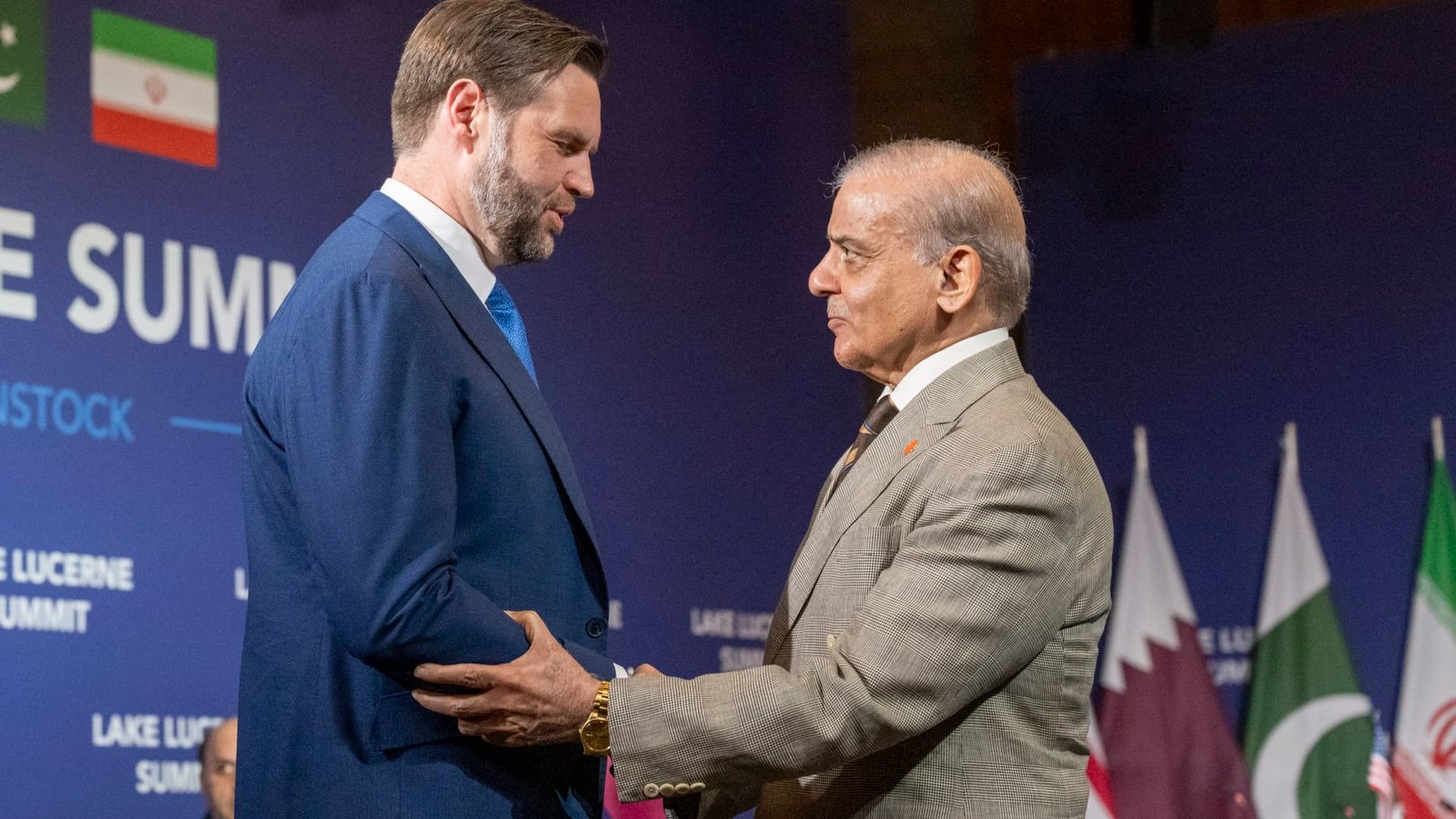
Pakistan’s Prime Minister Shehbaz Sharif (R) greets US Vice President JD Vance prior to a quadrilateral meeting between the United States, Iran, Pakistan and Qatar at the Burgenstock luxury hotel complex overlooking Lake Lucerne, Switzerland, on June 21, 2026, as part of high-level talks aimed at advancing a deal to end the Middle East conflict. A new round of negotiations over the Middle East war was set to kick off on June 21, 2026 with Iranian negotiators arriving in the Swiss host city hours ahead of US Vice President JD Vance, even as Tehran said it was closing the Strait of Hormuz again over Israeli attacks in Lebanon. (Photo by URS FLUEELER / POOL / AFP via Getty Images)
Urs Flueeler | Afp | Getty Images
Pakistan’s role as a peacemaker in the Iran war, which undermined the security of the Gulf countries and affected multiple economies through energy price shocks, has raised its diplomatic profile across the world and garnered high praise from U.S. leadership.
Though the war has stressed Islamabad’s economy, its resolve to bring an end to the conflict is primarily driven by the need to avoid a spillover across its borders while fostering warm ties with the U.S., experts said.
Pakistan shares a 900-kilometer border with Iran and is home to the world’s second-largest Shia population, after Iran. In March, following the killing of Iran’s Supreme Leader Ayatollah Ali Khamenei, protests erupted in Karachi and Islamabad, leading to the deaths of more than 20 people, according to multiple media reports.
“Pakistan, perhaps more than any other country outside the Middle East, was highly vulnerable to the effects of the war,” Michael Kugelman, senior fellow for South Asia at the Atlantic Council, told CNBC in an email.
The country not only has economic ties with the Gulf countries, but also has a “mutual defense pact with Saudi Arabia—one that it wouldn’t want to have to invoke, given that it didn’t want to get dragged into the war,” he said.
“Pakistan had an especially strong incentive in seeing the war come to an end,” he added.
On Sunday, U.S. Vice President JD Vance credited Pakistan’s Prime Minister Shehbaz Sharif and Field Marshal Asim Munir, chief of Pakistan’s Defence Forces, for their efforts in the peace process.
“I have talked to Field Marshal Munir more than I have talked to anyone in the last three months,” Vance said, adding that he would not have been at the peace talks without the “statesmanship” of Munir.
Even Trump, in an interview last week with Axios, called Munir a “great man.”
Given the significance of the peace deal, experts said Pakistan will certainly want to leverage its mediation role for economic benefit, particularly in its dealings with allies in Washington and the Gulf.
But support is likely to come in the form of favorable loan terms from Arab states or security aid from the U.S, rather than investment commitments, they said.
In the last few years, the country’s economy has been under stress, leading to repeated bailouts from the International Monetary Fund.
Economic woes
“Pakistan’s number one problem is that the economy is in terrible shape,” said Pramit Pal Chaudhuri, South Asia practice head at Eurasia Group. The country is on its 24th loan from the IMF due to” perpetual internal problems” and is not seen as a “favorable investment destination,” he added.
Pakistan has traditionally run large fiscal and external deficits, with a resultant rise in public debt. In the decade leading up to the pandemic, a study by the Atlantic Council found Pakistan to be one of only five developing economies, out of a sample of more than 60 countries, whose interest payments consumed more than 40% of its annual revenue intake. A ratio of more than 25% for a prolonged period is unsustainable, it said.
But not much has changed.
In the financial year ending June 2027, the country’s interest-to-revenue ratio is projected to be 39.1%, substantially above the median 12.1% of its peers, Fitch Ratings said in a report.
Even before the Iran war started, multinational companies such as Procter & Gamble, Shell, Caltex, and Eli Lilly were leaving Pakistan. Average incomes had stagnated for almost seven years, which led to weak domestic demand, as per local media reports.
Rising global energy prices have worsened the situation. Pakistan imports 85% of its fuel and almost all its liquefied natural gas supply from the Middle East and had to resort to austerity measures to soften the impact of price rises. On Saturday, following the progress on the peace deal, the austerity measures had been lifted, according to local media reports.
But the disruptions from the conflict have already led to double-digit inflation in the country of 11.7% in May, squeezing households’ purchasing power, according to Oxford Economics in a report earlier this month. Inflation is expected to remain in double digits through September, it added.
The economic research firm has lowered its household consumption growth forecast to 1.2% in 2026 from 2.2% previously, and cut its estimates for economic growth by 60 basis points to 2.1% for the year.
The IMF has been pushing Pakistan to make structural reforms that include rebuilding international reserve buffers, broadening the tax base, strengthening competition, and raising productivity.
The government does not earn tax revenues from a large chunk of economic activity. The military in Pakistan accounts for a fifth of the country’s economic activity as it produces everything from cereals to cement, but this output does not contribute to tax revenues, explained Chaudhuri, adding that large landowners also do not pay tax on their income.
The military plays an influential role in Pakistani politics, and its backing is critical for ruling governments. In 2024, Sharif secured the support of the military to keep his government in power, according to the Financial Times.
Shariff represents the interests of the landowning class, while Munir looks out for the interests of the military, said Chaudhari.
Until Pakistan can fix some of its economic fundamentals, the U.S. administration’s warm words are not going to translate into action. “Trump has increasingly shown how he values transactional relationships, and Pakistan just doesn’t have anything to offer,” he said.