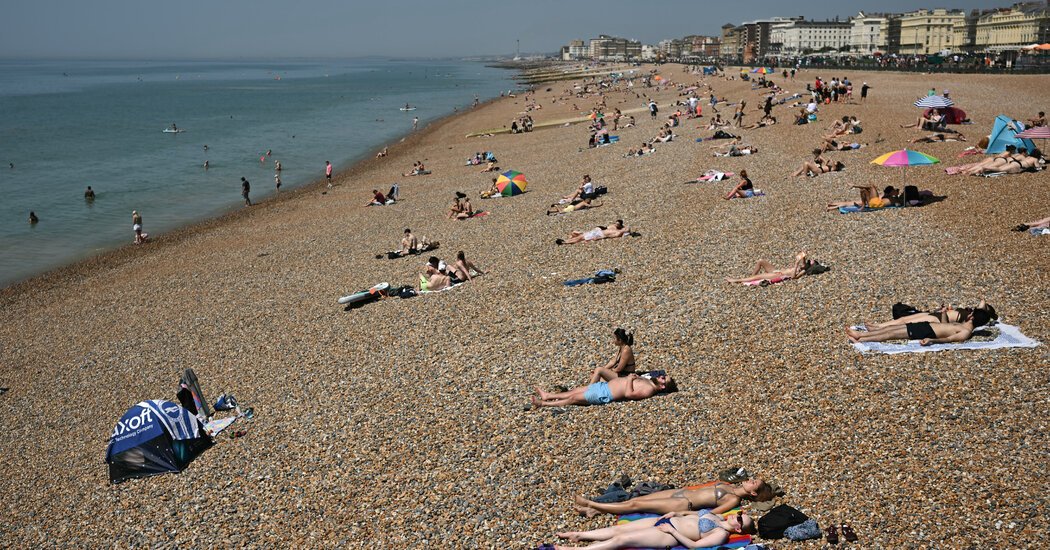
Large parts of Britain were officially in their first heat wave of the year on Monday, with forecasters warning that temperatures could climb to the highest level ever recorded in the month of May.
Temperatures were expected to surge far above seasonal averages, with highs reaching 35 degrees Celsius (95 degrees Fahrenheit) in some areas of England. If reached, that would shatter Britain’s May temperature record of 32.8 degrees Celsius (91 degrees Fahrenheit), which was set in 1944, according to the Met Office, the country’s official weather service.
The service described the heat as “unprecedented for the time of year,” noting that temperature records are typically broken by only fractions of a degree.
The unusually hot conditions had been building through the week, but the first major peak arrived over the weekend, particularly across England and Wales. On Saturday, temperatures climbed to 30.5 degrees Celsius (86.9 degrees Fahrenheit) in southeast England. The Met Office said temperatures above 30 degrees Celsius in May were rare in Britain, last occurring in 2012.
By Sunday, eight locations in southeast England had officially met the country’s heat wave criteria, after recording three consecutive days above their local temperature thresholds.
Britain’s conditions for a heat wave differ from those commonly used in the United States, where the National Weather Service broadly defines it as “a period of abnormally hot weather generally lasting more than two days.” In Britain, however, the Met Office uses a more formal set of criteria: an official heat wave is declared when a location records at least three consecutive days of temperatures meeting or exceeding the local heat wave threshold.
Those thresholds vary across the country, ranging from 25 degrees Celsius (77 degrees Fahrenheit) in cooler northern and western regions, including Scotland and Northern Ireland, to 28 degrees Celsius (82 degrees Fahrenheit) in London and its surrounding areas.
The Met Office said it marked Britain’s first official heat wave in the month of May since the service introduced its formal heat wave definition in 2019.
For people accustomed to hotter climates, those temperatures may not sound especially extreme. Parts of the eastern United States recently endured more intense heat, with Philadelphia reaching 98 degrees Fahrenheit and setting a new May record, while Newark hit 99 degrees Fahrenheit, tying its highest May temperature ever recorded.
But in Britain, where the average high temperatures for May hover at around 15 degrees Celsius (59 degrees Fahrenheit), and few homes are equipped with air-conditioning, the heat could pose a health risk for some.
The U.K. Health Security Agency issued an amber heat health alert — the second-highest warning level in their three-tier system — covering most of England through Wednesday.
An amber alert means that significant effects are likely across health and social care services, including a rise in deaths, particularly among people 65 and older and those with certain health conditions.
Nighttime temperatures have also been unusually high. In Kenley, south London, temperatures overnight into Monday did not fall below 19.4 degrees Celsius (66.9 degrees Fahrenheit), provisionally breaking the previous highest daily minimum temperature record for May of 18.9 degrees Celsius, set in 1944.
Britain is not alone in experiencing unusual early-season heat. Across western Europe, multiple countries have broken May temperature records in recent days.
In Spain, temperatures peaked at just over 38 degrees Celsius (100 degrees Fahrenheit) on Sunday. France and Germany also saw temperatures climb into the mid-30s Celsius, with hundreds of locations reporting record May heat.
Forecasters said Monday was expected to bring more intense conditions in Britain, when temperatures across central, southern and eastern England, including London, could reach 35 degrees Celsius (95 degrees Fahrenheit). By early Monday afternoon, temperatures had already equaled the 1944 record in Teddington, Greater London, and were expected to continue rising.
Temperatures may ease slightly later in the week, but heat wave thresholds are expected to persist in southern parts of the country through at least Thursday.