
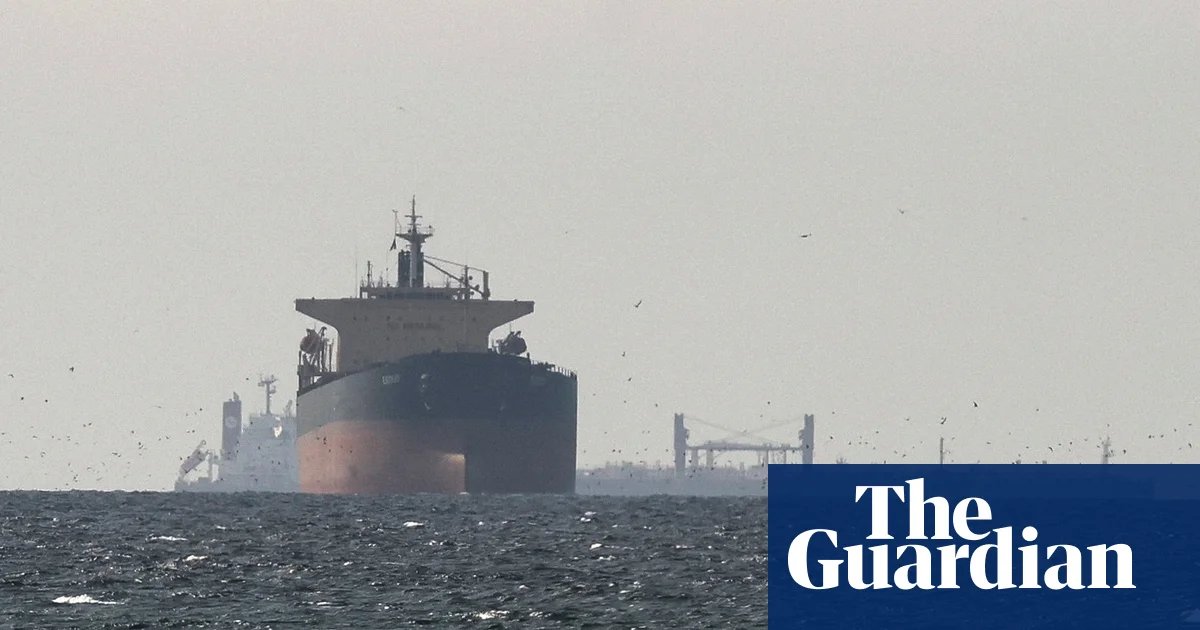
Good morning. The Gulf is stuck in limbo between war and peace. Despite a ceasefire deal between the US and Iran, both sides have ramped up threats once again. A lasting end to the violence feels possible, but so does a renewed round of fighting – and more death, destruction and economic pain.
JD Vance, the US vice-president, is expected to fly to Pakistan today if Iran agrees to further talks on ending the conflict. Tehran has given mixed signals about whether they will attend and, at time of writing, it remainds unclear. Meanwhile, time is ticking away on the current two-week ceasefire, which runs out in less than 48 hours.
For today’s First Edition, I spoke with Patrick Wintour, the Guardian’s diplomatic editor, to understand if a permanent peace is possible – or whether it is time to brace for a new escalation in the conflict.
Five big stories
-
Iran war | JD Vance was expected to fly to Islamabad at the head of a US diplomatic delegation on Tuesday if Iran agrees to further talks in the Pakistani capital as the deadline for the current ceasefire looms.
-
UK politics | Keir Starmer has accused Olly Robbins of deliberately and repeatedly obstructing the truth about the Peter Mandelson vetting scandal before a high-jeopardy appearance of the sacked top official before MPs on Tuesday.
-
Health | Changes to microbes that live in the gut can identify people at greater risk of Parkinson’s disease long before symptoms develop, according to work that also raises hopes for new therapies.
-
Economy | A quarter of a million people could lose their jobs by the middle of next year as Britain “flirts with recession”, analysis suggests, after business confidence was shattered by the US-Israel war on Iran.
-
Technology | Apple announced on Monday that it had named a replacement for Tim Cook as CEO after nearly 15 years, with head of hardware engineering John Ternus succeeding him on 1 September. Cook will stay at the company in the role of executive chair.
In depth: ‘People really need to focus on how dangerous this situation is’
The ceasefire between the US and Iran expires tomorrow. Each country appears to think they have the upper hand, which is fuelling mutual intransigence.
Donald Trump has, once again, threatened to destroy civilian infrastructure in Iran if Tehran does not accept US demands to give up its nuclear programme and reopen the strait of Hormuz. The American military will wipe out “every single power plant” and “every single bridge” unless they back down, Trump says, despite many experts warning such an attack would be a war crime.
To declare victory, Trump needs a deal that is better than the 2015 nuclear deal reached under Barack Obama, Patrick Wintour tells me. (The same deal that the US, under Donald Trump, exited in 2018.)
On the Iranian side, there is a deep mistrust of American claims of a desire for peace. The US has launched attacks during previous negotiations, and Tehran is bracing for more this time. On Monday, Esmail Baghaei, Iran’s foreign ministry spokesperson, said the US demands were “unserious”.
“Iran thinks it’s winning,” says Patrick. “They’ve realised, and proven, that the strait of Hormuz is, geographically, an incredible asset to have because it has seized up so much of the world economy. And the Iranians can’t stop looking at the price of oil – they love it when it’s over $100 a barrel. The war has shown that they can survive so far.”
Early on Tuesday, Iran’s parliamentary speaker, Mohammad Bagher Ghalibaf, who is expected to head the Iranian delegation if talks take place, said his country would not attend negotiations while under threat – and warned they were “prepared to reveal new cards on the battlefield”.
If there is a change in the Iranian stance, Pakistan has been preparing since Sunday to host both sides again. The world will be watching.
The two big talking points
Patrick says two main issues need to be unlocked in talks, and they are unlikely to be resolved in a single round of negotiations.
“The first is the longstanding nuclear dispute: what happens to Iran’s stockpile of highly enriched uranium? And will Iran retain the right to enrich uranium on its own soil?” he says. “There’s a debate over how long there should be a suspension of that – mainly whether it would be for five years, or more like 20.”
The majority of Iran’s enrichment facilities have been destroyed by the US and Israel, but Iran is still believed to possess around 440kg of uranium enriched to about 60%. America would like Iran to hand it over as part of any deal, either to Washington DC or an agreed third party such as Russia, says Patrick.
“The second relates to the consequences of this war. What to do about the strait of Hormuz? Should there be a long-term procedure whereby any ship that passes through would have to pay a toll or seek permission from Iran?” he says.
But, as all recent American presidents have found, reaching a lasting agreement with the Iranian regime is not an easy task.
‘The scale of what could happen is immense’
A false sense of security has developed around the conflict. Bellicose discourse has quickly become normal – and stock markets still appear relaxed about the state of the conflict. However, there are still major risks to a future escalation, says Patrick.
“I find the American rhetoric repulsive. But it’s also quite dangerous, because it’s so apocalyptic and so repeated that you [might not] take it seriously. The US has the power to cause immense destruction, as they’ve shown. There are targets that they haven’t yet hit, including power stations, electricity stations and bridges that are largely intact. If they do attack, the Iranians will bomb desalination plants in the Gulf, which these states are really dependent. Within a matter of days, you could find countries literally running out of water,” he says.
“The scale of what could happen is so immense and daunting that people really need to focus on how dangerous this situation is.”
The spectre of a global hunger crisis is lurking, too. There are a growing number of warnings about the consequences to the ongoing collapse in fertiliser supplies for the Gulf, which could result in major food shortages around the world.
‘It’s all quite doable’
A lasting peace is possible, says Patrick. Allowing Iran to have a civilian nuclear programme in the future and rewarding de-escalation with economic development could become a virtuous circle as sanctions are lifted and the Iranian economy grows, he says. But it can only be achieved through dialogue.
“The way Trump has conducted his relations with Iran has been very much influenced by what the Israelis said was possible, including regime change. Now that’s been proven not to work, he needs to go back to the slightly less dramatic but more important path of developing better relations with Iran, and changing them through contact and trade rather than confrontation,” Patrick explains.
“I think it’s all quite doable. Iranian politicians would respond to that. Because there’s been so much against Iran, the hardliners are now in charge. That can be reversed if western policy is also reversed.”
What else we’ve been reading
-
Victoria Turk unpacks a recent attempt to catfish her with a job offer, and helpfully explains the recruitment scams to look out for. Martin
-
I never miss The pet I’ll never forget our series. This week’s, about Benny the cat, is a heart-warmer. Patrick
-
Philip Oltermann reviews an intriguing documentary about Peter Sichel – the so-called “Jewish James Bond” – in which, from beyond the grave, the CIA spymaster castigates US foreign policy. Martin
-
The photographer Petra Collins is refreshingly candid about her need to make images the way we all need to breathe air, her difficult childhood and how her poor eyesight affects her work. Martin
-
I really enjoyed Amy Fleming’s interview with the psychiatrist Amir Levine, an expert on types of attachment, about how we can all have healthier, happier relationships. Patrick
Sport
Football | A 0-0 draw between Crystal Palace and West Ham at Selhurst Park leaves Wolves with no way back and Tottenham two points adrift of safety.
Snooker | Stan Moody blew his chance to become the first teenager to win a match at the World Snooker Championship since 2005 as he fell to a 10-7 defeat to the 2024 champion, Kyren Wilson.
Rugby | State of Origin coaches Billy Slater and Laurie Daley have backed the NRL’s pursuit of a stake in the Super League.
The front pages
“Starmer on collision course with Robbins over Mandelson vetting” is the Guardian’s take on events. The Mail says “It’s everyone’s fault but his” and the Times has “PM ‘forced Foreign Office to approve Mandelson job’”. “They chose not to tell me” – that’s the Mirror while the Telegraph splashes on “I know many MPs will find these facts to be incredible”. Similarly the Express has “For once you are actually right PM … ‘It beggars belief!’” and the i paper picks up the same theme “Starmer: I know my story sounds ‘incredible’”. The Metro joins in: “Incredible? Yes, prime minister”. The Financial Times says “Starmer claims officials deliberately kept him in the dark over Mandelson”.
Today in Focus
Starmer addresses the Mandelson vetting saga
Jonathan Freedland on what Keir Starmer said – and didn’t say – to the House of Commons about the Mandelson vetting failure.
Cartoon of the day | Ben Jennings
The Upside
A bit of good news to remind you that the world’s not all bad
Coventry City is returning to the Premier League after 25 years. The Sky Blues fell three divisions during that time and were forced to play “home” games at Northampton and Birmingham as a protracted stadium ownership saga almost killed the club.
Jonny Weeks used to go regularly in the 1990s, and says: “I didn’t truly appreciate how lucky I was to be present for those salad days, and to be there with my dad.” His father’s hobby of collecting footballers’ autographs – a collection “so vast and so impressive, it belongs in a museum” – was something they bonded over.
“Whatever happens next season, at least I can live off those precious memories we made together in the 90s – they’re more valuable to me than any autograph.”
Sign up here for a weekly roundup of The Upside, sent to you every Sunday
Bored at work?
And finally, the Guardian’s puzzles are here to keep you entertained throughout the day. Until tomorrow.


