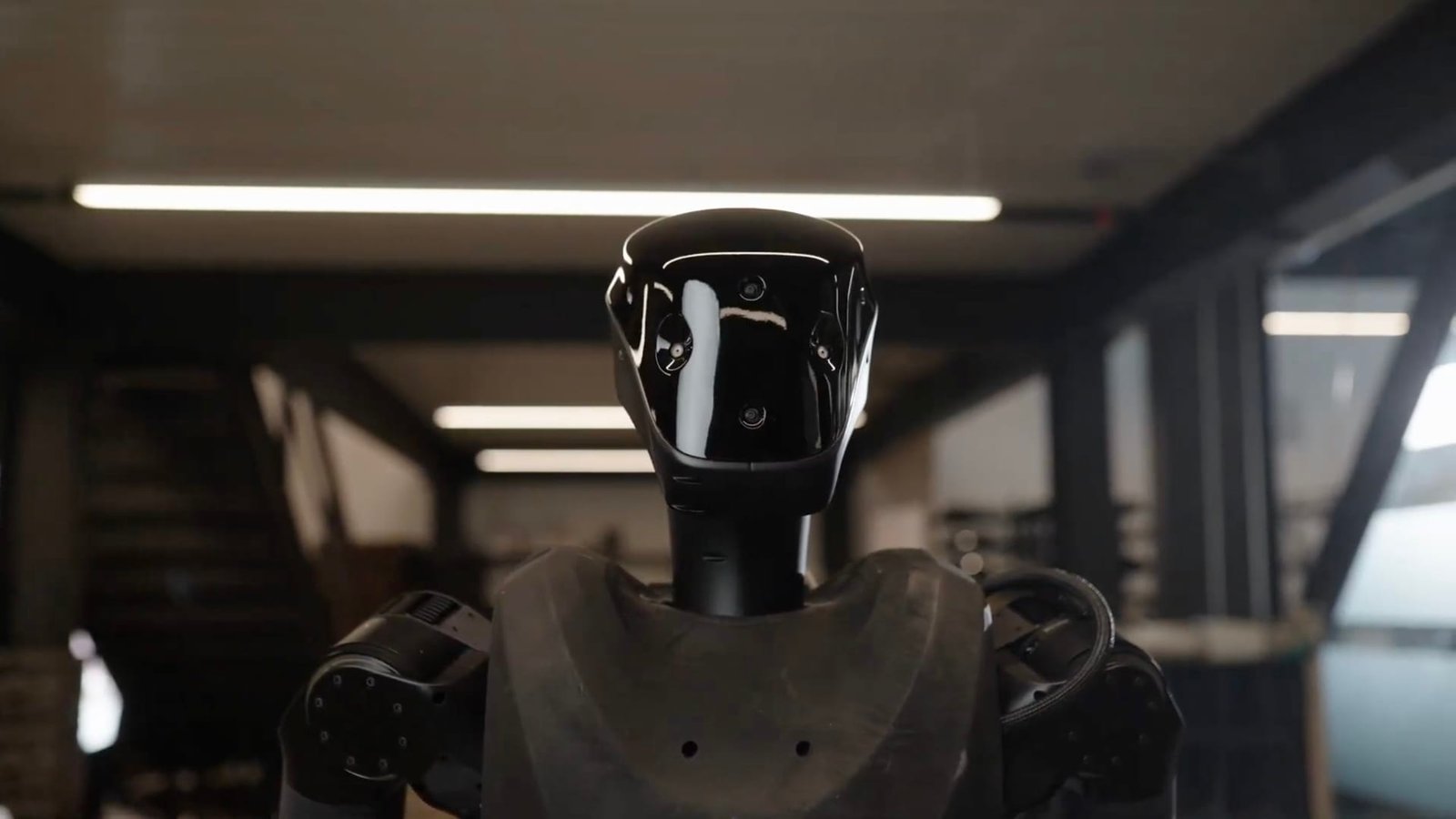
Foundation Future Industries, a start-up founded in 2024, aims to leverage humanoid robots for military and industrial work, rather than household tasks and the service sector.
Foundation Future Industries
As Silicon Valley races to build humanoid robots that can fold laundry and pour a latte, at least one start-up sees a very different use for the technology: war or other potentially hazardous and deadly jobs.
Meet Foundation Future Industries, a San Francisco-based robotics company with ties to the Trump family, developing ‘dual-use’ autonomous humanoid robots for both heavy industrial environments and military applications.
While the robots sound like something out of a Terminator-esque science fiction movie, they are nearing reality, with early iterations undergoing tests in Ukraine for potential use in Kyiv’s war against Russia.
Core to the company’s mission is the belief that humanoid robotics should be put towards humanity’s greatest challenges rather than household chores and service roles, Foundation CEO Sankaet Pathak told CNBC.
“I’m convinced the technology is reaching a level where it can replace jobs that are dangerous for humans to perform, and if you can do that, it’s the highest net good you can create out of all applications of robotics,” Pathak said.
Sankaet Pathak, CEO and founder of Foundation, a company that builds a humanoid robot Phantom-01, poses for a photo during an interview with Reuters at his company’s factory in San Francisco, California, U.S., February 4, 2026.
Aleksandra Michalska | Reuters
Though Foundation operates in an increasingly crowded humanoid field, its explicit embrace of potential military uses for its technology has set it apart.
But the start-up has set ambitious targets for itself, with Pathak planning to scale production to thousands of units this year, and to begin frontline testing with the U.S. military within the next 18 months.
The plans and the firm’s growing ties to Washington represent yet another example of how artificial intelligence and robotics are beginning to transform modern warfare and become a focus of national security.
From Silicon Valley to Ukraine
Pathak is best known for previously leading Synapse, a controversial fintech platform that declared bankruptcy in 2024. Soon after, he started Foundation with Arjun Sethi, former CEO of Tribe Capital and Mike LeBlanc, a co-founder of Cobalt Robotics.
Pathak’s latest venture has also attracted some scrutiny after the company suggested it had close ties to General Motors and could receive investment from the automaker, claims GM later rejected.
Foundation would eventually gain more global recognition earlier this year when it sent two of its Phantom MK-1 units to Ukraine for a pilot demonstration, marking what the company described as the first known deployment of humanoid robots in a combat theater.
The ongoing tests, backed by the U.S. government and conducted with Ukrainian officials, focused on logistics in hazardous areas.
Foundation Future Industries, a start-up founded in 2024, aims to leverage humanoid robots for military and industrial work, rather than household tasks and the service sector.
Foundation Future Industries
Ukraine was a natural debut, as its ongoing conflict with Russia has already emerged as a major test bed for robotics and AI in combat. The war, now in its fifth year, has seen the use of ground robots to deliver supplies to the front line, and autonomous and AI-augmented drones for precision strikes and reconnaissance.
According to Pathak, the MK-1 testing in Ukraine has already proved the robot’s potential to perform supply pickups, which often expose soldiers to danger.
But while the MK-1s help demonstrate the utility of the core technology, they are far from super soldiers, carrying only about a 44-pound payload, and lacking waterproofing and sufficient battery life to be deployed at scale.
Foundation aims to send new and improved robots to Ukraine this year in the form of its Phantom 2, which Pathak says will come with “superhuman abilities” and double the payload capacity of Phantom 1.
The Ministry of Defense of Ukraine declined to comment on the matter, while the U.S. Department of Defense did not respond to an inquiry.
Alignment with Washington
Foundation expects its tests in Ukraine to inform future work with the U.S. military. The start-up has already received government research contracts totaling $24 million for feasibility testing in inspection, logistics, and weapons handling across the Army, Navy and Air Force.
Pathak said conversations with government officials had shifted from research to how to scale the use of the robots. The CEO is aiming for Foundation to deploy its technology with the U.S. military and, if needed, on the front lines of conflicts within the next 12 to 18 months.
Notably, that goal will be carried out with Eric Trump, the second son of the sitting president, who recently joined the company as its chief strategy advisor — a move that has drawn scrutiny from Democratic Senator Elizabeth Warren, who alleged the firm’s government contracts were “corruption in plain sight.”
A Foundation spokesperson told CNBC that Eric Trump had been an investor in the firm before stepping in as an adviser, with the two parties having a shared vision of bringing manufacturing back to the U.S.
Phantom-01, a humanoid robot developed by San Francisco-based startup Foundation for military purposes, sits at the company’s factory in San Francisco, California, U.S., February 4, 2026.
Aleksandra Michalska | Reuters
Foundation has heavily leaned into its alignment with Washington’s interests, framing the importance of its tech in the broader geopolitical competition between the U.S. and China. The goal is to deliver “the best robots we can build” to the U.S. military — better than anything China has,” Pathak said.
While several American companies are working with the U.S. government to deploy autonomous robots for military applications, the Pentagon has yet to disclose the deployment of a humanoid robot for such purposes.
China, which has a number of leading humanoid robot companies, has also publicly funded and supported initiatives for the technology, primarily focused on industrial and economic applications. While Chinese military researchers have released reports on the potential of humanoid robots in the military, the extent of their trials remains unclear.
China’s military has previously showcased early iterations of AI-powered robotic dogs for combat, as well as motion-controlled humanoid robot soldiers.
The age of autonomous war
Proponents of humanoid technology in military and industrial fields argue that human-like robots are generally better suited than other forms of robotics to navigate real-world construction sites, logistics centers and war zones.
Kateryna Bondar, a senior fellow with the Wadhwani AI Center at CSIS, told CNBC that humanoid robots could theoretically provide certain upsides on the battlefield due to their autonomy and human-like dexterity.
“Modern urban combat spaces — where there are stairwells, ladders, basements and narrow corridors — were created for human movement, which could give humanoid systems an advantage over tracked or quadruped robots in certain scenarios,” Bondar said.
Still, there remain questions about the complexity and costs of manufacturing humanoids compared to other systems.
As humanoid robots move towards the battlefield, the technology has raised ethical concerns, particularly around the use of autonomous decision-making in combat when human lives are at stake.
Though most weaponized uses of the Phantom robots will retain some human confirmation in the decision loop, Pathak said Foundation’s robots will need to make fully autonomous decisions in certain time-critical scenarios.
Foundation Future Industries, a start-up founded in 2024, aims to leverage humanoid robots for military and industrial work, rather than household tasks and the service sector.
Foundation Future Industries
Still, the U.S. military has already shown a willingness to adopt AI models, with the technology reportedly used to inform strikes and decision-making in its ongoing conflict with Iran.
A bigger hurdle for companies such as Foundation could be proving that their human-like robots can be more practical and cost-effective for military applications than other alternatives on the market — something many experts doubt.
“Making robots look like humans is a complex and expensive engineering challenge, and what Ukraine has taught us is the opposite — that we need the ability to adapt rapidly and manufacture quickly and cheaply,” said Melanie Sisson, a senior fellow with the Brookings Foreign Policy program.
What experts seem to agree on is that, regardless of shape or size, the age of AI robots in war is near.
“I expect tracked, flying and underwater robots to replace human forces,” said Toby Walsh, chief scientist at The University of New South Wales’s AI Institute.
However, it might be a “science fiction trope to expect humanoid terminator-style robots,” he said.