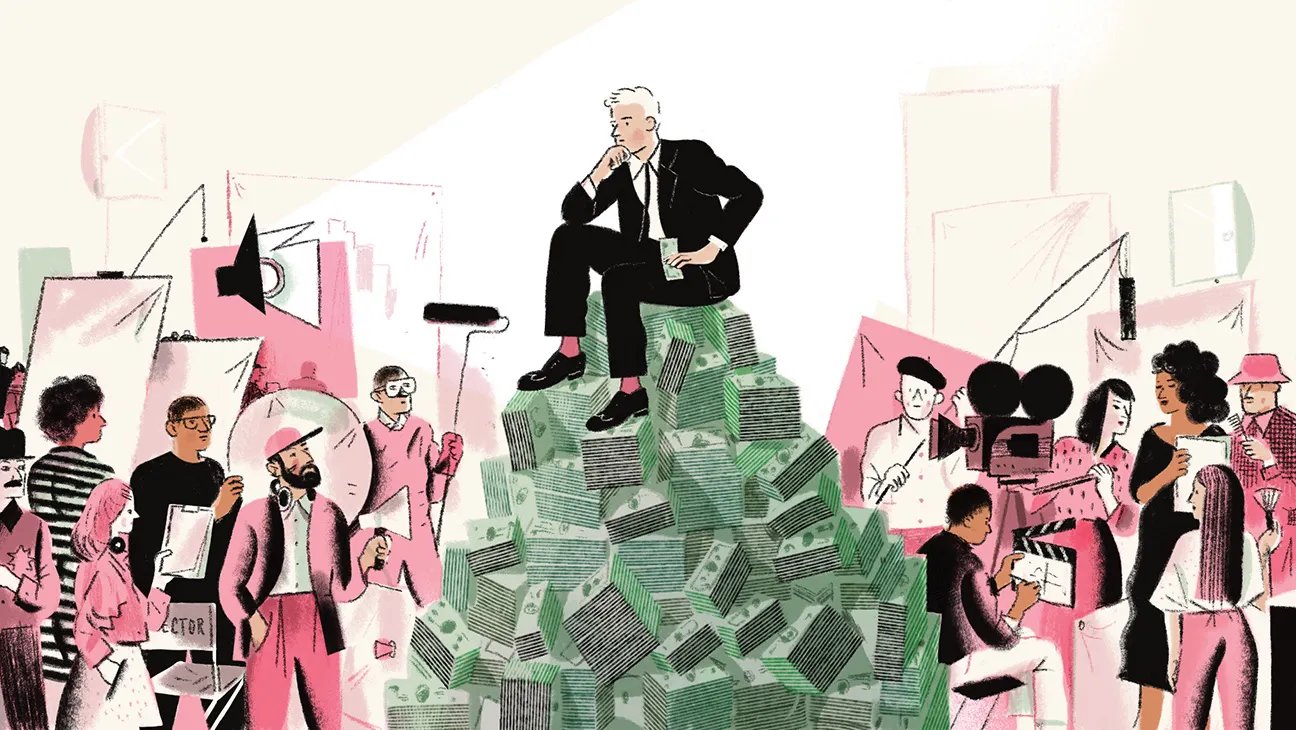
Hollywood really is a larger-than-life version of corporate America, especially in the C-suite. Across all U.S. industries, median CEO pay hit $29.4 million in 2025, data firm Equilar finds. But for top entertainment execs, that’s on the low end, per The Hollywood Reporter’s annual look at the highest-paid media chiefs. Many of the moguls on our list made around $50 million. Or much more.
Not only that, but the employee-to-CEO pay ratio is higher in entertainment. Across all industries, 341 employee salaries equal one CEO’s take-home pay. That median is far exceeded at most of the major Hollywood companies tracked for this list (think 805-to-1 for former Disney chief Bob Iger). “Large stock awards drive much of this elevated pay,” Equilar exec Amit Batish notes.
Leading the way is David Zaslav, who took Warner Bros. Discovery from $9 a share to sell in a bidding war to David Ellison’s Paramount for $31 a share. His pay last year, $165 million, was only trounced by his 2021 package of $246.6 million, driven by a $202 million stock option grant related to a contract extension and the WarnerMedia merger. And both of those years are far outweighed by his golden parachute — which may total between $550 million and $887 million, depending on the value of stock options and when the megadeal closes. (In a non-binding vote on April 23, 82 percent of WBD shareholders rejected Zaslav’s parachute.)
“A golden parachute itself is not necessarily unusual, but this size is unheard of,” Jun Frank, head of compensation & governance services at ISS-Corporate. “Many of these exit packages can be quite controversial because it’s a really big sum,” adding, “and certain provisions, such as last-minute sweeteners, tend to trigger more concern.”
Just look at one of the newest captains of entertainment industry, Paramount CEO David Ellison, whose Skydance closed the acquisition of the venerable Hollywood company in August. That megadeal helped him collect a huge pay package worth more than $60 million last year, even if mostly in stock awards that vest over five years, beaming him up into the top ranks of sector paydays.
Comcast honcho Michael Cavanagh’s ascent also continued, with his $70 million-topping package putting him into the upper echelon of the annual entertainment industry top executive compensation list for 2025.
The lion’s share of Cavanagh’s pay came, just like in the case of Ellison, in the form of stock awards, a big portion of them being tied to his promotion in December to the co-CEO role, which he started this year. Such stock awards are based on the fair value price on the grant date, so they may end up being worth far less or more, depending on where the stock price goes.
“Executive pay has been on the rise throughout corporate America,” notes Chris Crawford, managing director, executive compensation, at consulting firm Gallagher. “Whether it is going through volatility, whether it is mergers, which are happening across entertainment right now – those factors will drive larger one-time packages,” including for newly hired, promoted or exiting managers.
ISS-Corporate Media & Entertainment, a unit of proxy advisory Institutional Shareholder Services (ISS), also crunched some of the early pay data for the past year, focusing on 318 companies listed on the broad-based S&P 500 stock index, at which the CEO was in the same role for the previous filing years. Companies in the media & entertainment sector that fit this criteria saw the most drastic increase in CEO compensation, with a median rise of 117 percent, while their median total shareholder return, a metric looking at stock price and dividends, was down 28.6 percent.
Lawrence Cunningham, director of the Weinberg Center for Corporate Governance, told THR: “Media comp has tended to be higher than corporate America’s medians for various reasons, including industry flash that elevates creativity and persona alongside the primary CEO skills, such as capital allocation, management and leadership.”
CEO pay ratios at some Hollywood giants are also above broader trends in corporate America. The ratios are calculated by comparing the pay of a company’s CEO with that of a median employee. Starbucks CEO Brian Niccol found out that the devil is in these kinds of details when the coffee chain disclosed that he made 6,666 times more than the median staffer in 2024. Hollywood isn’t quite dealing with those kinds of beasts. However, among Equilar 100 companies, the CEO pay ratio rose to 341:1 in 2025, up 13.7 percent from 300:1 in 2024. And as THR‘s chart shows, the head honchos of the likes of Paramount, Cinemark, TKO, Disney, and Comcast exceed this median.
That said, pay ratios are difficult to compare, according to experts. After all, CEO pay is largely equity-based, while median employee pay is typically primarily cash-driven. “One might expect the ratios of CEO to median pay in many cases to infuriate the rank-and-file, assuming they are aware of them, but not sure they are always informed about either the data or the potential rationale,” says Lawrence Cunningham, director of the Weinberg Center for Corporate Governance. “High CEO pay is not automatically bad governance, but unusually high pay warrants a close look at the executive, the board, and the shareholder voting.”

“CEO pay ratios are all over the map,” Gallagher consulting firm expert Crawford says. “There’s not a great way to compare. Some companies have a lot of frontline workers, so their median employee to the CEO is going to have this much larger gap versus a tech firm or a biotech or an engineering firm that might have a lot more professional-level staff. And if a company is global and they’ve got a lot of international employees, again, it might show a higher CEO pay” ratio gap.
The employee-to-CEO pay ratio for Zaslav would have been even higher, 1,378-to-1, without adjustments for one-time stock option grants. But the Warners chief is likely to leave the role of the lightning rod for industry pay to someone else soon, though, given that 2025 could well be his final full year atop the entertainment industry powerhouse due to its deal to sell itself to Ellison’s Paramount, which expects to close the deal this year.
Hollywood’s Labor Chief Pay
THR Photo Illustration/Frazer Harrison/Getty Images
Nearly all of Hollywood’s top union leaders received a 10-plus percent raise in 2025, according to entertainment unions’ filings with the Department of Labor. SAG-AFTRA head Duncan Crabtree-Ireland? A 10.27 percent raise. Directors Guild of America leader Russell Hollander? A 10.48 percent raise. IATSE international president Matthew Loeb? A 10.45 percent raise.
The only exceptions to the trend were the Writers Guild of America leaders, given that WGA East executive director Sam Wheeler is relatively new to his job and did not receive a salary from the union in 2024. And WGA West executive director Ellen Stutzman received a 12.53 percent raise, which may have had something to do with the fact that this pay period overlapped with her official ratification by members as the WGA’s top staffer on September 2024. (In 2023 the union’s board of directors appointed her to the role after previous leader David Young stepped down.)
In 2025 SAG-AFTRA’s Crabtree-Ireland again won the distinction of being Hollywood’s top-paid labor leader, with a salary of $1,120,502. He was followed by the DGA’s Hollander ($883,873), then the WGA West’s Stutzman ($768,257) and IATSE’s Loeb ($611,326). Not bad for a year in which none of the unions undertook one of their major Minimum Basic Agreement labor negotiations with studios and streamers, even as labor leaders’ pay of course still paled in comparison with that of Hollywood CEOs.
But the raises are notable in a year that saw many unionized Hollywood workers struggling and/or out of work amid a pullback in the industry. Unions often argue that they can’t force employers to create more work, they can only create good working conditions when jobs are available. That’s true, but it’s also true that they can play a role in incentivizing employers to work locally through terms in their contracts, and through policy advocacy.
In the latter regard, Hollywood unions were very active in 2025, helping to get an augmented $750 million California film and television tax credit over the finish line. Still, it appears that at a moment when times were tight for many members, unions still found room in their budgets to reward their leaders.
These charts appeared in the May 6 issue of The Hollywood Reporter magazine. Click here to subscribe.