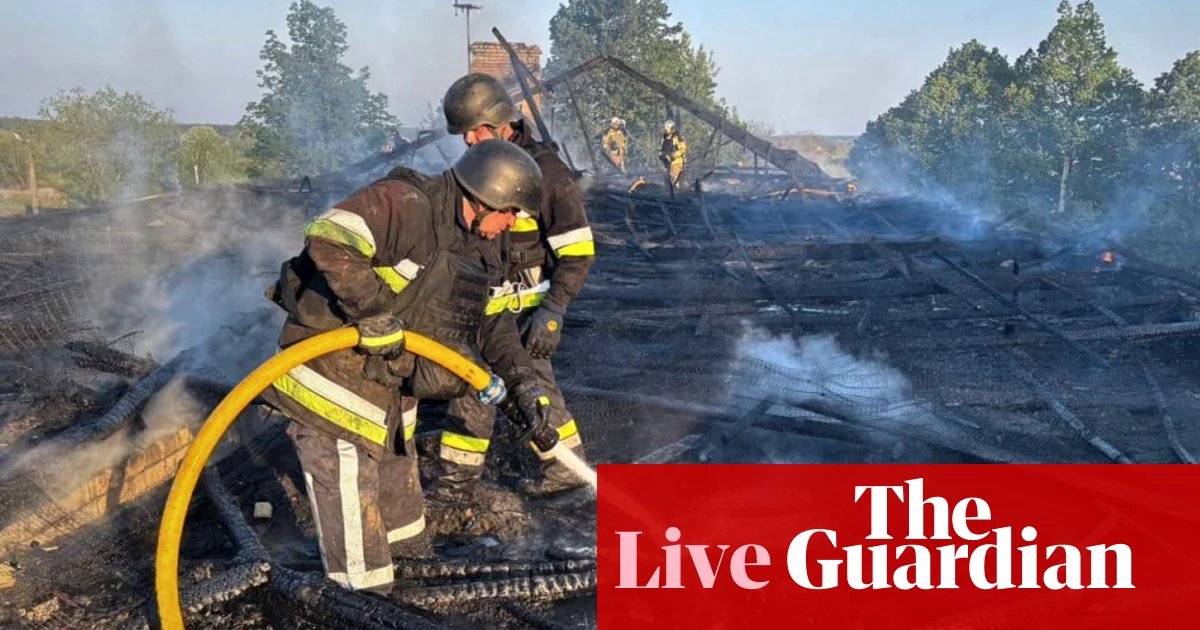
Three-day ceasefire between Russia and Ukraine ends with fresh waves of attacks
Today’s talks in Brussels come as the three-day ceasefire between Russia and Ukraine announced by president Donald Trump last week ended with a fresh wave of Russian strikes.
AFP reported that Moscow launched a wave of more than 200 attack drones that damaged energy facilities and apartment buildings, killing at least one person.
In a post on X, Ukraine’s president Volodymyr Zelenskyy said that “Russia chose to end the partial silence that had lasted for several days.”
“Attack drones were shot down in the Dnipro, Zhytomyr, Mykolaiv, Sumy, Kharkiv, and Chernihiv regions, as well as in Kyiv and the region. Energy facilities, apartment buildings, and a kindergarten were damaged, and there was also a strike on an ordinary civilian locomotive on the railway… People have been reported injured as a result of these strikes. And, unfortunately, there are fatalities.”
Zelenskyy added that Ukraine “will respond in kind” to Russian attacks, before saying:
“Russia must end this war, and it is Russia that must take the step toward a real, lasting ceasefire. Until that happens, sanctions against Moscow are necessary and must remain in place and be strengthened. It is important that there be no easing of pressure and that partners do not stand aside, but continue working together for security, justice, and a reliable peace.”
Key events
‘We failed to modernise our country,’ German chancellor Merz tells unions in tricky speech
Chancellor Friedrich Merz said Germany must “pull itself together” or risk being left behind in a rapidly changing world, in a speech to trade unionists on Tuesday that sparked jeers, whistles and boos, Reuters reported.
After a year in office, Merz’s popularity has sunk and his government has become embroiled in disputes over how far and how fast to reform Europe’s largest economy to revive growth and tackle ballooning healthcare and pension costs.
“The challenges are also so great because we have created problems for ourselves for far too long, problems that we now have to solve. We have simply failed to modernise our country,” Merz told the German Trade Union Confederation.
“Germany must therefore pull itself together. Germany must tackle the structural problems that we have been putting off for many years, problems that have consequently grown steadily larger. You know it, we all know it.“
Merz said high costs and bureaucracy were hurting business, putting jobs and the prosperity of future generations at risk.
But his case for reforming health and pensions, the latter a straightforward question of “demographics and mathematics“, was greeted with periodic heckling, whistles and laughter, while some in the audience held thumbs-down signs.
Hungary to carry ‘lawful correction’ of controversial LGBTQ laws to reflect EU values, incoming minister says
Over in Hungary, we are expecting the Magyar government to be fully confirmed in place later today (for now, it’s just the prime minister).
But we are already getting first signals as to how the new administration will be different from the one led by Viktor Orbán over the last 16 years.
The justice minister nominee, Marta Gorog, told lawmakers this morning that Hungary will need to revise legislation restricting access to LGBTQ content after the European Union’s top court ruled they breached EU laws.
“Hungary is a member of the European Union, which means that there are responsibilities on Hungary,” Gorog told a parliamentary committee.
“This means that regarding this court ruling the justice ministry needs to carry out a lawful correction.“
She added that Hungarian legislation cannot exist in isolation and must reflect international and European legal standards, including common EU values.
Quite a shift in tone from Orbán years.
WHO expecting more hantavirus cases to emerge given contacts on cruise ship before prevention measures were taken
Meanwhile, the World Health Organization’s Tedros Adhanom Ghebreyesus is currently giving a briefing alongside the Spanish prime minister Pedro Sánchez on the current situation on hantavirus, following the evacuation of the MV Hondius cruise ship over the weekend.
The key lines appears to be that Tedros conceded that the WHO is expecting more cases to emerge given the prolonged incubation period of six to eight weeks.
“We would expect more cases, because, as you may remember, the index case, the first case in the ship, was on 6 April, and until … the report was confirmed as infectious – that’s around 24 April or 25 – there was a lot of interaction [between] the passengers.
As you know, the incubation period is also six to eight weeks. Because of the interaction while they were still on the ship, especially before they started taking some infectious prevention measures, … we would expect more cases.”
But WHO’s Tedros insisted that “there is no sign that we are seeing the start of a larger outbreak,” before caveating this:
“But of course the situation could change, and given the long incubation period of the virus, it’s possible we might see more cases in the coming weeks.”
He also urged all affected countries to follow the health security advice on 42-day quarantine and constant monitoring of high-risk contacts.
Zelenskyy’s ex-chief of staff accused in Ukraine corruption investigation
Meanwhile, Ukrainian authorities have named Volodymyr Zelenskyy’s powerful former chief of staff as a suspect in a major corruption investigation, a move likely to pile pressure on the president’s office at a sensitive moment in the war with Russia.
Kyiv’s political class was rocked by a wide-ranging probe last year that had fuelled public anger and prompted the ex-top adviser and Zelenskyy’s right-hand man, Andriy Yermak, to resign.
In a statement on Monday, Ukraine’s anti-corruption agencies said the “former head of the Office of the President of Ukraine” was among those suspected of participating in a criminal group that laundered about $10.5m through an elite housing development outside the capital, Kyiv.
The agencies did not name Yermak, in line with Ukrainian law, but he was widely identified by local media. Speaking to Ukrainian outlet Radio Liberty, he denied owning real estate in the development but did not comment further.
via Reuters
Three-day ceasefire between Russia and Ukraine ends with fresh waves of attacks
Today’s talks in Brussels come as the three-day ceasefire between Russia and Ukraine announced by president Donald Trump last week ended with a fresh wave of Russian strikes.
AFP reported that Moscow launched a wave of more than 200 attack drones that damaged energy facilities and apartment buildings, killing at least one person.
In a post on X, Ukraine’s president Volodymyr Zelenskyy said that “Russia chose to end the partial silence that had lasted for several days.”
“Attack drones were shot down in the Dnipro, Zhytomyr, Mykolaiv, Sumy, Kharkiv, and Chernihiv regions, as well as in Kyiv and the region. Energy facilities, apartment buildings, and a kindergarten were damaged, and there was also a strike on an ordinary civilian locomotive on the railway… People have been reported injured as a result of these strikes. And, unfortunately, there are fatalities.”
Zelenskyy added that Ukraine “will respond in kind” to Russian attacks, before saying:
“Russia must end this war, and it is Russia that must take the step toward a real, lasting ceasefire. Until that happens, sanctions against Moscow are necessary and must remain in place and be strengthened. It is important that there be no easing of pressure and that partners do not stand aside, but continue working together for security, justice, and a reliable peace.”
Morning opening: EU defence ministers meet for talks on Ukraine, Middle East

Jakub Krupa
As the UK goes through a yet another major government crisis, EU defence ministers are meeting in Brussels today to discuss the bloc’s threat assessment, its support for Ukraine, and what Europe could do to help in the Middle East.
The ministers will consider “how we can use the €90bn loan, and how does that all proceed so that it answers the urgent needs of Ukraine?” EU’s foreign policy chief Kaja Kallas told reporters this morning.
They will also talk about how to ramp up domestic defence manufacturing in Europe to answer to the growing needs amid warnings over increasingly assertive Russia.
I will bring you all the key lines from Brussels.
But there is also a lot happening elsewhere, as the new Hungarian government led by Péter Magyar is expected to be formally appointed today, with the new prime minister asking the president, a loyalist of Viktor Orbán, to stay out of the pictures.
I will also look at travel disruptions in Brussels with major union strikes.
Finally, this evening saluti a tutti, Moldova will report for duty as we are going to see the first semi-final of the Eurovision song contest in Vienna, with some unexpected favourites emerging after last night’s rehearsals.
Oh, and if you are after updates from that other news story unfolding today, we have it here:
Lots for us to cover.
I will bring you all the key lines here.
It’s Tuesday, 12 May 2026, it’s Jakub Krupa here, and this is Europe Live.
Good morning.