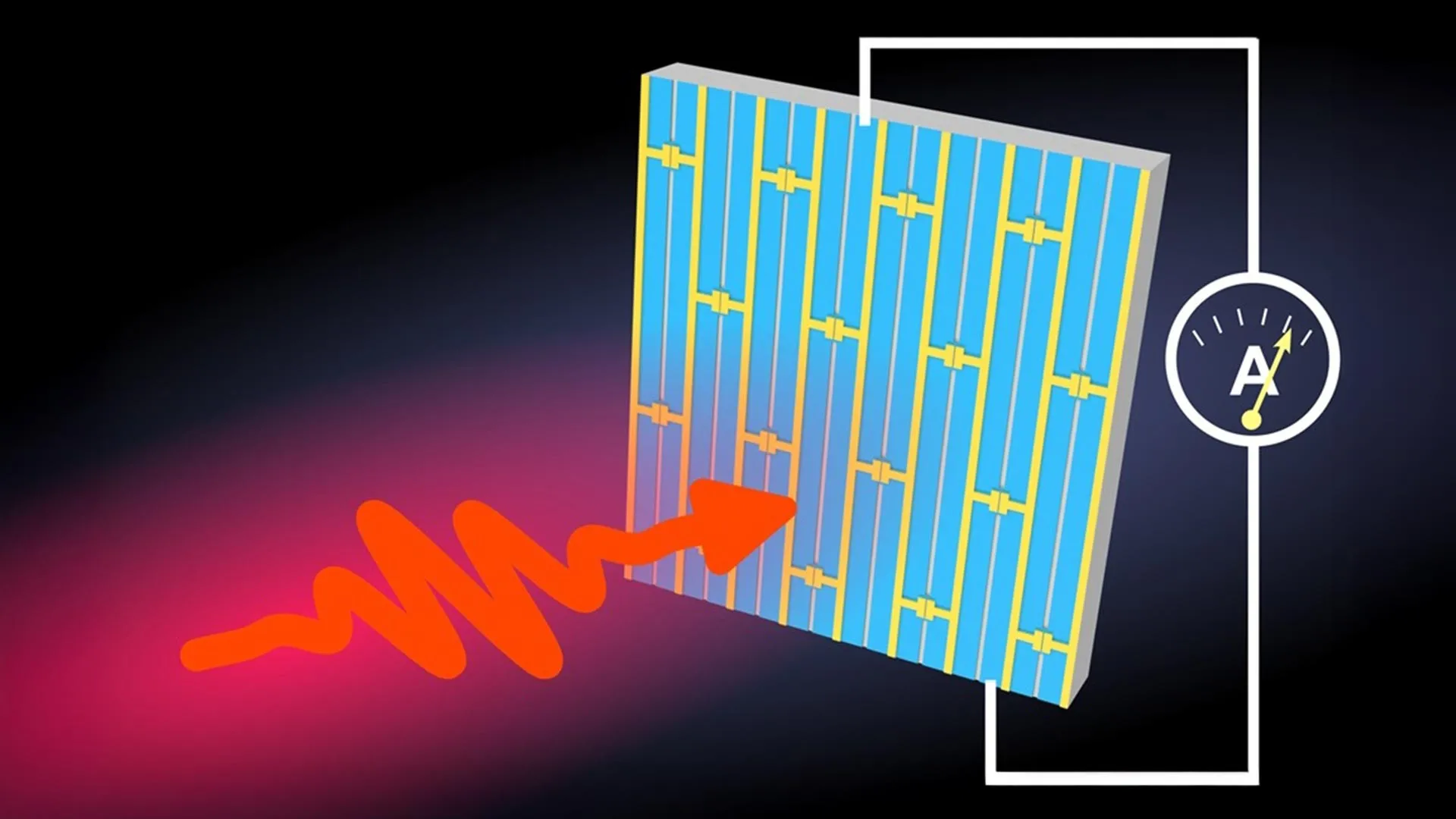
Creating nearly invisible wearable technologies such as smart contact lenses and ultrathin augmented reality (AR) glasses will require a radical redesign of conventional optical components. Instead of relying on bulky lenses and hardware, researchers are exploring materials that can manipulate light at the atomic scale.
A team from XPANCEO, working with scientists from the National University of Singapore and the University of Chemistry and Technology, Prague, has reported a major advance in that effort. Their study focuses on a layered crystal called molybdenum oxychloride (MoOCl2), which displays a collection of unusual optical properties that could help dramatically shrink future optical devices.
Published in Nano Letters, the research presents the first experimental mapping of the crystal’s optical behavior. The findings show that MoOCl2 exhibits the strongest light-bending effect ever measured in a natural material, potentially opening a path toward much smaller and more capable optical technologies.
A Crystal That Acts Like Metal and Glass
Researchers describe MoOCl2 as a kind of optical “chameleon.” Its behavior changes depending on how the crystal is oriented.
When positioned one way, it reflects light much like a metal. Rotate it by 90 degrees, and it becomes transparent like glass. This unusual characteristic stems from its extreme optical anisotropy, meaning its properties vary dramatically depending on direction.
The crystal also has an in-plane birefringence value of approximately 2.2, allowing it to split and bend light with exceptional efficiency. For XPANCEO, this could make it possible to perform the sophisticated light control needed for AR displays using materials that are thousands of times thinner than a human hair.
Rare Light-Slowing Effect Found in Visible Light
The researchers also identified a rare epsilon-near-zero point at 512 nm (green light).
At this point, part of the material’s optical response falls almost to zero. As a result, light effectively slows down while the electric field inside the crystal becomes stronger. This combination can significantly enhance interactions between light and matter.
For integrated photonic chips, this effect could be especially valuable. Stronger light-matter interactions may enable faster data processing while using much less power.
Why Scientists Are Interested in MoOCl2
Physicists have been studying MoOCl2 for several years because of its unusual electronic structure.
The material is classified as a “bad metal” and contains one-dimensional chains of molybdenum atoms. These chains allow electrons to move more easily in one direction than another. As a result, the crystal behaves like a metal along one axis and like a dielectric material along the perpendicular axis, creating its exceptionally strong anisotropy.
Previous studies published in Science and Nature Communications had already observed tightly confined light waves called hyperbolic plasmon polaritons traveling through the crystal. Those experiments showed that MoOCl2 could guide light in highly directional and unexpected ways.
However, an important piece of the puzzle was still missing. Scientists could observe the optical effects, but they had not directly measured the material’s full optical constants. Without those measurements, designing practical devices based on the crystal remained much more difficult.
Mapping the Crystal’s Optical Properties
The new work provides those missing measurements.
The researchers found that near 512 nanometers in the green region of the visible spectrum, one component of the crystal’s optical response approaches zero. In practical terms, this can intensify the electric field inside the material and slow light down, squeezing electromagnetic energy into a very small volume and boosting light-matter interactions.
This phenomenon is known as a visible-light epsilon-near-zero (ENZ) point. While many materials exhibit ENZ behavior only in the deep ultraviolet or mid-infrared regions, MoOCl2 reaches this state within the visible spectrum. That is particularly important because many existing technologies, including lasers, microscopes, cameras, and sensing systems, already operate in this range.
“Observing a phenomenon is the first step, but engineering requires precise numbers,” said Dr. Valentyn Volkov, founder and CTO of XPANCEO and corresponding author of the study. “By rigorously measuring the complete dielectric tensor of MoOCl2, our work provides the experimental foundation needed to understand why this material behaves the way it does and to design around it with greater confidence. That makes it a valuable scientific result for the field, with possible relevance across compact polarization optics, nonlinear devices, and, in the longer term, highly miniaturized integrated systems including smart contact lenses.”
Shrinking Future Optical Hardware
The detailed optical map also highlights the material’s potential for further miniaturization of optical technologies.
Because of its strong structural anisotropy, MoOCl2 functions as a natural hyperbolic medium. In simple terms, this allows light to travel through the crystal in highly directional nanoscale paths without diffracting (or scattering), a key requirement for building smaller optical circuits.
Its ability to operate in the visible spectrum further strengthens its appeal for integrated photonic chips, where light must be routed, filtered, and concentrated within extremely small spaces.
The researchers point to several possible applications. These include ultrathin broadband polarizers that control the direction of light in compact optical systems, as well as sub-diffractional waveguides capable of guiding light through spaces smaller than those allowed by conventional optics.
The findings also suggest opportunities in nonlinear nanophotonics, where intense light-matter interactions can be used to create new colors of light or process optical signals more efficiently.