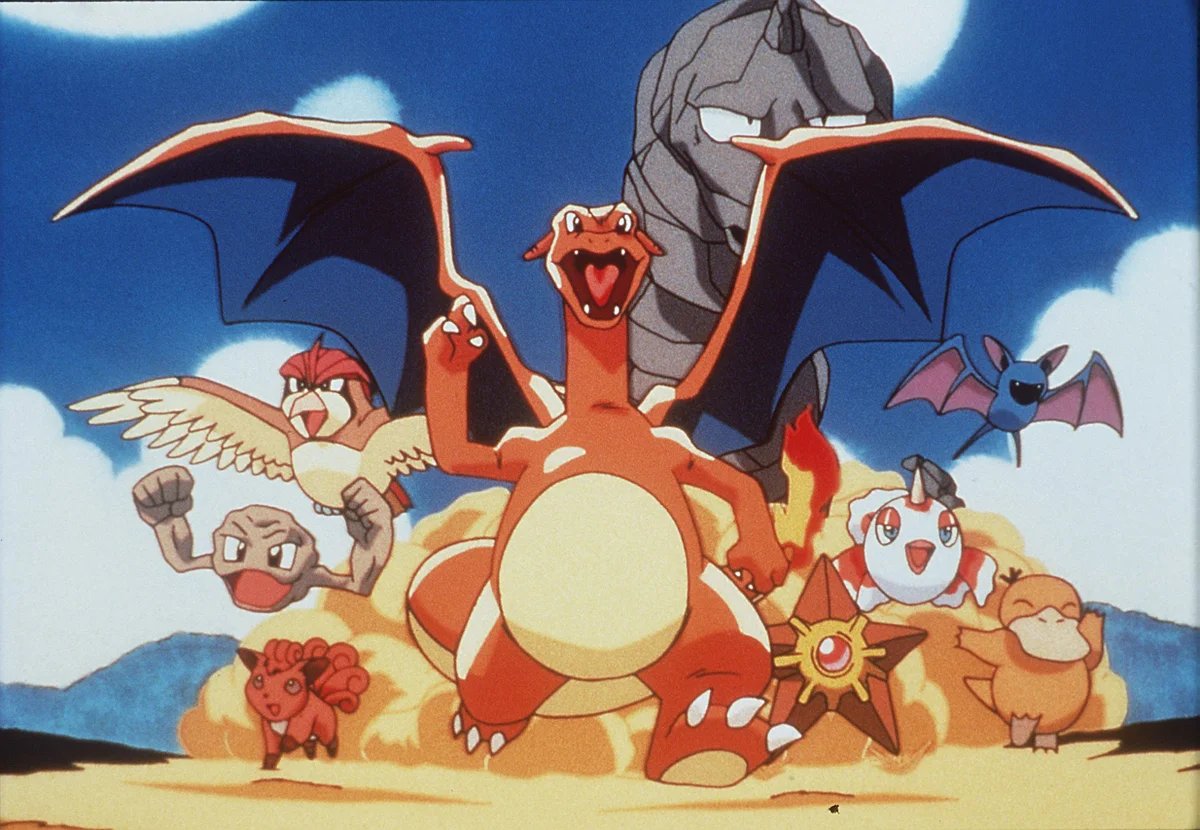
Pokémon’s beloved world of charismatic and powerful “pocket monsters” and their trainers may be fantastical, but it has arguably become one of the most scientifically thought-out. Themes of conservation and ecology are tightly woven into the ongoing video games, prized trading cards and hit anime series.
Video game designer Satoshi Taijiri, who created the first Pokémon game in 1996, was inspired by his childhood love of catching insects. And 30 years later the franchise continues to take science seriously: ahead of the release of its new game Pokémon Champions on April 8, The Pokémon Company announced that it was looking to hire employees with Ph.D.s in science, engineering, agriculture or ecology.
Pokémon isn’t just about leveling up your team to win battles or completing the Pokédex (in-game encyclopedia), though. It’s about learning Pokémon’s habitats, understanding their strengths and weaknesses, and helping them thrive or even “evolve” into new stronger versions. Actual science suffuses the characters and the places they live. The wildly popular new video game Pokémon Pokopia, released in February, is perhaps one of the clearest examples: players restore damaged habitats for Pokémon after an environmental disaster. The entire franchise’s use of real-world science is partly why many scientists have become fans who pursue that iconic slogan: “Gotta catch ’em all.”
On supporting science journalism
If you’re enjoying this article, consider supporting our award-winning journalism by subscribing. By purchasing a subscription you are helping to ensure the future of impactful stories about the discoveries and ideas shaping our world today.
“The reason I love Pokémon is collecting all the animals,” says Gabriel-Philip Santos, co-founder of Cosplay for Science and co-host of PBS’s Eons. “As a kid, I loved doing that. I would pick up bugs and have tiny little aquariums.”
People at the Pokémon Europe International Championships in February get a preview of the new game Pokémon Pokopia on Nintendo Switch 2.
The connections to science run so deep that researchers can easily spot their subjects of study while they play the games. “I know things that look like [Pokémon]. I’ve seen butterflies that look like that. I’ve seen little caterpillars that look like that,” says Middlebury College entomologist Greg Pask.
Here are a few examples of the more than 1,000 Pokémon from various generations and the science behind their backstory, appearance and behavior. (A representative from The Pokémon Company declined an interview for this article.)
Insects
Caterpie is a green caterpillar-looking creature, and it turns into Metapod, an intermediate pupal Pokémon, before becoming a stronger Bug-type and Flying-type final form—Butterfree. This “evolution” is similar to the metamorphosis of a real-world caterpillar as it develops into a butterfly or moth, Pask says. For instance, before turning into Butterfree, Caterpie has lower health and a limited number of battle moves—like “String Shot,” which reduces an enemy’s speed and is sometimes described as involving silk (real caterpillars are known to make silk). Metapod—which equates to the real insect’s hardened cocoon stage—has almost no attack moves. But it has a higher defense, which it can improve even more with the move “Harden.”
Nincada is based on a cicada not only in shape but also in life cycle. Just as cicadas leave behind an exoskeleton when they molt, so does Nincada when it evolves. That exoskeleton can be used in battles like any other Pokémon but is much weaker, so most players just like to collect it. “They do insects really well and accurately in Pokémon,” Pask says.
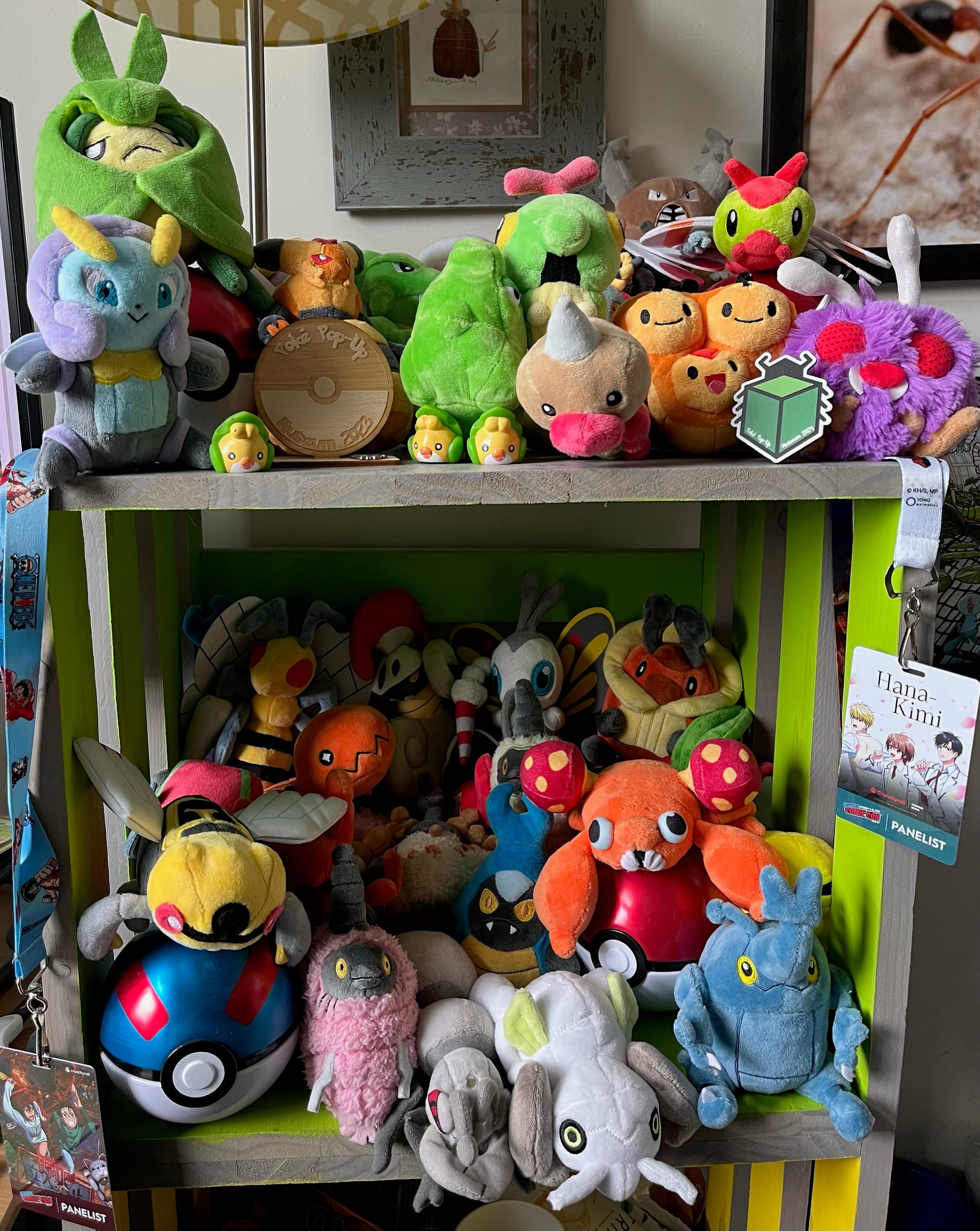
Entomologist Greg Pask’s display of Bug-type Pokémon toys in his office at Middlebury College.
Image courtesy of Greg Pask
Aquatic Species
A diverse array of marine Pokémon are inspired by real creatures of the deep. Octillery, just like an octopus, has suction-cup-covered arms that can be used to manipulate objects in its environment. And as a marine biologist who studies the class of fishes that includes sharks, my favorite Pokémon is, of course, the sharklike Sharpedo, easily identifiable by its gill slits, large dorsal fin and triangular teeth that it uses in its bite attack.
Some Pokémon have grim backstories inspired by current conservation issues. Take Corsola, the coral Pokémon. Depending on where a player finds and catches it, “one of the regional variants for Corsola is all-white and Ghost-type and is inspired by coral bleaching in the real world,” Santos says.
Plants
Several plant Pokémon are clearly based on real flora. These include the cactuslike Cacnea, covered in armorlike spikes, and the Venus-flytrap-like Carnivine, which attracts prey into its mouth.
Mammals
Sandshrew, a burrowing desert-dwelling Pokémon, closely resembles the heavily poached pangolin, a small African mammal covered in protective keratin scales. Sandshrew’s move set includes digging into the ground or curling into a ball in defense—just as pangolins are known to do in the wild.
One of the most common Pokémon is Rattata, and the rats it is based on are one of the world’s most common mammals, found on every continent but Antarctica. There are also beaverlike Pokémon, such as Bibarel—buck teeth, paddle tail, dam-building behavior and all—and buffalolike Pokémon, such as Bouffalant, which headbutts just like a bison.
Birds
Real birds have inspired many other Pokémon, such as the pigeon analogue Pidgey or the flamingo analogue Flamigo, which has a long curved neck and a pink body, stands on one leg, and lives in large flocks.
Other Life-Forms
Some Pokémon are inspired by fungi—Parasect, for instance, is a small possessed insect controlled by a large mushroom on its back. The mushroom is modeled after parasitic fungi such as Ophiocordyceps,the inspiration for the video game zombies in The Last of Us. Fungi in this genusweave through an insect’s tissue to control its muscles, eventually killing it.
There are myriad Pokémon inspired by extinct animals, as well. For example, Anorith—an ancient Pokémon that can be “revived” with its fossil in the game—is based on the Burgess Shale fossil Anomalocaris, a marine arthropod that lived about 500 million years ago during the Cambrian explosion and is known for its segmented armor-plated body and nasty-looking claws.
Science Inspired by Pokémon
Just as the natural world and research have deeply shaped the franchise, Pokémon itself has become a resource for science and education. At least 16 real-world animals are named after Pokémon. Museum exhibits, such as one opening soon at Chicago’s Field Museum of Natural History, and an annual pop-up exhibit created by Pask’s students at Middlebury College are using Pokémon to teach audiences about nature.
Santos also uses these creatures to inspire a love of animals on our planet. “There’s a lot of folks who say, ‘I wish Pokémon were real,’” Santos says. But there are ways to explore the animals and environments of the real world just like in the fictional games, he notes. “You can learn about them, find them and catalog them with things like iNaturalist, which is just like a Pokédex.”