
Over its two centuries, acclaimed writers and artists have found inspiration at London zoo, from Edwin Landseer’s Trafalgar Square lions, to AA Milne’s naming “Winnie” after resident bear Winnipeg, and Sylvia Plath’s poem Zoo Keeper’s Wife.
Plath’s husband, Ted Hughes, who would become poet laureate, worked at the zoo briefly as a dish washer, an experience said to have helped fuel his inspiration for The Thought-Fox.
As the ZSL (Zoological Society of London) celebrates its 200th anniversary, the current poet laureate, Simon Armitage, now joins their ranks with his latest work, The Moon and the Zoo, published to mark this milestone in the international conservation charity’s history.
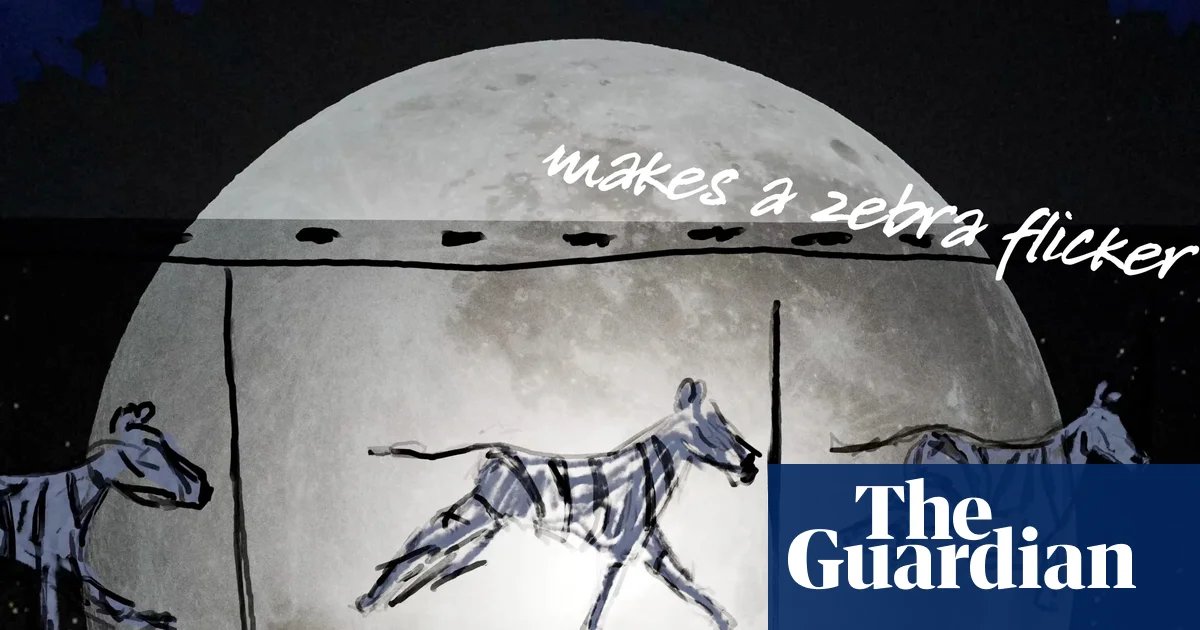
Armitage narrates the poem, which conjures up the night-time world at the zoo, in a specially commissioned animation illustrated by Greg King, which carries the words through a dreamlike journey from the zoo out into the wider natural world.
The poem opens as the world sleeps, and the moon “slides in under the turnstile after dark, moves in a silent arc at an ancient pace, dabs its ointment on the gibbon’s paw, nitpicks its way through the troop of gorillas, smooths the silverback’s fur.”
It culminates with dawn break, as Armitage reflects on shared responsibility of the natural world, and “the moon hands over the keys of the world and trusts them to us.”
During time spent with animals and staff at London zoo, Armitage said he “met Katie, a Mexican red-kneed spider”, watched Sumatran tigers, and went behind the scenes in the reptile house. He was intrigued by the secret lives of animals, “the mysterious aspects of their existence which we never really get to see … their thoughts and dreams, which we can only imagine and guess at.”
He said: “The night is a metaphor for the unknown, and the moon is an eternal watch and witness over those lives, and has been for millions of years. Some animals are very active in the darkness, but for others it must provide a respite and a refuge from the global human activity that can be so disruptive to their needs.”
The moon was also a metaphor for the work of ZSL, he said, representing the “keeping and caring”, and the “important research” away from public view.
The poem also aims to share ZSL’s message about the “wonder of the natural world” and “how the richness of nature can enrich our own thinking and extend our imaginations”, he said.
“Daylight brings the human world out of its bed and its sleep, the world of the sun is a world owned and run by humans – the last line of the poem is about our obligation to nature, and the trust needed for humanity and nature to find a harmonious relationship. Oh, and I wanted the poem to be fun as well – playful in its imagery and ideas.”
ZSL was founded in 1826 to advance zoological science, and opened the world’s first scientific zoo, London zoo, in 1828, for zoologists including Charles Darwin. It opened to the public in 1847.
Kathryn England, the CEO of ZSL, said: “For 200 years, ZSL has worked to bring people closer to wildlife and inspire action to protect it. Simon’s poem captures both the wonder of those encounters and the responsibility that comes with them. With our anniversary just days away, it’s a powerful reminder of the role people can play in the future of wildlife.”
The Moon and The Zoo
It slides in under the turnstile after dark,
moves in a silent arc at an ancient pace,
dabs its ointment on the gibbon’s paw,
nitpicks its way through the troop of gorillas,
smooths the silverback’s fur.
The moon
puts a crystalline glint in the tiger’s eye,
makes a zebra flicker like old film,
shushes the two-toed sloth when it stirs.
On it goes, incognito keeper and carer
wheeling through tunnels, passing through fences,
casting the black kite in a platinum glow,
mending cracked hide with its soft flux
and welding the armadillo’s chainmail coat.
A restless otter slips out of its holt
and rolls the ball of the moon in its feet;
the full moon smears its milky smile
on the lips of pups and kittens and cubs.
It crowns the giraffe in its standing sleep,
draws out the aye aye’s ET fingers
for a midnight manicure, blesses a tortoise,
lifts up its lamp to check on the lions,
sharpens the warthog’s tusks, brushes the strings
of the cupboard spider’s jittery web
without sounding a note, then makes
a final sweep of the nests and dens.
But there’s still work to do before dawn,
spreading out through the city, leafleting streets,
leaving animal dreams under pillows
and conjuring tundra, rain forest, swamp
or savannah from gardens and parks,
lighting up waking minds with wild thoughts.
Then morning breaks; the moon hands over
the keys of the world and trusts them to us.
©Simon Armitage

