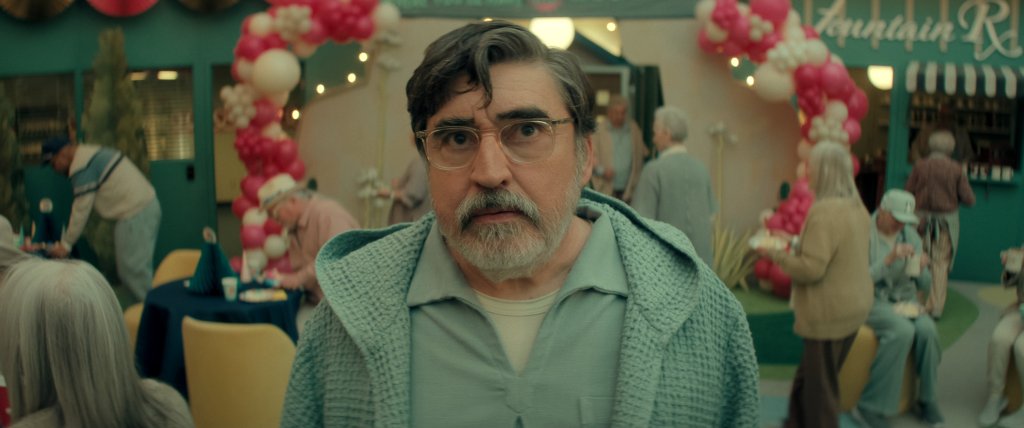
SPOILER ALERT: This post spoils the entirety of the first season of The Boroughs now on Netflix.
The tight-knit group of neighbors in the eponymous retirement community where The Boroughs takes place have mostly survived the show’s first season, but not completely unscathed.
Created by Jeffrey Addiss and Will Matthews (The Dark Crystal: Age of Resistance), The Boroughs follows Sam Cooper (Alfred Molina), who did not know what he was getting into when he moved into a vacant house next door to Renee (Geena Davis), Art (Clarke Peters) and Judy (Alfre Woodard), Wally (Denis O’Hare) and Jack (Bill Pullman). Unfortunately, it took Jack’s mysterious death one night to rally his neighbors into investigation mode — mainly starting with Sam and Wally, who conduct several experiments on blue glittery blood left behind at the scene of the crime.
With the help of Renee and Paz (Carlos Miranda) who scour security footage and sniff out their suspicions about lead security guard Hank (Eric Edelstein) as well as Judy’s dusted off investigative journalism skills, Wally finds strange marks at the back of Jack’s throat, and he then discovers that Sam and Judy have them too. These puncture wounds allow the creepy crawlies that come out of the oven shafts and hang from the ceiling to suck brain fluid out of Boroughs residents to bring that back to their “Mother,” or the first of their kind, who was discovered by Blaine (Seth Numrich) and Anneliese Shaw (Alice Kremelberg) when they founded The Boroughs as a mining town in 1959.
“We wanted [them] in a way to look and feel like death. [They’re] in the shadows. Is that the creature? Is it something else? Is it just a shadow? You can never quite know what you are looking at, because death could be anywhere. It’s lurking in the shadows,” co-creator Jeffrey Addiss said of the inspiration for the look of Mother and her “kids.” “In terms of the design of it, we looked a lot at older skin, the way it moves, the way it hangs, very old people, the spots, the lines, the thinness of the skin. We made it sound like sandpaper when it moves.”
Blaine and Alice, who masquerade as descendants of their former selves, but who are really as old if not older than the Boroughs residents themselves, in turn benefit from the golden elixir that is Mother’s blood, which keeps them immortal and freezes them in time.
“We had to design a whole system that hopefully we could summarize in like two lines. So we thought of it like bees,” Addiss said. “The drones bring the nectar to mom, who turns it into honey. So we even made it look like honey, magical honey. That was the inspiration.”
One first encounters with a “kid” have Judy whip out her pistol, Ethel, and shoot one, and most of the cul de sac residents feel the same about the creatures, wanting to avenge Jack’s death.
L-R: Denis O’Hare as Wally, Alfre Woodard as Judy, Alfred Molina as Sam, Clarke Peters as Art in ‘The Boroughs’
Courtesy of Netflix
“The show starts off about a guy who sets out to kill a monster, but it ends up as a show about a guy who saves a monster and saves the town that he doesn’t want to be in, doesn’t want to be part of. So we had to make a creature that could start off as scary, but then become sympathetic and sad,” Addiss said.
Things change when Sam gets thrown in The Manor after his daughter Claire (Jena Malone) thinks he might be going crazy. It’s there that he meets the mysterious Duchess (Mary McDonnell) who can communicate with Mother because she, like Sam and Mother, is frozen in time.
“She was incredible. She was unbelievable. The part is impossible. She’s basically the Oracle,” Matthews said of McDonnell. “How can you be a human and also have access to all this magical information? She was able to do both.”
Addiss praised the Battlestar Galactica star for delivering “ a lot of exposition” and making it “seem like human talk.”

Mary McDonnell as The Duchess in ‘The Boroughs’
Netflix
The Duchess needs a cigarette as a cue to come back to herself, and she informs Sam that Mother has been appearing to him as his dead wife Lilly (Jane Kaczmarek) because Sam is frozen in time over grieving his wife, who died from a stroke shortly before they were set to move into The Boroughs. He has one foot stuck in the past when she died and the other in the now trying to move forward without her.
“As much as Sam is initially motivated by the death of his wife, the relationship that’s the most difficult for him in the actual show is [with] his daughter,” Matthew said. “So we also wanted the bad guy — you think it’s the bad guy — the monsters, to have a similar thing of parent and child, because the hero has parent and child. Now they’re all part of the same show.”
It’s The Duchess who relays the reveal that Jack’s death at the hands of Mother’s children was an accident, and she changes Sam’s mind about Mother and her fate.
“You start to think, ‘Okay, if he needs to save a monster, and we got a couple of these crawlies running around, we needed our E.T.’ We had this image of Mother, and instead of taking her to the stars like at the end of E.T., her end is to die, to shift [Sam’s] relationship with death,” Addiss said. “The creatures go from scary and other to almost sad and heroic, and that is their release. So to break it down, the creature is death and the way Sam’s relationship changes to it.”
Blaine and Annaliese and their cronies close in on the rest of the Boroughs residents once Wally’s kidnapped Mother and they’ve made a plan to save her, but Sam and his daughter have teamed up to make particle accelerators with a bunch of old TVs that ultimately destroy Annaleise.
L-R: Alice Kremelberg as Anneliese Shaw, Seth Numrich as Blaine Shaw in ‘The Boroughs’
Courtesy of Netflix
“So the monster is reflecting Sam’s relationship with his daughter, parent to child, and Blaine is reflecting his relationship to Lilly, husband to wife.,” Addiss said. “At the end of the last episode, Lilly says to Sam, ‘Time is a gift, and in the last episode, Blaine says ‘Time is a thief.’ That is the two ways you can look at time. Which is Sam going to be?”
Though incapacitated by the TVs, Blaine’s body falls to the ground before he can disintegrate like Annaleise has. A twitch of his hand signals that he may not be fully dead, and he comes back very much alive later when Sam helps Mother get to the underground cave where Art (Clarke Peters) found his forbidden fruit tree.
“We can tell you exactly why that tree is there, and how it is, what it is, and everything. We actually wrote versions of answering that question into the first season. We had some scenes that we wrote, we never shot them, and we ultimately decided to save it for later, that answer,” Addiss said. “So it’s not in there. You’re not crazy. If we get the chance to do another season, I promise we’ll, we’ll tell you where that tree came from. It’s also a little nod to Dark Crystal: Age of Resistance. We like trees and caves.”
Clarke Peters as Art in ‘The Boroughs’
Courtesy of Netflix
Mother warns Sam that she’s going to explode after he sets her down in the cave, her kids freed from their cages by Judy and Paz to roam and be with her, but Blaine interrupts the pair’s heartfelt goodbye, attacking Sam. Mother’s explosion distracts Blaine and frees Sam. Though Mother has exploded, it seems she could play into the trajectory of the story still, as well. Her choice to heal Judy after Annaliese brutally stabbed her to try and get Art to spill the beans reflects the untapped scope of Mother’s powers. As Matthews pointed out, even Blaine says to Sam, “You have no idea what Mother is or what she’s capable of.”
“It was a big part of the homages to E.T., the sense of rebirth, of regeneration, the sense of Mother as somebody whose powers are bigger than what we’re seeing even this season and setting up things to come, if we’re being honest,” Addiss said. “So it was doing a lot of things in that moment. But, it’s very much an E.T. moment that we think of, but it’s the first moment, even beyond that, where you go like, ‘Oh, Mother might have powers, even beyond what we’re seeing.’”
As for Sam’s bathroom scene at the very end of the finale where his form goes static in the mirror as he looks down after fixing a cut on his forehead, his was a way for the co-creators to hint at what lies ahead should they get more seasons. The moment is reminiscent of Will Byers (Noah Schnapp) coughing up that leftover Demogorgon tentacle after he’s been rescued at the end of Stranger Things Season 1.
L-R: Jane Kaczmarek as Lilly Cooper, Alfred Molina as Sam in ‘The Boroughs’
Netflix
“We called it glitching. You see Lilly do it. You see a couple of people do it. Transmission messages are a big theme throughout the season, because Mother is broadcasting this message all the time that only certain people can hear, her SOS help signal. It’s what causes the birds to go down,” Addiss said. “So this idea of signals, that’s old TVs, old radios, they’re all transmission based. And so we were using the language of the old TVs and the glitching as a way to show communication and other. Why he glitches at the end is not something we can reveal, but hopefully can reveal, knock on wood in a season two, because it’s a big part of where we’re going.”
And it sounds like the Duffer brothers, who produced The Boroughs, may have influenced that ending scene.
“We had a little more of a cliffhanger tying too much into what the season might be. And they were like, ‘Listen, you don’t know what’s gonna happen. Tell a whole story and crack the door, but don’t tie yourself down to anything,’” Matthews said. “So I think it made the ending much better.”
When asked how far out they’ve envisioned the story going in terms of number of seasons, Addiss held up three fingers. This could change depending on the show’s success, and The Boroughs has not yet been officially renewed for a second season. Regardless of the path to get there, which Addiss and Matthews acknowledge could change, they know “the last shot of the last scene of the last episode,” as Addiss says or what Matthews describes as the “emotional point.”
RELATED: Everything We Know About ‘The Boroughs’ So Far