Drug discovery is notoriously inefficient. Pharmaceutical projects span years, moving from one specialized human team to the next through disconnected workflows that result in knowledge loss during each handoff.
A shocking 90% to 95% of drug discovery projects reportedly fail — one of the highest failure rates of any industry. A single successful drug can take over a dozen years and up to $1 billion from initial discovery to patient distribution, according to published reports.
Generative AI is being used to solve some of the challenges, but Stanford researchers have moved the ball forward with agentic AI.
A team led by James Zou, associate professor of Biomedical Data Science at Stanford University, has deployed thousands autonomous AI “scientist” agents in a virtual biotech that simulates the full lifecycle of drug development. The agents handle everything from initial discovery through safety testing and clinical trial design, while maintaining the continuity that’s lacking in today’s drug discovery processes, according to Zou.
The project uses a hierarchical orchestration framework. At the top sits a chief scientist officer agent that acts as a planner, delegating tasks to teams of specialized agents, Zou told VentureBeat during a call ahead of his upcoming session at VB Transform 2026.
While one team of agents focuses on discovery, another manages safety, and others handle specialized analytical tasks. Because these agents operate within a unified, hierarchical ecosystem, they retain the full context of a project, maintaining continuity from the first molecule identified to the final clinical outcome.
The “brain” of the system relies on a vast amount of primary data. The agents are granted access to data sources ranging from genomics and FDA chemistry data to clinical trial databases using a model context protocol.
The team has invested heavily in agent-native and agent-friendly data, allowing the AI to synthesize complex information more effectively. The system relies on a combination of models, with Zou noting that while Claude often serves as the backbone for coding and data analysis, the architecture employs a mixture of models, including those fine-tuned specialized use cases.
Zou is raising money at a roughly $1 billion valuation for his startup, Human Intelligence, based on the research.
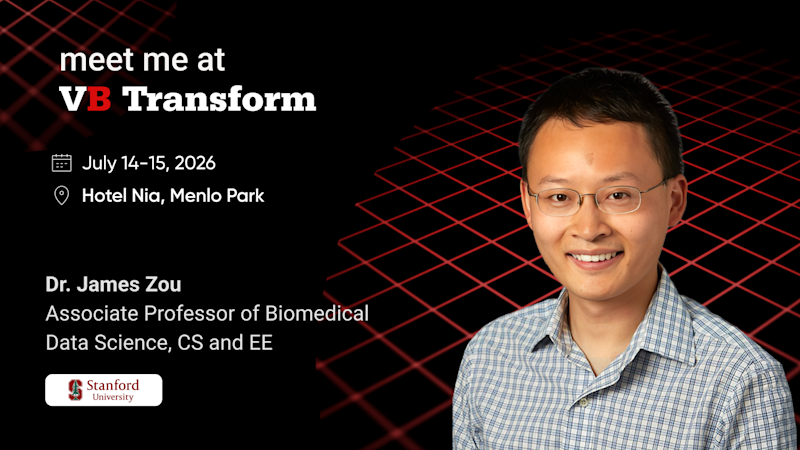
During Zou’s session at VB Transform on July 15, titled How 10,000 agentic scientists in Stanford’s lab are set to revolutionize medical research and discovery, he will share valuable insights including strategies for managing context and long-running, multi-step workflows in a multi-agent system, the process of transforming and indexing raw enterprise data to make it agent native, and how to use human auditing and experimental reward signals to verify agent actions.
Another session at VB Transform focused on the value of agentic context includes Building a trustworthy agentic AI foundation: How Zillow accelerated engineering by 40%, with Zillow’s SVP of engineering and technology, Toby Roberts and Glean’s CEO Arvind Jain.
Interested in attending VB Transform 2026? Register here. A select number of complimentary passes are also available to senior technology leaders. Contact us to get yours.