
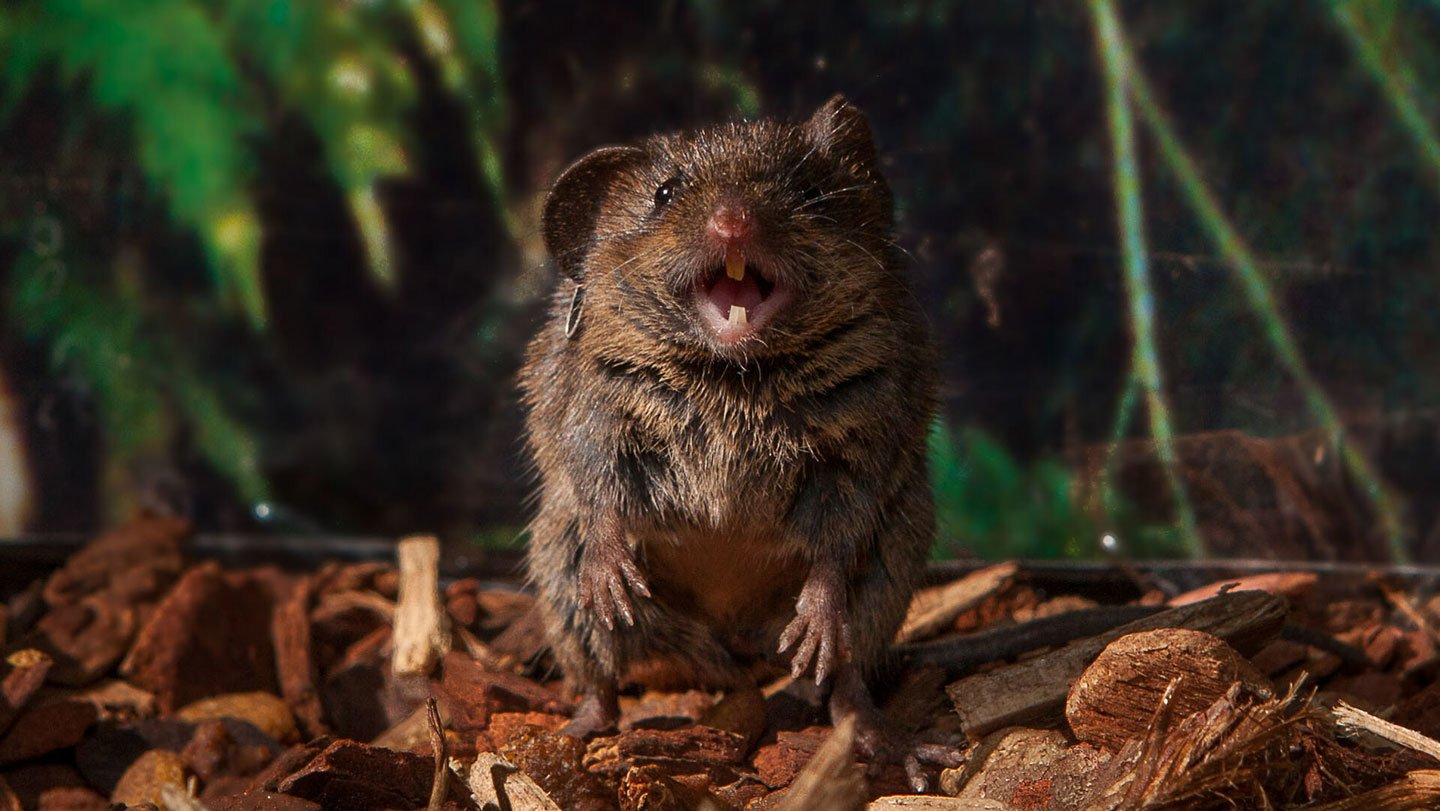
Musically inclined mice inflate their throats like balloons to sing their whistling tunes.
The rodential aria is produced by inflatable air sacs in the mice’s airway, researchers report May 6 in Proceedings of the Royal Society B. Creating these piping numbers may be a unique use for air sacs in the animal kingdom.
Alston’s singing mouse (Scotinomys teguina) lives up to its name. Males and females of the small species — native to Mexican and Central American forests — communicate with a train of high-pitched notes more complicated than those of any other rodent. The 10-second songs, which appear to attract mates and warn rival males, consist of around 100 individual breaths and notes, says Samantha Smith, an integrative biologist at the University of Lausanne in Switzerland. This speed and song length is far more “extreme” than other rodents’ calls, she says.
Smith and her colleagues wanted to know how the vocal system may have evolved to make the mouse melodies. So the team dissected the larynges — the voice boxes — of euthanized singing mice and hooked those larynges to a tube, with a microphone and camera pointing toward their tops.
“A larynx is basically just a tube with a valve in it that can open and close,” says Smith, who did the work while at the University of Texas at Austin. When the team blew air through the tube, they could record how the larynx moved and produced sound.
Whenever the larynx produced sounds in the right pitch range for the mouse’s natural song, a pouch in the larynx was always inflated. When the researchers blocked this balloon with bits of wax or small metal balls, the larynx went silent. Cutting the sac had the same effect. The air sac was crucial for making the song.
Other rodents have air sacs too, but don’t appear to use them to sing like this.
Raffaela Lesch, a bioacoustician at the University of Arkansas at Little Rock, says she’s impressed by the team’s experimental approach and their choice of species.
“Working with larynges this small is not an easy task,” she says. “[Rodents are] such a diverse group with such fascinating social, behavioral and ecological adaptions that I’m excited to see our knowledge in their sound production mechanisms grow.”
It’s not yet clear how the sac generates the whistling tone. One possibility is that air circulating inside the inflated sac generates the tone by vibrating at the sac’s entrance, the way opening a car’s sunroof or side window can make noise as air rushes past the opening. The other is that the tone comes from air being deflected by a sharp cartilage rim at the sac’s entrance, a bit like how flutes and organ pipes work.
Inflatable sacs in airways have evolved multiple times — in primates, birds, reptiles, frogs and more. But in those cases, air sacs are thought to alter or amplify sound produced elsewhere in the respiratory tract. The song of the singing mouse is made by the sacs themselves.
“Our study expands our understanding of the ways in which [air sacs] can shape vocal communication,” Smith says.
Studying how different features of rodent air sacs contribute to vocal output may help researchers better understand how these itsy-bitsy serenades first evolved.


