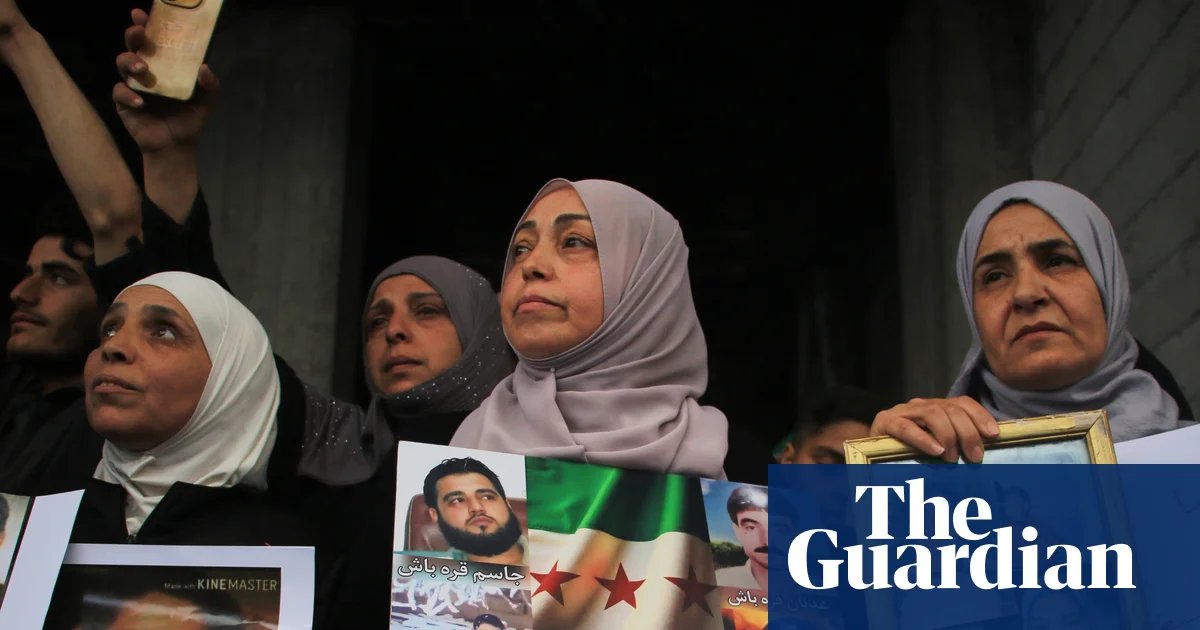
Ahmad al-Homsi is a deep sleeper, but when he was woken last month and told that Amjad Youssef, a Syrian intelligence officer who killed civilians in the 2013 Tadamon massacres, had been arrested, he bolted out of bed. He ran into the street to find other people already celebrating the news.
“We stayed out for almost three or four days celebrating. People from neighbouring areas sent camels, sheep, livestock for us to slaughter and distribute them to people. The tears of joy didn’t stop,” said al-Homsi, a 33-year-old activist with the Tadamon Coordination Committee, which documented the atrocities in the Damascus neighbourhood.
To al-Homsi and people all over the country, Youssef’s arrest was a milestone in Syria’s long road to achieving justice for the Assad regime’s atrocities. The video of Youssef killing blindfolded civilians as part of a series of massacres that killed at least 300 civilians had become synonymous with the regime’s brutality.
But al-Homsi’s joy turned to anger when he saw a seemingly forced confession released by Syria’s interior ministry last Sunday, in which Youssef was put in front of a camera and said he acted alone in his killing of civilians.
“Of course it upset us. Of course I didn’t like what he said. This was a cover-up for others [involved],” al-Homsi said. “There are many more criminals. We want to know everyone who held a position or was responsible at the time of the massacres.”
The aftermath of Youssef’s arrest has exposed a tug of war between two very different visions of transitional justice in Syria – and with it, of the country’s future. Victims of Assad’s atrocities, and those of other parties in the country’s long civil war, are demanding transparent processes of accountability. However, some in Syria’s new government have prioritised internal security, showcasing the arrest of some of Assad’s henchmen while making deals with others in the name of stability.
“We’ve moved from transitional justice into selective and performative justice,” said Ali Aljasem, a researcher at Utrecht University’s Centre for Conflict Studies. “The idea is, you arrest a couple of people, put them on TV and use them as scapegoats.”
Aside from Youssef’s confession video, Aljasem also pointed to the first hearing in the trial of Assad’s cousin Atef Najib, the former head of political security in Deraa province, last Sunday. The picture of Najib sitting in a courtroom cage, and being confronted by one of the teenagers whose torture he oversaw at the beginning of Syria’s revolution, has been hailed by the public as a first step towards transitional justice.
However, a narrow focus on showcasing the punishment of a few “bad guys” can distract from a proper reckoning with past crimes, said Nousha Kabawat, the head of the Syria programme at the International Centre for Transitional Justice.
“Transitional justice is not just a punitive process; it is about rebuilding a society and rebuilding trust. While some level of performance is part of this, it should not overshadow fairness, and the Syrian people should be treated as partners rather than spectators in the rebuilding process,” Kabawat said.
Aljasem, who co-authored a recent report on the government’s deal-making with former regime cronies such as Mohammed Hamsho and Samer Foz, warned that a security-first approach could have long-term consequences for Syria’s future. “These deals have nothing to do with justice or moving away from the past. Instead, they risk reproducing authoritarian structures from that past,” he said.
The government has worked out reconciliation deals with Assad-era war profiteers in return for assets and information, as well as temporarily shielding some past security officials in exchange for intelligence and to tamp down an insurgency by Assad loyalists on Syria’s coast.
Aljasem said a key middleman between the old and the new guard was Fadi Saqr, a former commander of the Assad regime’s NDF militia who has helped the government mediate with some regime figures while aiding in the arrest of others. Saqr is widely accused, however, of involvement in the mass killing of civilians in Tadamon and other Damascus districts. Saqr has denied responsibility.
“Even those now protecting Fadi will tell you he’s a criminal, but he’s useful to them,” Aljasem said. “Their reasoning is: if you arrest Fadi, you only arrest one person, but if you keep him, he will lead you to many others.”
The Syrian government is internally divided on the approach to transitional justice, but not all sides wield equal influence. While the administration has integrated former activists, lawyers and academics dedicated to transitional justice, analysts say decision-making on security issues lies with a narrow circle of confidants around the president, Ahmed al-Sharaa, who prefer a security-focused approach.
Cooperation between former regime officials and the government has angered victims, who, while understanding the need for stability, have been frustrated by the lack of transparency.
“We have trust in the government; we don’t want to immediately say: ‘No this is not correct.’ But we will demand our rights and the rights of all the families,” said al-Homsi, who has met Syrian officials to discuss Tadamon families’ concerns over the role of Saqr in the new government.
The strategy also risks undermining the credibility of some of the grassroots work that the government has done to encourage social cohesion. It has worked on inter-communal dialogue and has brought Assad-era perpetrators to face their victims in areas of north Syria such as Salamiyeh and Homs to try to defuse sectarian tensions there. The process, while successful in some areas, is uneven, and lags behind in other parts of Syria.
The legal structure of Syria’s nascent government is also not equipped to properly tackle the legacy of the civil war. The Syrian penal code does not define war crimes or crimes against humanity as independent legal categories and it may be many months before parliament passes a transitional justice law to address these issues.
Still, mounting popular pressure for justice has pushed certain parts of the government towards accountability.
The Guardian revealed on Thursday that the Commission for Transitional Justice was preparing a case against Saqr accusing him of war crimes and crimes against humanity – claims that he denies. The commission expects that a wider case will be mounted against those implicated in the Tadamon massacres, not just Youssef. “Just an arrest is not justice,” said Zahra al-Barazi, the commission’s deputy chair, referring to Youssef’s recent capture.
For years, al-Homsi documented atrocities in Tadamon in silence, stealing out when no one was watching to take pictures and gathering information in whispers. Now that Assad is gone, he is determined to see that evidence used. Only then can he and other residents of Tadamon move forward with their lives.
“People are returning and want to live in their homes. They want to rebuild,” said al-Homsi. “But we are standing there saying: ‘This entire place is a mass grave. It’s full of martyrs; you can’t build yet. You can’t erase the scene of the crime.’”