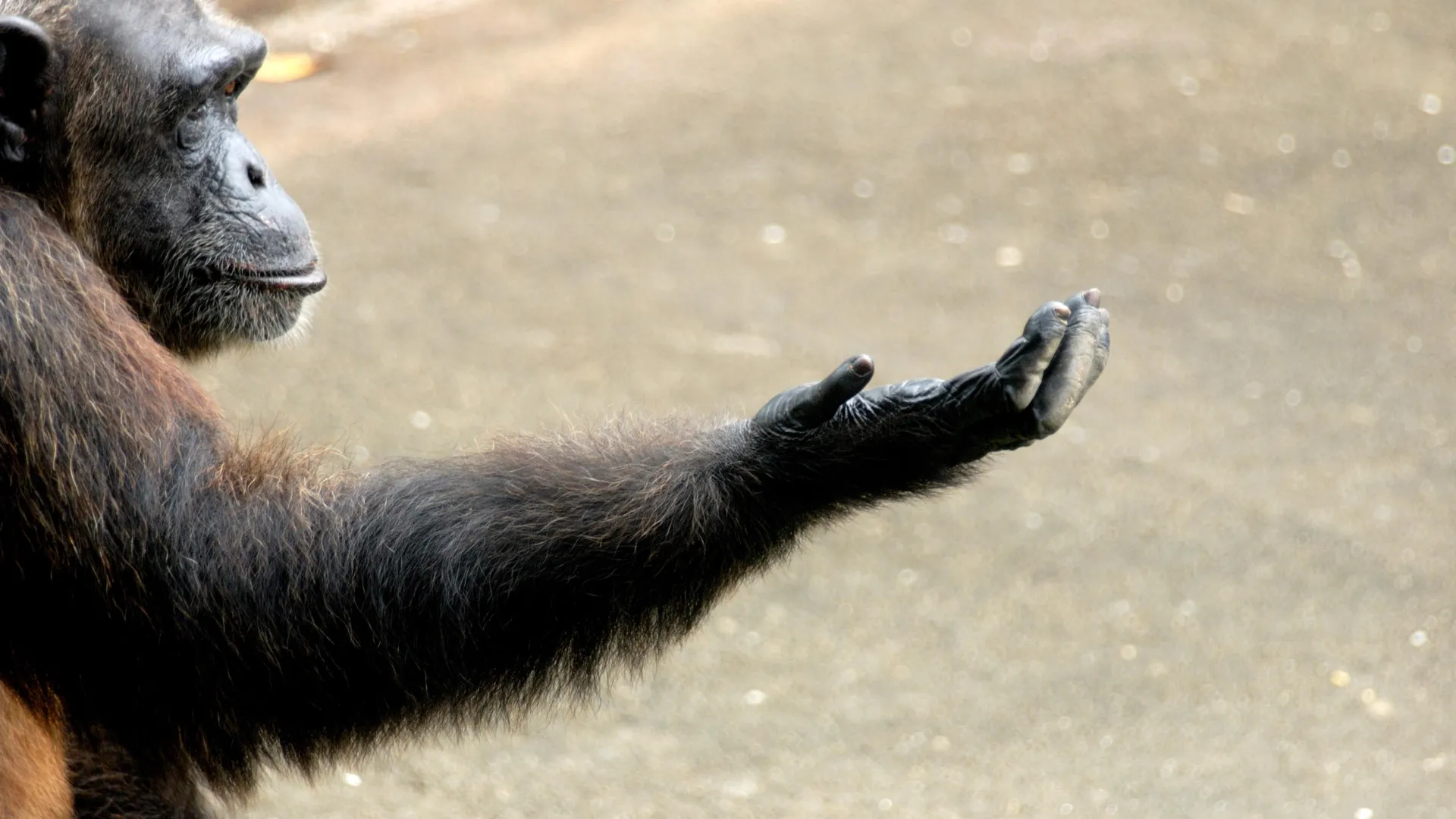
One of the biggest mysteries in human evolution has long puzzled scientists: Why are humans so overwhelmingly right-handed? Around 90% of people across cultures prefer using their right hand, a level of dominance not seen in any other primate species. Researchers have spent decades studying the brain, genetics, and development behind handedness, but the reason humans became so strongly right-handed has remained unclear.
Now, a new study led by researchers at the University of Oxford points to two major evolutionary milestones: walking upright and the dramatic growth of the human brain.
The research, published in PLOS Biology, was conducted by Dr. Thomas A. Püschel and Rachel M. Hurwitz from Oxford’s School of Anthropology and Museum Ethnography, together with Professor Chris Venditti from the University of Reading. The team analyzed data from 2,025 monkeys and apes representing 41 different primate species.
Using Bayesian modeling that considered how species are evolutionarily related, the researchers tested several major theories about the origins of handedness. They examined factors including tool use, diet, habitat, body size, social structure, brain size, and movement patterns.
Upright Walking and Brain Expansion
Humans initially stood apart from every other primate in the analysis. However, that changed once researchers added two key traits into their models: brain size and the ratio between arm length and leg length, which is commonly used as a marker of bipedal movement.
After accounting for those features, humans no longer appeared to be such an evolutionary exception. The findings suggest that the combination of upright walking and larger brains may explain why humans developed such an unusually strong preference for the right hand.
The study also allowed researchers to estimate likely handedness in extinct human ancestors. Their results suggest that early hominins such as Ardipithecus and Australopithecus probably showed only mild right-hand preferences, similar to what is seen in modern great apes today.
That pattern appears to strengthen significantly with the emergence of the genus Homo. Species including Homo ergaster, Homo erectus, and Neanderthals likely had increasingly strong right-hand preferences, eventually leading to the extreme dominance seen in modern humans.
The Curious Case of the “Hobbit” Species
One species stood out from this trend: Homo floresiensis, the small-bodied species often nicknamed the “hobbit” because of its tiny size. Researchers predicted that this species had a much weaker right-hand bias.
According to the team, that finding fits the broader evolutionary pattern. Homo floresiensis had a relatively small brain and retained physical adaptations for both climbing and upright walking, rather than being fully specialized for bipedal movement.
The researchers believe the evidence points to a two-stage evolutionary process. First, walking upright freed the hands from locomotion, creating new pressures that favored more specialized and asymmetric hand use. Later, as human brains became larger and more complex, the preference for the right hand grew much stronger and more widespread.
Dr. Thomas A. Püschel, Wendy James Associate Professor in Evolutionary Anthropology at the University of Oxford, said: “This is the first study to test several of the major hypotheses for human handedness in a single framework. Our results suggest it is probably tied to some of the key features that make us human, especially walking upright and the evolution of larger brains. By looking across many primate species, we can begin to understand which aspects of handedness are ancient and shared, and which are uniquely human.”
Why Left-Handedness Still Exists
The study also raises new questions for future research. Scientists still do not fully understand why left-handedness has persisted throughout human evolution or how human culture may have helped reinforce right-handedness over time.
Researchers are also interested in whether similar limb preferences found in animals such as parrots and kangaroos could point to deeper evolutionary patterns shared across very different species.