Rachel Feltman: For Scientific American’s Science Quickly, I’m Rachel Feltman. Instead of going through a series of news stories you may have missed last week, we’re going to focus on one major headline today.
[CLIP: Marco Rubio speaks at a cabinet meeting: “The number one priority of our foreign policy is to protect the American people. We cannot and will not allow any cases of Ebola to enter the United States.”]
Feltman: That was U.S. Secretary of State Marco Rubio speaking at a cabinet meeting on May 27.
On supporting science journalism
If you’re enjoying this article, consider supporting our award-winning journalism by subscribing. By purchasing a subscription you are helping to ensure the future of impactful stories about the discoveries and ideas shaping our world today.
On May 15 health officials from the Democratic Republic of the Congo declared that the country was in the midst of an ebola outbreak. Two days later, the director general of the World Health Organization designated the spread of Ebola in the DRC and Uganda as a public health emergency of international concern.
Here to tell us more about this developing crisis—and to explain why the response outlined by Rubio is a massive, dangerous departure from the way the U.S. has historically dealt with Ebola outbreaks—is Tanya Lewis. Tanya is senior desk editor for health and medicine at Scientific American.
Tanya, thanks for joining us.
Tanya Lewis: Thanks so much for having me
Feltman: So for listeners who, you know, were maybe distracted by other outbreak news—of course, the last time we had you on we were talking about Hantavirus—how long has this Ebola outbreak been going on?
Lewis: So we have only really known about it for the last two weeks or so, when the World Health Organization declared a public health emergency of international concern, which is kind of like their highest official alert for an outbreak like this. But, you know, given the high numbers of cases and deaths, it’s likely the outbreak was going on well before that.
So, you know, we’re still kinda catching up and figuring out exactly where some of the earliest cases were. But as far as the world at large was aware, we really only found out about it about two weeks ago.
Feltman: And give us a refresher: What is Ebola? I know it looms large in a lot of people’s imaginations but, of course, can cause these really horrifying outbreaks. So could you tell us more about the disease?
Lewis: Sure. Yeah. So Ebola is actually one of a family of viruses. They’re called orthoebolaviruses, and they all cause what is known as a type of hemorrhagic fever, or—it’s a kind of disease where, like, your immune cells are infected by the virus, and this leads to internal bleeding and organ failure and death.
And it has a very high fatality rate, obviously. But what’s different about this outbreak is it’s actually caused by a strain or what’s technically called a species of [orthoebolavirus] called Bundibugyo virus. And this is a less common one. It’s only caused, like, I think two outbreaks in the past that we know of.
And so while we have seen, you know, very large outbreaks the, quote-unquote, “traditional Ebola virus,” which used to be called the Zaire ebolavirus, before, and we’ve developed vaccines and treatments for that, we don’t actually have any approved vaccines or treatments for the Bundibugyo strain. So researchers are racing to test a couple of antibody drugs and a drug called remdesivir, which is an antiviral drug.
But we don’t have any approved vaccines for this current strain. The good news, if there’s any good news, is that the mortality rate for this strain is, like, slightly lower than the Ebola Zaire strain, but we’re still talking about people dying from this disease.
Feltman: And how contagious is this species of Ebola?
Lewis: So it seems to be similar to other [orthoebolavirus]; this is not a disease that is transmitted through casual contact. I mean, we’re talking sharing close contact, bodily fluids. You know, taking close care of family members is how it’s often transmitted and sometimes through burial practices.
So while it is an extremely severe disease, it is not one that is readily transmitted the way that, you know, COVID is, for example.
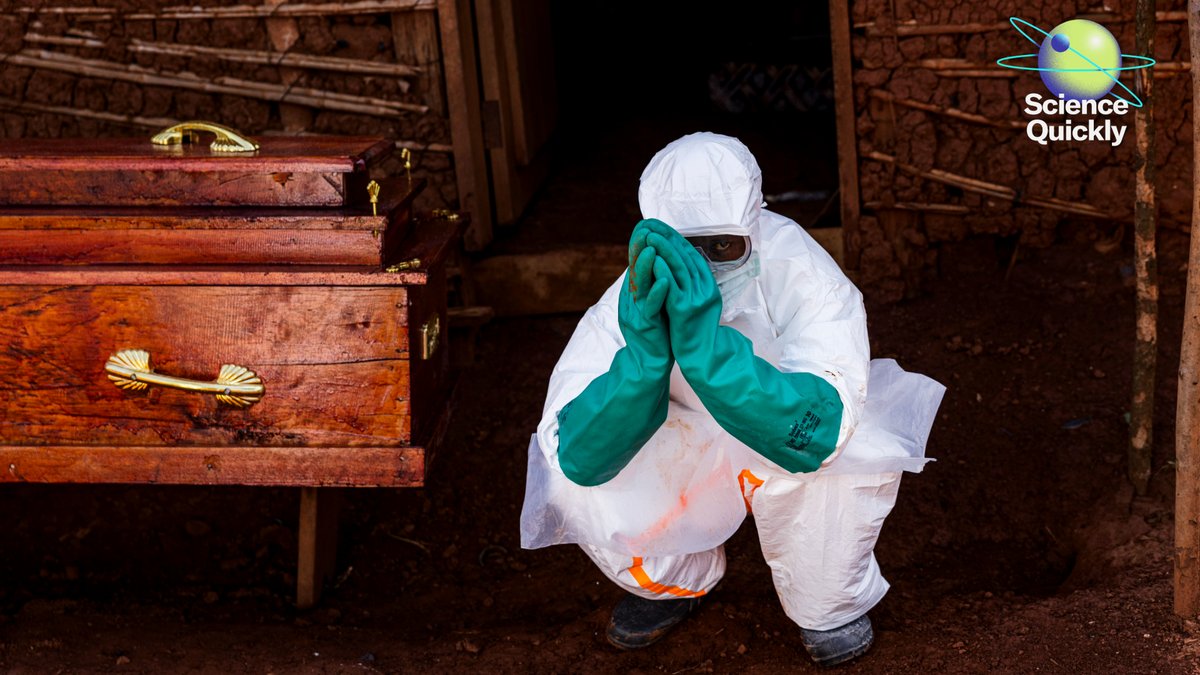
Feltman: Right. I think people, you know, see the level of precautions that are necessary in the context of caring for someone with Ebola, you know, the hazmat suits, the decontamination, which is very scary, and it is, you know, very dangerous for the health care workers. But I think it is important to remember that this isn’t something you’re going to get from somebody coughing in the same subway car as you
Lewis: Yeah. No, exactly. And I mean, the reason for the hazmat suits is that this is a very severe disease. I mean, it’s what we probably call a high-consequence pathogen, so, you know, you definitely don’t want to transmit it. And so when you’re treating someone with Ebola—it makes people very sick, so, you know, bodily fluids are something that health care workers are exposed to all the time, through treating patients, so that’s why you see those individuals wearing, you know, full-on PPE and protective gear. But it’s not casually, yeah, transmitted.
Feltman: Well, and I remember the, the largest outbreak to date, which was 2014 to 2016, there was a lot of discussion among public health officials of there being a lack of trust of medical personnel on the ground and people working to contain the disease and a real reluctance to surrender the dead, which was contributing to spread.
And I know in the DRC now, there is active conflict going on. Could you talk more about sort of what real-world factors on the ground are contributing to this being such a, a dangerous outbreak.
Lewis: So one of the challenges of treating Ebola in an outbreak in these types of conflict zones is that doctors and health care workers, they’re not only risking their lives by treating people with a deadly virus, they are also exposed to the harms of the violence itself. There have been clinics that have been caught in crossfire in these conflicts, and people often target health care workers themselves and aid workers because they are just sort of in the wrong place at the wrong time.
And it’s very challenging to contain an epidemic under these conditions. That is why I think the World Health Organization has really emphasized the importance of making safe places for people to be treated and not targeting health care workers because they are already putting their lives on the line to care for these very sick patients.
And if they have to do that in a war zone, that makes things incredibly, exponentially more difficult.
Feltman: Speaking of 2014, you know, obviously this is not the first Ebola outbreak since then, but it does seem like experts are prepared for it to be the worst we’ve seen since then.
Could you talk a little bit about what the most optimistic outlook is for this outbreak ending?
Lewis: I think it’s still an open question exactly how bad this outbreak will get. I have seen experts and folks from the International Rescue Committee, which is one of the nonprofits working over there, say that this could be, you know, worse than any Ebola outbreak we’ve seen before.
That said, the 2014 to 2016 outbreak [is] currently the deadliest on record. It had [about] 30,000 cases and 11,000 deaths that we know of. This outbreak so far, as of May 26, has had more than 1,000 suspected cases and more than 240 suspected deaths.
And I think what’s so concerning to experts is that we basically only became aware of this outbreak, as I said, a couple weeks ago, when it was already in the hundreds of cases. So that’s concerning because where there are deaths, there are likely many, many more cases.
And we just don’t have an idea of exactly where this outbreak is gonna peter out, because so far the rate of growth is, you know, by some estimates, much faster than some of the previous outbreaks. Scientists are actively trying to figure out exactly how bad this will get, but I think it remains to be seen.
It depends a lot on the outbreak response and what countries like the U.S. do in terms of providing aid to DRC and Uganda, because this is not something that we can expect to just go away on its own.
Feltman: The U.S. has made so many cuts to its international aid programs. How is that affecting what help we’re providing, which, of course, research shows us is not just altruistic and us being good humans but absolutely necessary for containing, outbreaks like this?
Lewis: Yeah, absolutely. I mean, the cuts that were made to USAID and to the State Department have absolutely affected our response to this outbreak. Some experts say that it would not gotten out of hand the way it has if we had not made those cuts. There’s also been a very big departure in how we are responding to this outbreak compared to previous ones.
Like, for example, in previous outbreaks, Americans who contracted Ebola while caring for sick people or who were exposed to the virus were brought back to the U.S. to quarantine and be treated. In the current outbreak, Marco Rubio, the secretary of state, recently said that, you know, no one with Ebola will be entering the U.S.
And in fact, they are now being shipped to other countries. A doctor was recently treated in Germany as well.
This is how the U.S. government is now treating our health care workers when we have safe ways to quarantine people and isolate them in biocontainment units in the U.S. Our tax dollars support these types of facilities.
So it’s not as if the U.S. does not have the capability to safely care for people and treat them if they have Ebola. We do, and we have done that in the past, and this is a big departure.
Feltman: Thank you so much for coming on to chat with us about this
Lewis: Yeah. Thanks so much for having me.
Feltman: That’s all for today’s episode. For more up to date information, go to ScientificAmerican.com. We’ll be back on Wednesday to talk about how math can help solve everyday problems—including arguments over pizza toppings.
Science Quickly is produced by me, Rachel Feltman, along with Fonda Mwangi, Sushmita Pathak and Jeff DelViscio. This episode was edited by Alex Sugiura. Aaron Shattuck fact-checks our show. Our theme music was composed by Dominic Smith. Subscribe to Scientific American for more up-to-date and in-depth science news.
For Scientific American, this is Rachel Feltman. Have a great week!