
Risk of ‘megaquake’ in Japan higher after powerful earthquake strikes
After a magnitude 7.7 earthquake struck of the coast of Japan and set off tsunami warnings, there’s an elevated risk of a “megaquake” following in its wake
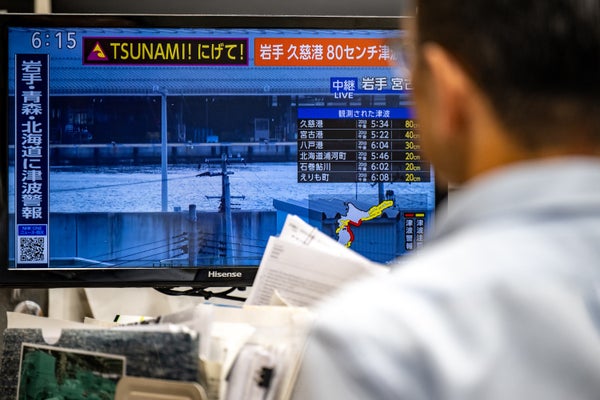
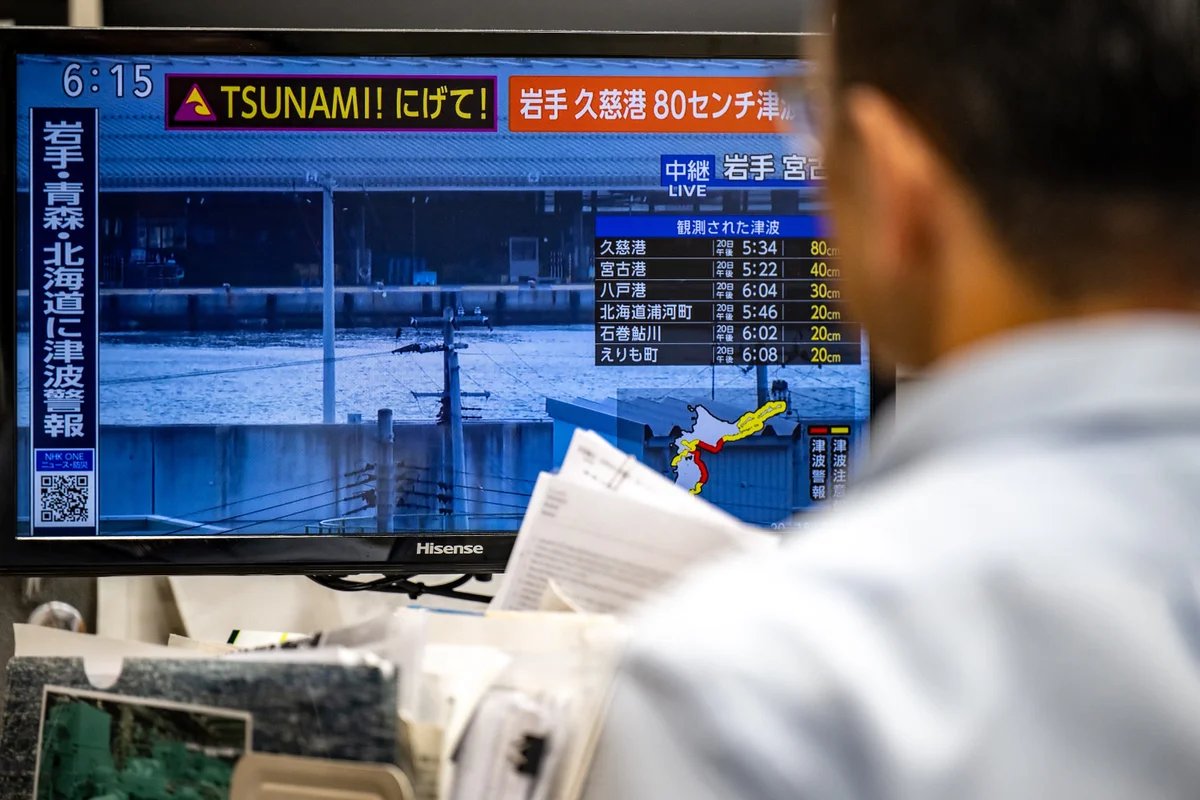
A live feed from the Japan Broadcasting Corporation (NHK) warns of a tsunami alert issued after an earthquake hit northern Japan on April 20, 2026.
Photo by Philip FONG/AFP via Getty Images
On Monday, at 4:53 P.M. local time, a magnitude 7.7 earthquake struck off the northeastern shores of Japan’s largest island, Honshu, where the Pacific tectonic plate plunges beneath the North American plate at the deep-sea Japan Trench. Immediately, the Japan Meteorological Agency (JMA) sent out a tsunami warning alert. Although small tsunami waves did soon reach various sections of the coast, no reports of injuries, deaths, or significant damage to homes or infrastructure were reported.
The danger, however, has not necessarily passed. Following the temblor, a JMA spokesperson told the media and those along the affected shoreline that “the likelihood of a new, huge earthquake occurring is relatively higher than during normal times.” Specifically, there is an elevated risk of a “megaquake”—one of magnitude 8.0 or greater—in the coming days.
The odds of an imminent megaquake are very low—around one in 100. “This 1 percent probability is still low in absolute terms, but it’s 10 times higher than normal, which is significant from a risk management perspective,” says Amilcar Carrera-Cevallos, an independent earthquake scientist.
On supporting science journalism
If you’re enjoying this article, consider supporting our award-winning journalism by subscribing. By purchasing a subscription you are helping to ensure the future of impactful stories about the discoveries and ideas shaping our world today.
That concern arises because a magnitude 8.0 quake is considerably more powerful than a magnitude 7.7 one, so if a megaquake were to occur, it might produce a far more extreme tsunami. “It is important for people who may be at risk to understand that another large earthquake is possible, even if it is unlikely,” says Wendy Bohon, an earthquake geologist.
But aren’t aftershocks usually much smaller than the initial quake? Well, it’s a bit more complicated than that.
Whenever a large earthquake happens, it unleashes a lot of pent-up stress that can cause faults around the one that ruptured to slip. In other words, “earthquakes make other earthquakes more likely,” Bohon says. This does usually take the form of aftershocks. The most powerful quake in a sequence is (retrospectively) referred to as the main shock, and the aftershocks are almost always less powerful than the main shock.
So far, this seems to be playing out in Japan, where myriad aftershocks have rattled the island, including several events above magnitude 5.0.
Rarely, an aftershock ends up being bigger than the original main shock. If that were to happen here, it would mean Monday’s magnitude 7.7 quake (which the U.S. Geological Survey recorded as magnitude 7.4) was actually a preshock to the “true” main shock. The JMA has calculated that, based on the stress changes around the Japan Trench, there is now a 1 percent chance of a magnitude 8.0 quake in the coming hours or days.
Consequently, the government has issued a “megaquake advisory.” Such advisories are a relatively new concept for Japan. The first one was issued in August 2024, when a magnitude 7.1 quake shook southern Japan. They are designed not as forecasts but as alerts to those nearby: such individuals should be aware of the elevated risk, know where their evacuation routes are and have their go bags of emergency supplies ready.
The likeliest scenario is that Monday’s magnitude 7.7 temblor was the main event and that the seismic party is now dying down. “There are many, many other times when there have been big earthquakes in Japan that were not followed by larger events,” Bohon says. But for the next few days, millions of people along the coast will be primed to flee just in case the odds truly are against them.
It’s Time to Stand Up for Science
If you enjoyed this article, I’d like to ask for your support. Scientific American has served as an advocate for science and industry for 180 years, and right now may be the most critical moment in that two-century history.
I’ve been a Scientific American subscriber since I was 12 years old, and it helped shape the way I look at the world. SciAm always educates and delights me, and inspires a sense of awe for our vast, beautiful universe. I hope it does that for you, too.
If you subscribe to Scientific American, you help ensure that our coverage is centered on meaningful research and discovery; that we have the resources to report on the decisions that threaten labs across the U.S.; and that we support both budding and working scientists at a time when the value of science itself too often goes unrecognized.
In return, you get essential news, captivating podcasts, brilliant infographics, can’t-miss newsletters, must-watch videos, challenging games, and the science world’s best writing and reporting. You can even gift someone a subscription.
There has never been a more important time for us to stand up and show why science matters. I hope you’ll support us in that mission.

