
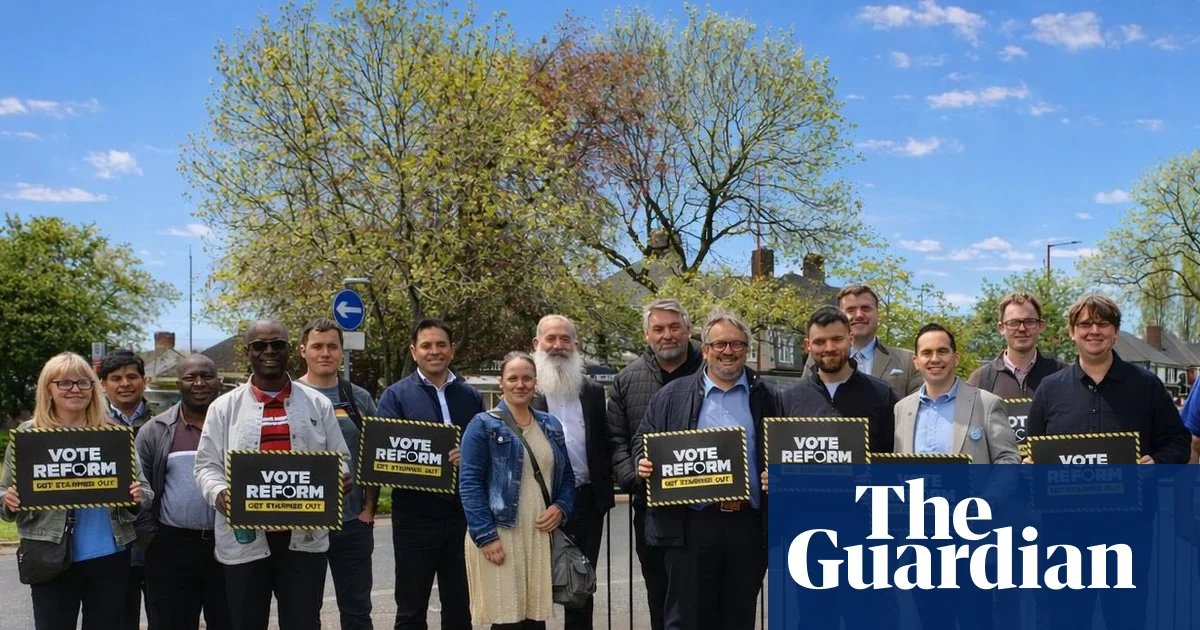
In a picture of a blue-skyed day in Birmingham, a diverse group of Reform supporters gathered with placards and cheesy grins to knock on doors for their party. Richard Tice, the party’s deputy leader, posted the picture as evidence of the activists’ commitment through thick and thin.
“That is what resilience looks like,” he wrote. “This is what belief looks like.”
But on closer inspection, the image looks to many observers more like something else: sausage fingers, melted faces, and AI manipulation.
After Tice posted the picture on Sunday, X users lined up to ask whether the picture was legitimate – or, as one put it, “pure AI slop”.
Reform disputed that the campaigners or the photo were fake, and a spokesperson said: “The photograph is real, however the version Richard Tice posted was slightly edited using AI, mainly to increase the brightness.”
But others saw evidence of more comprehensive fakery – from suspiciously straight lamp-posts to signs which appear to read “Vote Reform, Get Stuppence Out”.
Analysis by Peryton Intelligence, a digital intelligence company specialising in online hate and manipulation, found that the image was almost certainly generated or altered using AI.
“The faces (especially the mouths) of the figures all have a ‘smear’ to them,” the analysis said. “The woman in the denim jacket has extra long fingers on her left hand and what appear to be six fingers on her right. The man in the white jacket (fourth from the left) doesn’t appear to be gripping his sign at all.
“The signs themselves all smear ‘Starmer’ in the ‘Get Starmer Out’ slogan. The Reform arrow in the ‘O’ of the signs is inconsistently circular. The road sign in the back of the image has a blank white box underneath it, and there are other inconsistencies and blurs in the houses and windows behind the figures too.”
Zack Polanski, leader of the Green party, said: “There’s nothing real about the Reform party. Their supposed policies for working people are fake, they spin stories that are fake and now we know even their campaigners are fake.”
The photo also includes pixel-perfect vertical lines that experts view as highly suspicious, and peculiarly regular pixel patterns in the foreground of concrete pavements. These are telltale signs of AI manipulation.
Tice said the photograph was taken in Erdington, a suburb of Birmingham, and said that there had been a sea change of support since 2022 when they only received 293 votes in a byelection.
He said of his recent visit: “The support, the recognition and the mood was something I had never quite seen before. On 7 May, this part of Birmingham is extremely likely to elect Reform councillors, and in a general election it could go even further and elect a Reform member of parliament. That possibility felt distant four years ago. It does not feel distant now.”
The is not the first time Reform politicians have fallen into trouble over the use of AI. Matt Goodwin, the failed candidate for Reform in the recent Gorton and Denton byelection gained the nickname “MattGPT” after being accused of using AI to write his book after historical figures were misquoted and some of the footnote URLs contained “chatGPT”. Goodwin acknowledged using AI to research some data, but disputed any of his book was written using the technology.
Kate Middleton, the Princess of Wales, was also accused of using AI to edit a Mother’s Day image posted in 2024. In the photo, her daughter Princess Charlotte’s left hand was misaligned with the sleeve of her cardigan. The royal family put out a “kill notice” for the photo, asking for it not to be used, after the scandal.

