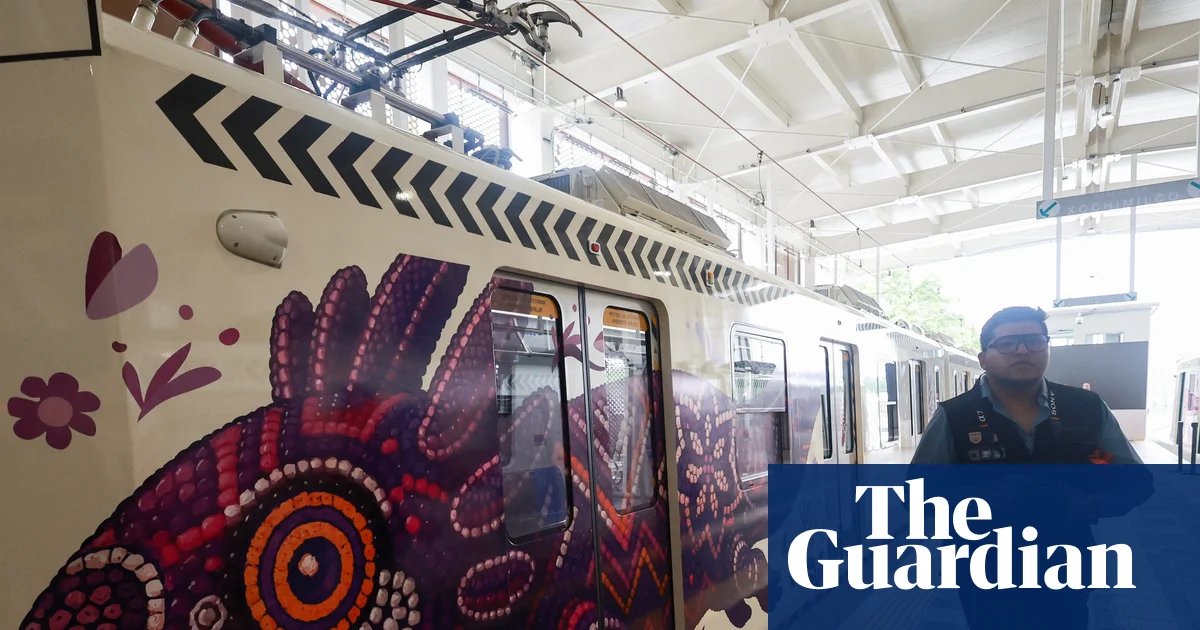
The giant purple axolotl peered up at Manuel Martínez from the black bitumen of the street. It was the second such painting of the rare amphibian he had walked past that morning. In recent weeks he had seen axolotl murals pop up in neighbourhoods across Mexico City.
“It’s a waste of money,” he said. “You could use that budget for fixing potholes, traffic lights, security cameras. They’re spending on something that doesn’t benefit us at all – it’s just for tourists.”
The axolotl, a kind of salamander native to the ancient waterways of Mexico City, is the capital’s mascot for this summer’s Fifa World Cup. And these days it is everywhere: painted on walls, plastered on trains, crawling up lamp-posts, swimming across traffic barriers.
Following in its trail is an apparent effort to beautify the city before the tournament by painting much of the capital’s infrastructure purple: pedestrian overpasses, building facades, walls, bridges, banisters, footpaths – all of them turned lilac, lavender or plum.
But many residents are unhappy with what has been called the “axolotlisation” of the metropolis, with some complaining that limited state resources could be better utilised elsewhere, particularly in a city filled with potholes, crooked pavements and flooding streets.
“In emblematic places like the Zócalo or Azteca Stadium it’s fine but in other places it’s just a waste of resources,” said 63-year-old Sergio Rivera, standing in front of a giant pink axolotl in the capital’s sprawling central plaza. “There are other priorities.”
The mayor of Mexico City, Clara Brugada, who launched the purplifying initiative, has stood firm amid widespread criticism.
“Some have said, out of prejudice or classism, that we are ‘axolotlising’ the city,” she told reporters at the reopening of a light rail service (renamed the Axolotl). “If axolotlising means filling what was once grey with colour, transforming public spaces and guaranteeing access to services for the benefit of thousands of people, then yes, we are axolotlising the capital.”
The criticism has been such that even the president, Claudia Sheinbaum, an ally of the mayor, has weighed in.
“All governments paint pedestrian bridges, all of them,” Sheinbaum said at a news conference on Friday. “Clara decided that to beautify the city she was going to use the colour lilac. And now there’s a lot of criticism. I don’t see why. Besides, the bridges look very pretty.”
Ernesto Moura, an expert in public policy and sustainable urbanisation at Mexico’s National Autonomous University, said some of the criticism was understandable.
“The city still has unfinished road safety infrastructure,” he said. “So there’s a great deal of controversy around, for example, putting axolotls on an avenue that has worn-out tunnels, and so to invest in an aesthetic matter rather than a road safety element.”
He said the purple paint job could also be dangerous, particularly when it came to traffic and pedestrian fixtures that needed to be painted in white or yellow to stand out in the dark.
But Moura said the biggest issue was that Brugada had not offered any kind of citizen input before abruptly transforming the look of a city of 22 million people.
In her previous role as borough president of the working-class Iztapalapa neighbourhood, Brugada earned widespread praise for covering the formerly drab area in bright murals, many of which could be seen from the cable car that soars above the community.
“In that case, she did a great job working with neighbours, with the community,” Moura said. “But extending that to the entire city of Mexico, it’s proving problematic.”
Much of the vitriol has played out online, with some people voicing frustration that while purple axolotls were appearing all over the city, the real axolotl was on the brink of extinction due to habitat loss and pollution.
“Clara Brugada, if you love axolotls so much, start investing in preserving this endangered species,” one user wrote on X.
Others made use of AI to generate a more lighthearted critique. In one video, Brugada is depicted as the Harry Potter villain Dolores Umbridge painting Hogwarts puce with the stroke of her wand and transforming a young student into a bright pink axolotl.
In another, a giant axolotl stalks the capital Godzilla-like, vomiting purple goo over buildings, people and even tacos. “I’m afraid of going out on the street and being axolotified,” wrote a viewer in the comments.