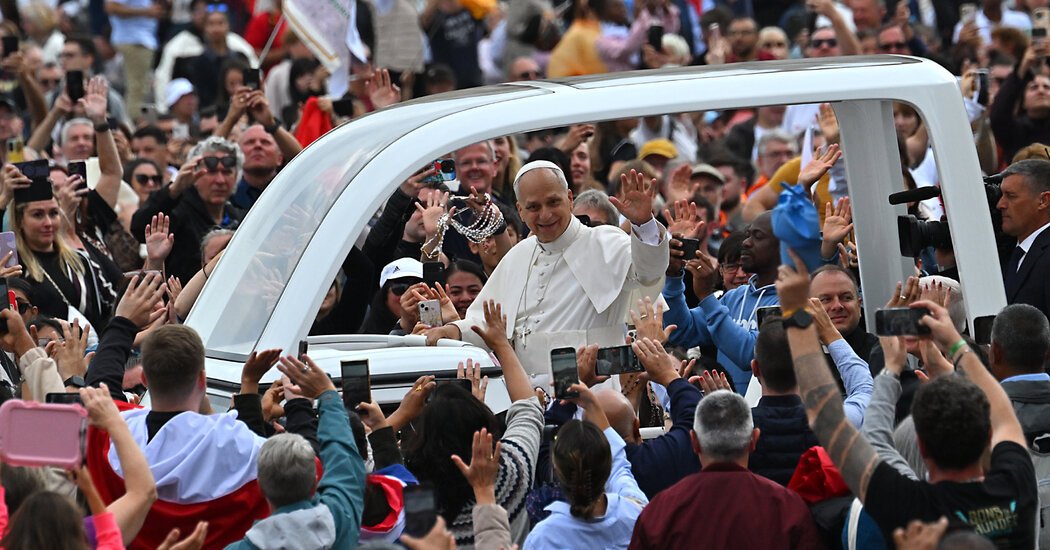
Pope Leo XIV on Monday set out a sweeping vision for corporate executives, politicians and individuals who will shape and be shaped by the future of artificial intelligence, warning leaders to safeguard humanity from A.I.’s most disruptive effects.
Leo’s declaration came in the form of a papal encyclical, an open letter to “all people of good will” that ran to roughly 42,300 words in its English version. It outlined his desire to protect human dignity and agency in an age in which technology threatens to replace humans in many professional and social roles. He presented it alongside Christopher Olah, a co-founder of Anthropic, a major A.I. developer, in a symbolic gesture of dialogue between leaders of the spiritual and technological worlds.
While emphasizing that “technology should not be considered, in itself, as a force antagonistic to humanity,” he wrote that “the pursuit of greater profits cannot justify choices that systematically sacrifice jobs.”
Among other things, Leo called for:
-
government regulation of the private companies that are driving the development of A.I.
-
protection and retraining for workers whose jobs are threatened
-
education to help students think critically about the technology
-
action to protect children from violent, hypersexualized or fake information online that is often generated by A.I.
-
safeguards to ensure that humans, not artificial intelligence, remain responsible for all decisions regarding the use of weapons.
Above all he emphasized the importance of retaining a fundamental social role for all human beings. “A society that guarantees employment to only a small fraction of the population, despite having a high level of technical development, risks exposing many to forced inactivity, a lack of responsibility and the absence of daily tasks and stimuli, resulting in human and cultural impoverishment,” he said.
“This creates a paradox of material progress and anthropological regression that undermines the foundations of a just and stable social peace,” he added.
Clergy, scholars and technology leaders have been expecting the pope’s document for months, with many anticipating that it would form one of the most significant moral warnings yet about the misuse or overuse of artificial intelligence.
A year ago, on his second day as pope, Leo made clear his focus on the perils of artificial intelligence, telling the College of Cardinals that, under his leadership, the church would address the risks that the evolving technology poses to “human dignity, justice and labor.”
He has since repeatedly spoken about A.I., including during a trip to Turkey and Lebanon, in an address to Catholic university leaders and even when celebrating the international day of mathematics. Last week, the Vatican announced it had created a commission of senior Catholic officials to discuss the challenges posed by A.I.
Pope Francis, Leo’s immediate predecessor, had also warned about the dangers of artificial intelligence and called for the ethical use of technology.
Although Leo publicly presented his encyclical on Monday, he formally signed it on May 15, the 135th anniversary of the publication of “Rerum Novarum,” — or “Of New Things” in English — a major encyclical written in 1891 by his namesake, Leo XIII.
The pope’s encyclical was timed to prompt comparisons with that earlier document, which guided Catholic teaching on how to protect workers after the technological and industrial disruptions of the 19th century.
Written amid the upheaval of the Industrial Revolution, “Rerum Novarum” sought to safeguard the rights and dignity of the working class and became one of the foundational texts of modern Catholic social teaching. It called on governments to “save unfortunate working people from the cruelty of men of greed, who use human beings as mere instruments for money making,” even as it praised the “discoveries of science.”
In the new encyclical, titled “Magnifica Humanitas,” or “Magnificent Humanity,” Leo struck a similar tone, warning of the new threat to workers posed by artificial intelligence.
Work, he wrote, is more than a way of earning income, but “a requirement of the human condition, a normal path toward maturity, development and personal fulfillment.” He called for “the protection of employment opportunities and the irreplaceable role of the individual.”
Leo expressed concern at how emerging A.I. tools might take over many routine tasks and jobs, implicitly devaluing those who do not have the training or ability to perform the work that remains available to humans. Leo wrote of the importance of preserving human dignity and warned of the “insidious” ideology that “suggests that every person must earn or justify his or her own worth, to the point of attributing greater value to those who are more efficient or effective.”
Unions and charities that were formed to protect workers during the first industrial revolution, Leo wrote, would not be sufficient to protect laborers during a technological transition that could leave millions of people unemployed.
“New collaborative efforts are needed among political leaders, labor organizations, the business world and the scientific community in order to develop rapidly adequate shared regulations and protections, including at the international level,” he wrote.
The encyclical also called for imposing the “most rigorous ethical constraints” on weapons developed using artificial intelligence, continuing Leo’s — and the Vatican’s — longstanding opposition to war.
“The growing ease with which autonomous weapons systems can be deployed makes war more ‘feasible’ and less subject to human control,” Leo wrote. That, he added, contradicted “the principle that armed force should be used only as a last resort in cases of legitimate self-defense.”
Although the encyclical includes significant references to scripture and religious teachings, the document in many ways reads like a policy paper from a think tank or a lawmaker.
Leo wrote in detail, for example, of the importance of protecting children, who are particularly susceptible to the warping effects of technology.
“Psychological and psychiatric literature has documented with growing insistence how early and unsupervised exposure to digital devices and social media can negatively impact sleep, attention span, control of emotions and relationships, especially during the most vulnerable stages of life, at times with tragic consequences,” he wrote.
Parents need support from schools and governments, he said, to help their children resist the excessive use of A.I., the possibilities of “isolation, bullying and cyberbullying,” and the pressure “to share intimate images or sensitive information.”
Scholars are divided about what effect, if any, the document will have on the technology industry, in which rival tech titans are racing for dominance.
Brian Patrick Green, director of technology ethics at Santa Clara University in Northern California, said some technology leaders “will have to take it seriously in a sense,” partly because it provides them with “a moral imperative.”
Writing in the encyclical, the pope recognized the autonomy of governments and private companies. The church, he said, “does not claim to supplant the responsibilities of politics or institutions, but offers itself as a foundation,” urging other institutions to “recognize and promote whatever serves the dignity of persons, the vitality of communities and the common good.”
Others said that an encyclical’s primary targets are the clergy and the faithful.
“I don’t think the ‘tech bros’ in Silicon Valley will listen that much,” said Prof. Noreen Herzfeld, director of a program on technology and ethics at St. John’s School of Theology and Seminary in Collegeville, Minn. “But I think within the church, it will be there as a reference for priests and bishops and particularly for those of us who are educating seminarians or young people.”
Priests can use the contents of the document to guide conversations with parishioners who share their concerns about the technological pressures of modern life, Professor Herzfeld said.
Reporting was contributed by Josephine de La Bruyère from Rome and Elizabeth Dias from Vatican City.