Police were outgunned at the Bondi massacre on 14 December, armed with 9mm Glock pistols in a gun battle against rifles, the royal commission on antisemitism and social cohesion has heard.
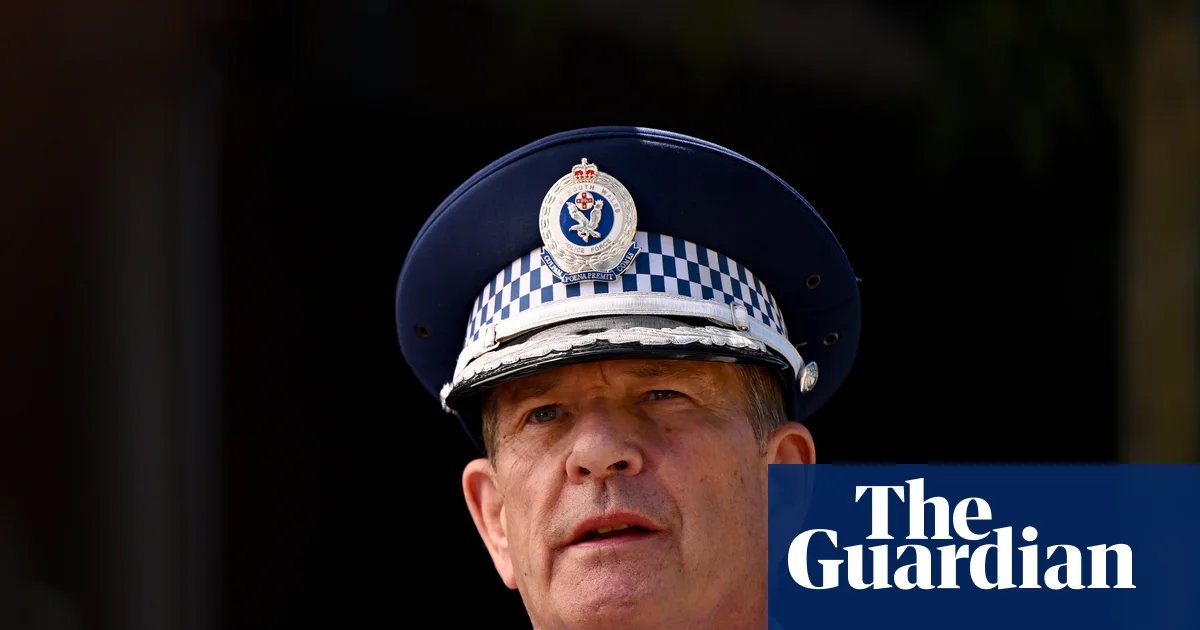
New South Wales police deputy commissioner David Hudson gave evidence to the commission that police officers put themselves in danger to shoot and neutralise the attackers.
“Obviously, on the 14th of December, our police officers were placed at significant risk, being in a gunfight armed with 9mm Glocks against long-arms,” Hudson said.
A plan to establish an armed response command – of 210 officers carrying long-arm weapons – has been “escalated”, but will still take at least another 12 months to be fully staffed, he told the commission.
The Police Association of NSW – the officers’ union – made representations to the police force and government about arming officers with long-arms more consistently after the Bondi terror attack.
“The availability of long-arms on a more frequent basis is certainly a response to that and also better protection of the community,” Hudson said.
The commission was established by the federal government after the Bondi terrorist attack. It previously heard that on the evening of 14 December 2025, two gunmen opened fire from a footbridge above Archer Park at Bondi beach, using a bolt-action high-powered rifle and shotguns to shoot at members of the Jewish community celebrating Hanukah.
The pair killed 15 people. Sajid Akram was shot dead by police; his son, Naveed Akram, was shot and wounded and is in custody facing charges, including 15 counts of murder and one count of committing a terrorist act that investigators allege may have been “inspired by” Islamic State.
The commission heard this week that within 30 seconds of opening fire at the Hanukah event, the gunmen had shot 11 people using long-arms, fatally wounding 10 of them.
The pair was subdued after seven minutes and 41 seconds. Det Sen Const Cesar Barraza is believed to have fired the shots – from his 9mm Glock pistol – which killed Sajid, 50, and disarmed Naveed, 24.
Two police officers, Const Scott Dyson and probationary Const Jack Hibbert, were seriously injured in the attack.
After the Bondi tragedy, NSW police announced the establishment of the armed-response command, describing it as an intelligence-led unit that will patrol high-risk areas, places of worship, major events, and mass gatherings such as protests and sporting events.
“The unit will be made up of 250 officers, and it’s a 24/7 specialised police operation,” the police and counter-terrorism minister, Yasmin Catley, said in February.
“What we’ve seen over the summer is police at our large events with long-arms … that will become part of this operation’s normal capability.”
The command was to take up to two years to set up and fully staff, but that has been accelerated, Hudson told the commission Wednesday morning, with the command fully operational within 12 months.
About 210 of the officers are expected to carry long-arms, with the remainder of positions filled by command and intelligence officers.
Hudson told the royal commission: “it is expected that the new Armed Response Command team will be in a position to respond differently or more rapidly than the current capability, for example, the riot squad or the [tactical operations unit].”
The riot squad is used “sparingly” to carry long-arms, Hudson said. Officers carrying long-arms are not able to engage in crowd control for safety reasons.
“The armed response command will have a dual purpose [for] high visibility operations, both static and mobile, similar to models we have seen overseas,” he said.