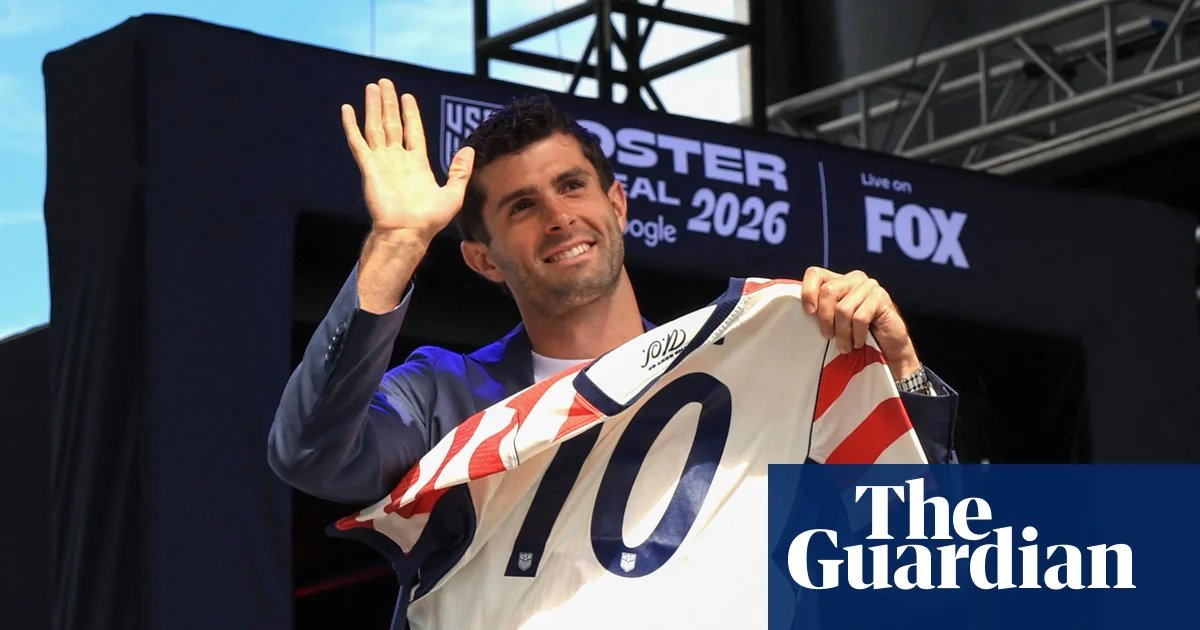
Mauricio Pochettino is entering the 2026 World Cup with plenty of confidence in his team’s biggest star, even after last summer’s saga that saw Christian Pulisic ask out of national team duty.
The Milan forward opted out of last summer’s Concacaf Gold Cup as he prioritized entering the 2025-26 season with adequate rest, wanting to avoid burnout for this crucial World Cup summer. The star and his international coach then exchanged words through podcasts in the lead-up to the tournament, which saw the US fall in the final against Mexico.
“I was disappointed with him [for missing the Gold Cup],” Pochettino reflected in a discussion with the Guardian and other reporters on Thursday. “I am transparent about that. He was disappointed with our decision not to include him in the two friendly games [against Switzerland and Turkey].”
Memories of that saga have already begun to dissipate, replaced by anxiety over the forward’s career-worst form. The 27-year-old hasn’t scored for his country since November 2024, nor has he for any team since 28 December. And yet, he’s as vital to the USMNT’s hopes of making a deep run this summer as anyone, the long-anointed face of the program positioned front-and-center in pre-tournament marketing.
On Thursday, Pochettino called Pulisic a “special player”, and admitted that among the team’s priorities before the group-stage opener against Paraguay is to recover his confidence.
“He is going to score in the World Cup,” Pochettino said. “I really have trust in that. I have confidence in him, he has very good attitude and commitment, he is trying so hard to get to his best level and I think he will achieve it for sure.”
Pulisic’s form was one of many topics Pochettino addressed from the new national training center in Fayetteville. As you may imagine, there’s a lot on his mind as he nears his first World Cup as an international manager.
How to make a midfield
Pochettino’s squad surprised many by only carrying four central midfielders among his 26 picks: Tyler Adams, Sebastian Berhalter, Weston McKennie and Cristian Roldan. When asked about it after Tuesday’s squad reveal event, Pochettino listed a handful of players (including Gio Reyna and Sergiño Dest) who could factor in the roles despite little to no experience playing in an engine room.
There are still viable concerns about depth specifically in defensive midfield, with McKennie having played a more advanced role for club and country alike in 2026.
“I think we think that the capacity of Malik [Tillman] or Weston going a bit deeper – we have better possibilities in our buildup and better control and to play much better, to claim the ball easier, to move the ball more quickly and to have this capacity to put the ball in the final third in a better condition,” Pochettino said. “We need to be strong in our defensive side but we also need players in front of our center-backs that have the possibility to play and feel comfortable.”
The Argentinian coach also expanded on a thought he expressed at Tuesday’s roster reveal: there may be times where the USMNT doesn’t have a holding midfielder on the pitch.
“It’s about having quality players on the squad who know how to play,” Pochettino said. “We don’t need to play another holding midfielder because I think Sebastian, or Cristian – if we play with one holding midfielder, that is enough. We need to have possession, more possession than the opponent, that is the idea, no?”
The archetypal American player?
Pochettino’s last World Cup appearance came as a part of Argentina’s squad in 2002 – the year the United States crystalized an identity first forged a decade earlier. That US group leaned on their athletic prowess and intrinsic determination, being difficult to outmuscle and springing breakneck counterattacks between shifts of low-block defending.
That identity largely remained over the ensuing 16 years, but the failure to qualify for Russia 2018 put the program on a path to reinvent its approach. Both Pochettino and predecessor Gregg Berhalter have wanted the USMNT to become a possession-dominant outfit, controlling proceedings to a greater extent at the expense of some defensive stability.
Led by a generation of players with clearer paths to European leagues than ever before, the stock and standard American player has gradually been redefined.
“We are seeing the real American player right now,” Pochettino said. “The important thing is that now, as a national team, we are competitive and they understand what we expect from them, and our culture and philosophy, and that we’re coming from different countries … If we want to play all these countries – Brazil, Argentina – we need to see that sport in the different way than we do now.”
It takes time to evolve a country’s approach to the sport, of course, especially when soccer’s place in the national sports landscape is markedly different than more football-rabid nations. Pochettino has previously questioned the US’ “emotional relationship” with the sport, and on Thursday, he again emphasized how much the country’s multisport reality affects the growth of soccer.
“We knew that [soccer lags behind other sports] already,” Pochettino said. “It was part of our motivation to come, the challenge, to try to help, no? That our vision and way of seeing things was going to help find a good balance and a possibility to compete better. I think it’s growing a lot. When we start to watch the U-20, 19, 17, I think it’s improving a lot here in the US. I think it’s good quality players. The most important thing now, that we were speaking about yesterday, is how we can stay with those players so they keep evolving and they don’t plateau at that level, those players.”
An aversion to being the ‘silly guy’
After Tuesday’s roster reveal, Pochettino confessed that “even today, I cannot enjoy the 26 guys that are in front of me because I am thinking of players who are out.”
Even with a further 48 hours of reflection, Pochettino couldn’t soften how “cruel” the process ultimately had to be.
“I discovered it last week. It’s so painful, it’s so difficult,” Pochettino said. “When you are at a club, if you’re not in the squad for tomorrow, you could be on the squad for next week. It’s a possibility. But when you are not on the roster for the World Cup, you have to wait four years more. For me that’s the worst thing.”
Pochettino on Tuesday vociferously defended his use of email to notify players of their roster cuts, and that continued Thursday.
“In the way that we manage people and players, nobody is going to convince me that the best way to communicate isn’t the way that we [do it],” Pochettino said. “In the way that we were acting during the past two years with these players, our relationship was building respect.”
On whether he would have requested an explanation after his omission from Argentina World Cup rosters in 1994 and 1998, Pochettino again said no.
“You appear in all the news like the silly guy that’s calling the coach,” he said. “You would lose all of the respect. In real life, in real football, in the real, competitive game, you cannot show to everyone that you’re the silly guy. People will start to laugh at you, to emphasize it – because you cried that you didn’t make the roster. People will say ‘ah, come on, be stronger.’ When you have the opportunity to play, show that you are the best. Fight for your place.”
A clean slate
Morale around US fans is at a nadir, largely informed by the calamitous results in March friendlies against Belgium and Portugal. Asked why US fans should have confidence heading into the World Cup, Pochettino pointed to the quality of those opponents.
“We were playing Portugal and Belgium, two teams that are contenders to win the World Cup. You can lose,” Pochettino said. “I’m optimistic because the World Cup is completely different. [In 2002] we arrived with Argentina after five years with Marcelo Bielsa winning all the games, winning against Germany in Stuttgart, winning against Brazil in São Paulo, winning in Spain against Spain, beating all the countries. And we arrive to the World Cup and ciao – out. The World Cup is completely different. It’s how you arrive, it’s the mentality, it’s the level at which you arrive at.”