Pep Guardiola is expected to leave Manchester City at the end of the season, calling time on a decade-long stay during which he made a transformative impact on English football.
The 55-year-old will depart as the second-most decorated manager in Premier League history, his total of six titles, so far, putting him behind only former Manchester United boss Sir Alex Ferguson.
Stylistically, though, no manager in the modern era can claim to have made a bigger impact than Guardiola. Between the Lines explains how his influence shaped the English game as we now know it.
Pep’s immediate impact
Guardiola’s first game in charge of Manchester City, a 2-1 win over Sunderland sealed by a Paddy McNair own goal at the Etihad Stadium in August 2016, was not an especially memorable one. But even then there was evidence of the transformation to come.
Joe Hart was benched, deemed a poor fit for Guardiola’s approach. There was the novel sight of full-backs Gael Clichy and Bacary Sagna inverting into midfield. City’s 77.7 per cent share of possession was their fourth highest on record in a Premier League game.
“That is the first step,” the new manager said afterwards. It certainly showed his intentions. Guardiola would of course end up trophyless for the first time in his career that season. But the shift towards his favoured, possession-dominant approach was immediate.
City went from averaging 55 per cent possession and 487 short passes per game during Manuel Pellegrini’s final campaign in charge, to 65 per cent possession and 584 short passes per game in Guardiola’s first as he set about overhauling their style.
Some costly individual errors caused scepticism about his commitment to playing out from the back. Guardiola provided fuel for his critics when he said “I don’t train tackles” after a 4-2 loss to eventual champions Leicester in December of that season.
But the issues around Manchester City’s build-up were ironed out in his first Premier League title-winning campaign in 2017/18, helped by a raft of signings which included that of goalkeeper Ederson, whose outstanding ball-playing ability proved transformative.
With Ederson able to orchestrate Guardiola’s build-up play with a level of composure similar to Manuel Neuer at Bayern Munich and Victor Valdes at Barcelona, Manchester City’s numbers for passes, sequences of 10 or more passes and build-up attacks shot up.
His excellent distribution over longer distances also provided an invaluable method of bypassing opposition pressing structures.
City were able to prove the effectiveness of Guardiola’s approach beyond all doubt in that second season, breezing to the Premier League title with record-breaking totals of 100 points and 106 goals scored in an emphatic vindication of their manager’s methods.
Premier League clubs follow his example
Some Premier League teams, such as Brendan Rodgers’ Swansea and Mauricio Pochettino’s Southampton and Spurs sides, had begun to implement Guardiola-inspired short-passing principles before his arrival in the Premier League with Manchester City.
But playing out from the back only began to become prevalent in the years afterwards. The average number of passes being played by Premier League sides in their own halves began to rise steadily with his appointment, having previously been on the decline.
Gary Neville previews a potentially nail-biting finale as Arsenal and Man City vie for the title
As per the interactive graphic above, the same trend could be seen in the averages for passing sequences of 10 or more passes, and for build-up attacks, underlining how Premier League teams gradually embraced Guardiola’s way of playing before the competition’s shift towards directness in the last two seasons.
Influence trickles down to EFL
Guardiola’s influence soon became apparent further down the English football pyramid as well as in the Premier League.
The trend was slower to materialise, but it wasn’t long before the average number of passes being made by teams in their own halves in the Championship, League One and League Two began to follow the direction of travel in the Premier League.
The numbers peaked across all four divisions simultaneously in 2023/24, following City’s treble-winning campaign in 2022/23, showing the extent of Guardiola’s impact on the English game.
Role of the goalkeeper transformed
The shift towards Guardiola’s way of playing impacted players in all positions. None more than goalkeepers, who were required to effectively act as additional outfield players in possession, able to play passes under pressure in and around their penalty box.
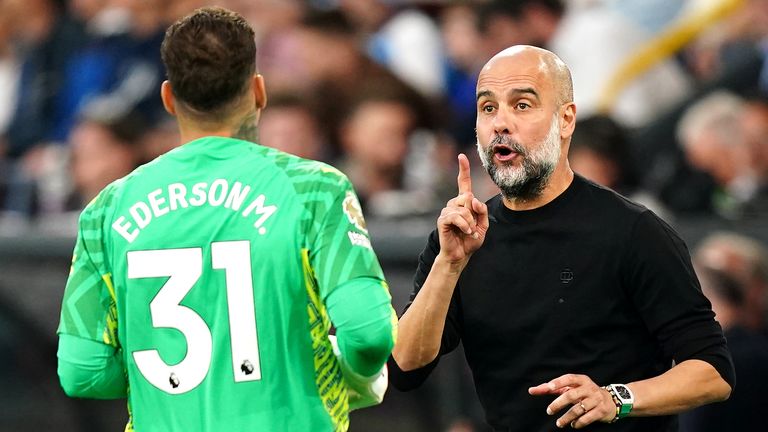
Ederson was a key part of Pep Guardiola’s treble-winning Man City teams
Hart was a two-time title-winner with nearly 350 Manchester City appearances behind him. But he lacked the technical security to play for Guardiola. His removal for Claudio Bravo, and subsequently Ederson, highlighted changing priorities in his position.
Under Guardiola, the number of successful goalkeeper passes in Manchester City’s half trebled in the space of two seasons, from seven per game under Pellegrini, to 19 in Guardiola’s first campaign in charge, and 21 per game in his second. Their average climbed to a high of 27 per game in 2023/24.
The wider uptake was not immediate. There was only a small increase in goalkeeper passes in the defensive half across the rest of the Premier League from 2015/16 to 2017/18. But the average rose incrementally after that as clubs sought ball-playing goalkeepers.
The Premier League average for goalkeeper passes in the defensive half peaked in the same season as Manchester City’s, at 19 per game in 2023/24, a 140 per cent increase from the average of eight per game in 2016/17. The interactive graphic above shows goalkeeper passing accuracy rates followed a similar trajectory.
Jamie Carragher and Patrick Vieira reacted to reports of Pep Guardiola leaving Man City this summer on Monday Night Football
Hart was the first high-profile casualty but there were plenty more to come, including Manchester United’s David De Gea, whose perceived inability to play out from the back, in the style popularised by Guardiola, eventually saw him replaced by Andre Onana, whose distribution was cited as being key to his appeal.
Pressing matters
Guardiola had an immense influence on how teams in England set up off the ball as well as on it. Co-ordinated, man-to-man pressing high up the pitch was key to his philosophy and became crucial up and down the Premier League as a means of disrupting build-up play.
By 2019/20, Manchester City were averaging just under 10 high turnovers per game, up from under eight in Pellegrini’s final season. Again, the Premier League average trended in the same direction.
A high press requires a high line in order to restrict the space available to opponents between the lines. Manchester City immediately started playing higher up the pitch under Guardiola, as shown by their start distance, which measures how far a team’s passing sequences begin from their own goal on average.
The graphic above shows the steady increase to Premier League start distances as well as high turnovers during Guardiola’s tenure as clubs embraced pressing to counteract the growing popularity of playing out from the back, before the subsequent shift that saw the tactical landscape move again.
Embracing directness and physicality
Guardiola has always seen himself as a pragmatist rather than an idealist. “My tactics adapt to the qualities of my players,” he said at his unveiling as Manchester City manager in 2016.
That pragmatism has come to the fore in the latter years of his tenure. Manchester City remain a primarily possession-based side capable of using short passing combinations to play through opponents. But they have also developed other ways of beating man-to-man marking systems, their threat diversified.
The signing of Erling Haaland marked a dramatic shift from the false nine model Guardiola previously favoured and gave Manchester City an invaluable outlet for direct play and fast breaks as the physicality of the Premier League, and the sophistication of opposition man-to-man marking systems, began to ramp up.
City have averaged less possession, and fewer passing sequences, than in any previous season under Guardiola this term. Meanwhile, their numbers for quick attacks have trended upwards as Guardiola emphasises transitions over intricate build-up play, and one-v-one specialists such as Antoine Semenyo and Jeremy Doku over passers.
There is little doubt that Guardiola’s arrival at Manchester City prompted a wider shift towards his way of playing in England, but more recent move away from those principles appears reactive. “You can complain, or you have to adapt,” as Guardiola put it recently.
Guardiola’s willingness to adapt may have encouraged others to do the same, but it is difficult to be sure. What is certain, as he brings down the curtain on his Manchester City tenure, is that his arrival inspired change in English football like no other manager.