One Nation has vowed to replace the contentious offshore gas profits tax and acquire 30% equity stakes in new ventures under an interventionist policy designed to extract “vastly greater returns” for Australian taxpayers from the resource.
The proposal for the commonwealth to co-own gas projects drew a mix of criticism and cynicism from the government, industry and the Coalition, which accused One Nation of importing ideas from Venezuela.
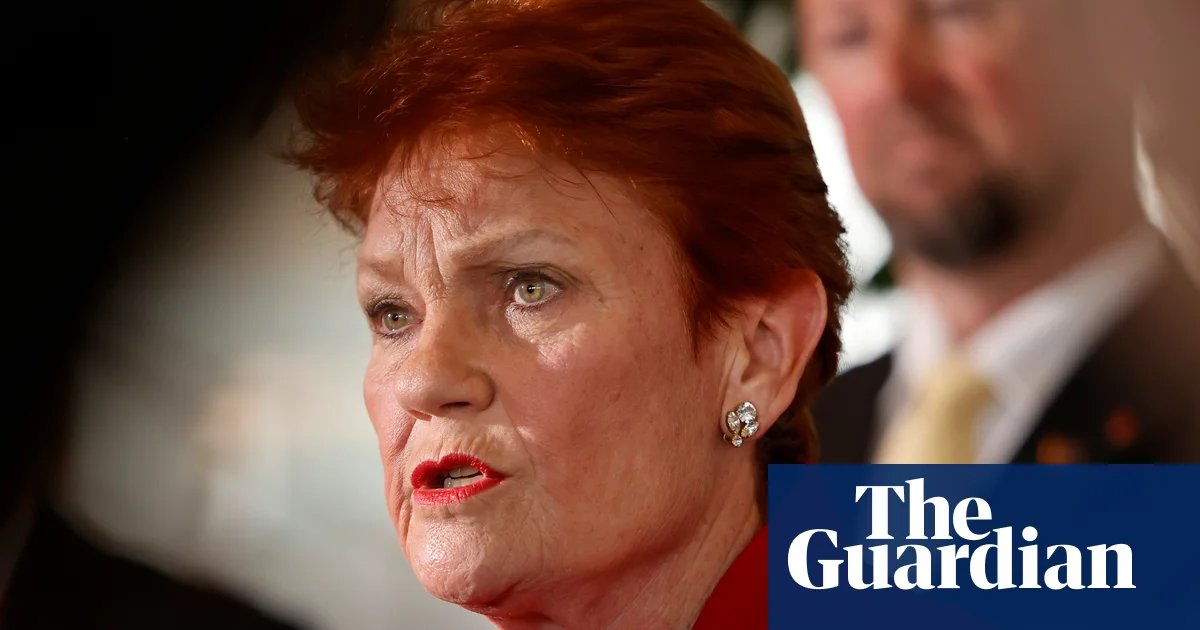
Pauline Hanson used a speech to a major gas industry conference in Adelaide on Thursday to detail a policy first flagged on the night of One Nation’s win in the Farrer byelection.
Hanson said the public was “rightly unhappy” and “public unrest is building” about the return to taxpayers from Australian oil and gas sector, voicing the same concerns as the broad coalition of groups campaigning to replace the petroleum resource rent tax (PRRT) with a 25% export levy.
The One Nation leader criticised a 25% export tax as “economism vandalism” despite some opinion polls suggesting supporters of her rightwing populist party back the idea.
Instead, she proposed abolishing the PRRT – which she described as a “failure” – and introducing a royalty regime for new projects.
Appearing in a room of gas industry executives in Adelaide, Hanson also announced a Norway-inspired proposal to acquire equity stakes in new ventures and stash the profits in a sovereign wealth fund.
Under the proposal, the government would offer companies a 30% rebate on the cost of exploration in commonwealth waters in exchange for taking an equity stake of up to 30% in the operation.
The arrangement would give taxpayers a share in potential profits but also expose them to financial risks, which could last decades given One Nation has proposed co-ownership would start at exploration and continue until a project is decommissioned.
It typically takes more than a decade for a project to progress from exploration to production, meaning taxpayers would not get an immediate return.
The government’s stake would be overseen by a new commonwealth investment body.
One Nation has just two lower seats in federal parliament but has been surging in the opinion polls, resulting in more attention and scrutiny of its policies.
Speaking before Hanson’s address, Liberal frontbencher James Paterson said he was sceptical about government-owned oil and gas companies.
“I mean, that is a policy borrowed from Venezuela and Hugo Chávez, not Australia,” Paterson told Sky News.
“Of course I understand the principle that Australians want to get better return on our natural resources, that’s a reasonable principle, and we can have a debate about the details of tax policy, but nationalising our oil and gas industry I don’t think is the answer.”
Hanson denied the proposal was a “socialist takeover”, insisting the government investment body would not have a day-to-day role in running the partner gas company.
The One Nation leader said there had not been any pushback from industry during private briefings on the proposal. She said mining billionaire Gina Rinehart wasn’t consulted.
Australian Energy Producers – the peak industry group and host of Thursday’s event – welcomed Hanson’s support for the oil and gas sector in a statement that defended the amount of tax it contributes.
“As the recent federal budget confirmed, our existing tax system is already working as intended, delivering more tax revenue when international oil and gas prices are high,” said AEP chief executive, Samantha McCulloch.
But the Minerals Council of Australia (MCA) – which represents the wider mining sector – opposed government equity stakes in a “mature” industry such as the oil and gas sector.
“It doesn’t work. You start these things for fledgling industries, you don’t start it halfway through when we’ve got a mature industry. So generally, I think equity in projects is not the way to go,” said MCA chief executive, Tania Constable.
The resources minister, Madeleine King, made a similar argument when asked about Hanson’s proposal.
“The best time for Australia to have invested in that part of the [gas] industry was 30 or 40 years ago. So that moment has passed. We cannot go backward,” she said.
“Also, I think there would be many people in the country that don’t think Australia, an Australian government, should invest in the gas industry given the capital that it is able to bring to bear on projects.”
In his speech to the AEP conference, the opposition leader, Angus Taylor, renewed his commitment to abandon a net zero emissions target, scrap the safeguard mechanism and promote more “digging and drilling” to achieve what he describes as “energy abundance”.
Taylor urged the oil and gas industry to “start making noise” and fight their detractors as he reaffirmed the Coalition’s opposition to a 25% export tax.
“The Coalition can’t take the fight up for your sectors alone. You need to start making noise. You need to use every campaign tool at your disposal – especially social media. Push back against your detractors,” he said.