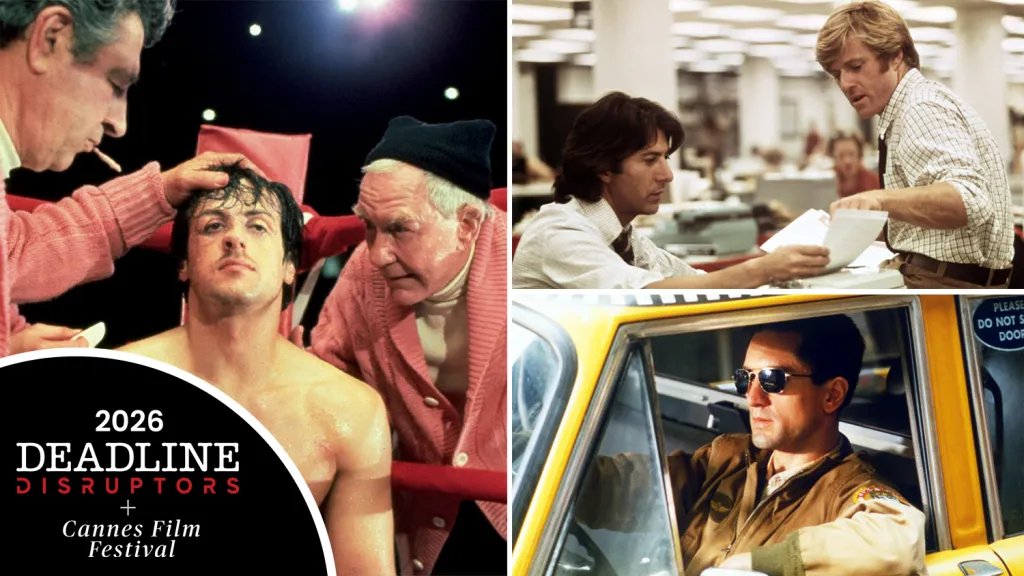
There was a lot going on in 1976. Underdog Jimmy Carter beat Gerald Ford for the presidency, China’s Chairman Mao Zedong died after 27 years in charge, and Australia passed the Aboriginal Land Rights Act, the first legislation in Australia that enabled First Nations people to claim land rights. While a heatwave swept Europe, pop culture caught fire; Abba put out “Dancing Queen”, The Eagles released their Hotel California album, and, in the year’s last month, The Sex Pistols cursed live on British TV.
But cinema was something else. People still talk in hushed tones about the Oscars that followed, where, for once, five stone-cold American classics made Best Picture: Taxi Driver, Rocky, All the President’s Men, Network and Bound for Glory. It was a glorious year for upsets and firsts; Martin Scorsese was snubbed, neither Dustin Hoffmann nor Robert Redford were even nominated for Best Actor and lost to the recently deceased Peter Finch. With “Evergreen”, from The Way We Were, Barbra Streisand became the first woman to win an Oscar for composing, and Italy’s Foreign-Language entry Seven Beauties made Lina Wertmüller the first woman nominated for Best Director.
Cannes, meanwhile, was just as eventful. Scorsese had gone home to New York and was in bed when he heard that Taxi Driver had won the Palme d’Or, despite the furious objections of jury president Tennessee Williams. Bernardo Bertolucci unveiled Robert De Niro’s other film in the official selection — his five-hour historical epic 1900 — and the master, Alfred Hitchcock, closed the festival with what would turn out to be his last film, Family Plot. In a special three-part series — including All the Presidents’ Men and Rocky — Deadline is looking back a half-century to 1976, an incredible year for movies.
Robert De Niro in ‘Taxi Driver.’
Everett Collection
TAXI DRIVER
The first of two collaborations between Martin Scorsese, Robert De Niro and screenwriter Paul Schrader, Taxi Driver is widely considered a groundbreaking ’70s film, just as the second effort by the trio, Raging Bull, is symbolic of the best cinema of the ’80s.
Still, Schrader was not surprised that Taxi Driver was ignored on Oscar night, or even that neither he nor Scorsese were nominated. And he was not surprised that it came out on the losing end for Best Picture, Best Actor for De Niro, Best Supporting Actress for Jodie Foster, and Best Original Score, which Bernard Herrmann recorded shortly before his death. This despite rapturous reviews from influential critics like Roger Ebert and Pauline Kael, and its having won the Palme d’Or at Cannes. Schrader didn’t attend the Oscars — he was directing another film.
Columbia Pictures, in fact, was caught off-guard when it started doing it as well as it did. They had written it off as an outlier and that’s why they didn’t market test it or put marketing behind it.
Pau Schrader
“I wasn’t a bit thrown that Taxi Driver did not win,” Schrader says now. “If you look at that category of Original Screenplay, it probably was the most original screenplay of that year, but it was just too controversial. Columbia Pictures, in fact, was caught off-guard when it started doing it as well as it did. They had written it off as an outlier and that’s why they didn’t market test it or put marketing behind it. It was one of those scripts that banged around town where everybody said someone else should make it, but not us.”
Then Julia Phillips wrote David Begelman a letter. Phillips, who produced the film with her husband Michael, dared the executive to get behind it as the studio’s art film, with an admonition: “Julia made the argument that everyone involved was young, and they were all going to have careers, and if you make this film, they will all will owe you a favor. And she was right. She and Michael produced Close Encounters of the Third Kind, and they moved it from Universal to Columbia, all because David said yes to Taxi Driver.”
Schrader figured All the President’s Men would own Oscar night, though he saw Network and Paddy Chayefsky as the last gasp of an era of filmmaking that was ending, with Taxi Driver symbolic of a new era and energy.

Martin Scorsese with Jodie Foster and De Niro at the Cannes Film Festival in 1976 for the screening of ‘Taxi Driver.’
GINFRAY/SIMON/Gamma-Rapho via Getty Images
“[The Oscars] is a beauty contest,” Schrader says. “I remember saying this years ago to Marty, when he didn’t get an Oscar. I said, ‘Marty, if your priority is to get an Oscar, you need some f*ucking new priorities. Because the depths you have to sink to, to prioritize that award, it’s not worth it.’ Honestly, to me the only way you could have gone wrong was to give the Oscar to Rocky.”
Schrader said the Rocky Balboa saga lost him when they gave the character pet turtles. Balboa was an enforcer for loan sharks and unlike Taxi Driver’s edgy vigilante Bickle, Rocky was a terrible leg breaker, never hurting anyone outside the ring.
“When I saw Sly with that goldfish bowl and the turtles, I hit the roof in the theater,” Schrader said. “It just undermined the whole movie for me, and it felt like a cheap ploy to make Rocky more likeable, humane and identifiable because he had those f*ucking turtles. It felt calculated to win the audience and raise the test marketing scores. The level of manipulation just seeped through your body as you watched. Taxi Driver did not go through that card system because we knew how the cards would come back. Why deal with that?”
All the President’s Men was calculated in a different way — one that Schrader admired.
“It was a kind of perfect synchronicity between what art can do and what political action can do,” he says. “I don’t even know whether you could get away with that today, in the Trumpian era, make a film that popular and that critical and have everybody treat it as mass entertainment rather than something divisive. All the President’s Men was not divisive.”
He also admired Hal Ashby’s Woody Guthrie tale Bound for Glory, the least-remembered film in the Best Picture category that year.
“[DP] Haskell Wexler’s work was remarkable, and they broke in the Steadicam with that film. Between that and Rocky, which also used it, filmmaking changed when you could just follow people around with the camera.”
De Niro and Scorsese on set.
Schrader is content with the memory of his own work that year, which was informed by his own difficult journey and borrowed inspiration from films like The Searchers, Vertigo and Obsession. Also key were the diaries of Arthur Bremer, whose 1972 assassination attempt left Alabama governor and presidential candidate George Wallace paralyzed from the waist down. While Wallace was a polarizing segregationist, Bremer’s motivation was to get famous, having previously stalked President Richard Nixon. Also on Schrader’s mind was Sara Jane Moore, whose attempt at shooting President Gerald Ford put her on the cover of Time magazine and Newsweek.
“I remember seeing those covers and thinking, ‘All you have to do is take a shot at the president to become famous,’” Schrader says. “‘God, that’s how easy it is to become a celebrity and a star? The temptation must be enormous.’ That was part of the germ of the idea of how it moved from a story of loneliness, of self-absorption, to something larger.”
All three of us, we knew this character, so it wasn’t like us sitting down in a room and saying, ‘Who is this guy?’
Paul Schrader
Bickle’s evolution — from Vietnam vet to a cab driver who worked nights when a crumbling Manhattan was at its worst — was inspired by Schrader’s own personal plummet, which started in LA when he clashed with AFI founder George Stevens and got drummed out. In short order, Schrader’s first marriage ended, as did a film reviewer job at the LA Free Press after he panned Easy Rider. He found himself a twentysomething drifter on the streets of New York, often sleeping through all-night shows in porn theaters, and being hospitalized with a bleeding ulcer. Yellow taxis were everywhere, and Schrader saw them as coffins, with drivers who traversed the sewer that was ’70s NYC, being around people, but feeling as alone as Schrader himself felt. He turned it all into a script that impressed Brian DePalma enough to give it to Scorsese, who sparked to the ferocity of Schrader’s writing and made Taxi Driver his follow-up to Mean Streets, shooting it in the sweltering summer Gotham heat.
Schrader recalls that “there wasn’t a lot of communication” between De Niro, Scorsese and himself. “I mean, all three of us, we knew this character,” he recalls, “and so it wasn’t like us sitting down in a room and saying, ‘Who is this guy?’ Bob knew who he was, I knew who he was, Marty knew who he was, and we all had our views on him.”
Read the digital edition of Deadline’s Disruptors/Cannes magazine here.
The biggest challenge: the studio pushed them to make Iris’s pimp white. “They said we would have a riot in the theater if he appeared to be a racist who only kills Black people,” Schrader said. “That was fine with Marty, who wanted to give Harvey Keitel the lead, until everybody realized Bob was much better for it. He had a role to give Harvey, but then Keitel wanted a prototype and Schrader was sent on a search through Manhattan and Harlem to find a white pimp. He says, “I was told there was one over on 103rd St. and 4th Avenue, and was told another operated from 122nd Street. Well, there never was a white pimp, and Keitel had to make it up himself.”
That search for the Great White Pimp led Schrader to a pimp bar where he met a heroin addict and sex worker named Garth Avery. “She was Iris,” he recalls. “Everything Jodie did in that movie, that girl did over breakfast in a diner in a diner where we met. Marty had hoped to use her in another film, but she fell back into addiction and died a few years later.” Avery informed Foster’s performance so much that Scorsese put her in the film — she is Iris’s companion as Bickle observes and befriends her.
As for the rough road that led to a classic film, Schrader says, “I think that is where originality comes from in movies. It comes from experience.”