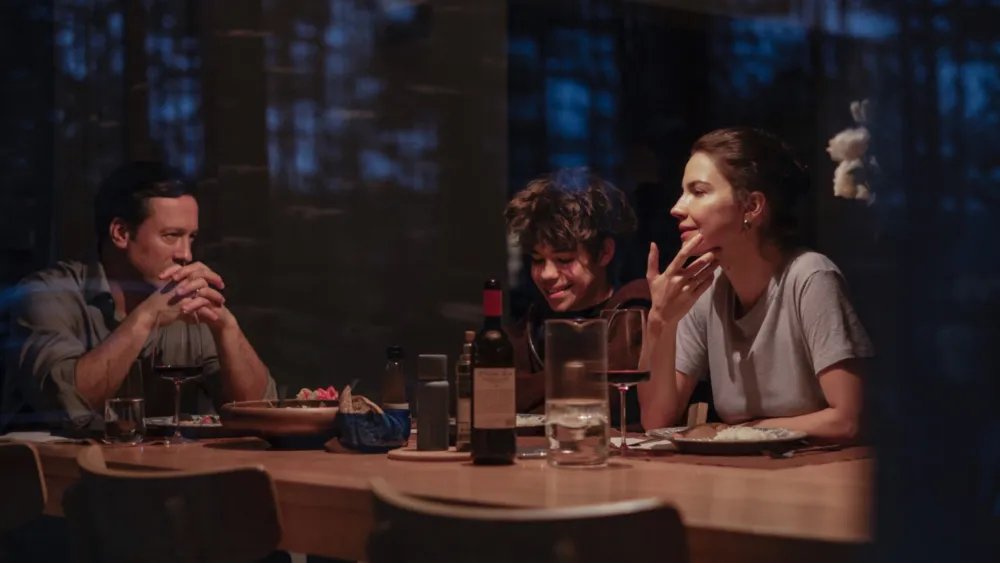
Nearly a decade after his last film, “Loveless,” won the Jury Prize at the Cannes Film Festival, two-time Academy Award nominee Andrey Zvyagintsev (“Leviathan”) returns to the Croisette with “Minotaur,” a modern-day parable about the emotional and moral collapse of a Russian businessman whose world unravels amid professional crises, global chaos and an extramarital affair. Zvyagintsev, who survived a near-death experience during the coronavirus pandemic, spoke to Variety about his latest Palme d’Or contender.
You’ve been living in Paris for nearly four years since recovering from a life-threatening illness. Was that a political choice?
I spent almost one year in a clinic in Germany, where after spending 40 days [in a medically induced] coma I was not able to stand up. When I left the clinic, I moved to France and I decided to stay in France. And more and more, I’m convinced that I should stay here. I have no desire and no interest and no intention to live in a country that’s at war with its neighbors.
Do you see yourself returning to Russia someday?
[Nobel Prize-winning Russian journalist Dmitry Muratov] said there is a choice: to stay with your motherland but to lose your freedom, or to stay with your freedom but to lose your motherland. My intention is very visible because my actions speak more than my words. I think there is no need to speak about this. There is no need to pronounce anything. I think it’s very important to act and not to talk. My actions are my language, and my language is cinema.
Is that why you filmed “Minotaur” in Latvia?
We couldn’t film in Russia, so the only option was to go to Latvia. From an architectural point of view, it was the best choice.
What can you tell us about the events that inspired the film?
The main dramatic part takes place in September 2022, when Russia announced a military draft [ahead of the February 2023 full-scale invasion of Ukraine]. So many people left the country for Kazakhstan, Armenia, Georgia. People were running away. In the movie, we witness the political and social divisions that create two different groups in society. But I don’t want to say more or explain the film to the audience. I dream that the audience enters the theater knowing absolutely nothing about the movie.
For the past two decades, you’ve chronicled the social and political ills of Russia under President Vladimir Putin. How would your filmmaking change if you decided not to go back?
I already feel the distance between me and Russia. I feel that I’m observing everything through some sort of cloudy lens. As time goes by, maybe I would not know exactly what the reality of Russian life is. But I am not afraid to keep making movies on the topics that concern me.
Such as?
One of the ideas I have is about Greece 2,500 years ago. I only know from Plato what Socrates was talking about. But my movies are about human beings, and once there is a human being at the center, the topics will always be the same. It doesn’t matter which country they are in.
Did facing your mortality change you in any way?
I became lighter. Everything became easier, because I know the light can go out at any second. We don’t really have much time. After this experience, I became even more daring. I became even more radical with my expectations. I became even hungrier. I want to move faster. I want to do one project after another. I understood that you just have to be brave. It’s easy to say, but it’s hard to do.