
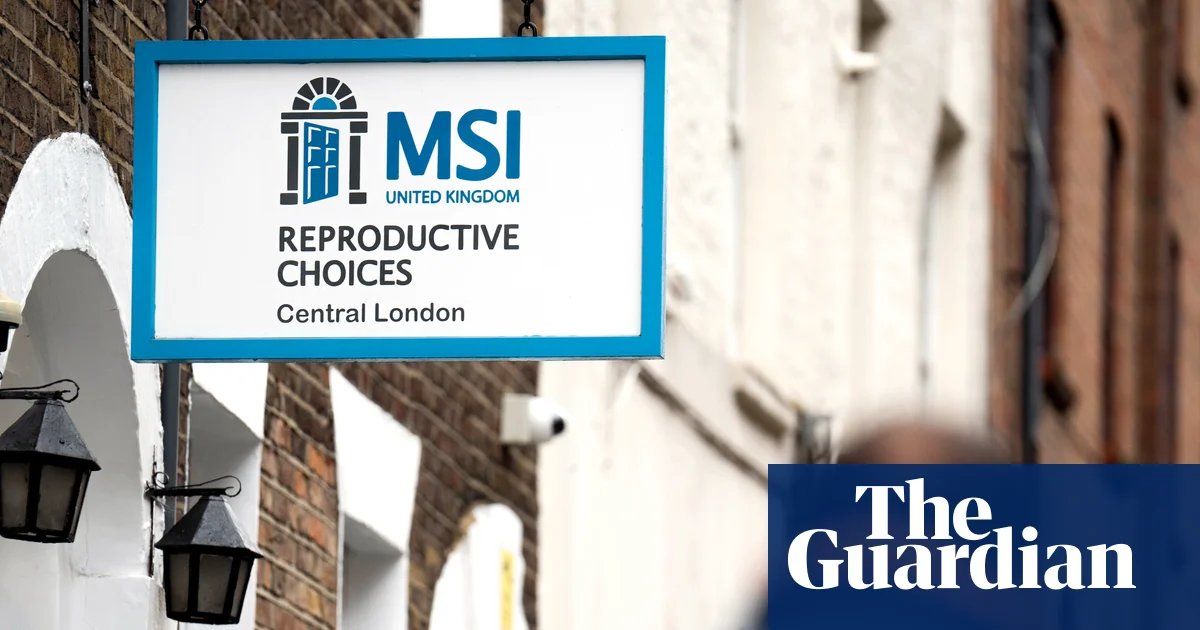
New polling has found that whatever their party political leanings, an overwhelming majority of people support the right to access an abortion – although young people, in particular, fear reproductive rights may be reduced.
The YouGov polling, commissioned by MSI Reproductive Choices to mark its 50th anniversary, found nine in 10 people support the right to access an abortion.
This was the case with 94% of Labour voters, 91% of Conservative voters, 95% of Green voters and 86% of Reform voters, pointing to one of the clearest indicators of cross-party political consensus in the UK.
The survey also found almost one in five people think abortion access could be reduced, rising to more than a quarter of 18- to 25-year-olds. Respondents cited developments in the US and the rise of the far right as factors.
Katie, 28, moved to the UK from Nebraska soon after the US supreme court overturned Roe v Wade, removing the federal right to abortion.
Katie said: “When that decision was overturned, it fundamentally changed how I saw my future in the country. It felt like a clear signal that even deeply personal medical decisions were no longer protected. That loss of autonomy played a major role in cementing my decision to move to the UK.
“My experience here has been very different,” she added. “I feel genuinely cared for by the healthcare system in a way I never did in the United States. That sense of security and support has made a meaningful difference in my life.”
While abortion is often seen as a taboo subject, the polling found that more than two-thirds of people said they were comfortable discussing their views on abortion, rising to three-quarters among young people.
Daisy Roscoe, 23, from London found out she was pregnant eight months after having a baby last year.
“I had a difficult pregnancy with my daughter,” she said. “Being pregnant is different for everyone and it’s not something you should feel obligated to go through.
“A lot of the women in my family have had abortions but I’m the first person to keep a pregnancy and have an abortion in my friend group,” she added. “I was really clear with all my friends that this was my choice. I invited the women around me to ask me questions. I was clear about what happened, the process and what happened afterwards. We feel comfortable sharing information about pregnancy so why would we not speak openly about abortion?”
However, Roscoe also said she was “very concerned” about news coming from the US about reproductive rights.
“It’s definitely my age group where I see a lot of worry about reproductive rights and fears around US politics bleeding into the UK,” she said.
Sophie Verstraeten, 27, lives in south London. She has been in a relationship for nearly nine years and has always known that she and her partner did not want children.
“A lot of my friendship group are male. I was open with all of them about having an abortion and they were so supportive,” she said. “They all responded asking if there’s anything that they can do. They knew I was supported in my relationship but there was no hesitation that they would be available if I needed them at any point too.”
She added: “I feel hopeful about the future of reproductive rights here, but it’s important to not be complacent. You still need to be aware of what’s going on in the world. Until you’re in that situation, you don’t know how you’re going to feel. There are so many unknowns.
“That’s why it’s important to talk about our experiences with abortion. I can’t imagine it being a part of my life that I don’t talk about. So many people have abortions, so I don’t understand why we can’t talk about it like other medical procedures.”
Louise McCudden, the UK head of external relations and advocacy at MSI Reproductive Choices (formerly Marie Stopes International), said the findings “remind us that people are united on abortion” and that it has “become a mainstream, openly discussed part of life”.
McCudden said:“Over the past 50 years, we’ve seen a clear arc of progress towards greater openness and understanding, yet the loud anti-abortion minority get a disproportionate amount of attention in public debate. These findings show that anti-abortion views are far from mainstream.
“Nine in 10 people in this country are pro-choice, and one in three women has an abortion in her lifetime,” she added. “At a time of global attacks on reproductive rights, most notably in the United States, we can be proud that there are MPs from all major parties who have voted to improve our Victorian abortion laws, to protect abortion clinics from harassment through safe access zones, and to protect telemedicine.”


