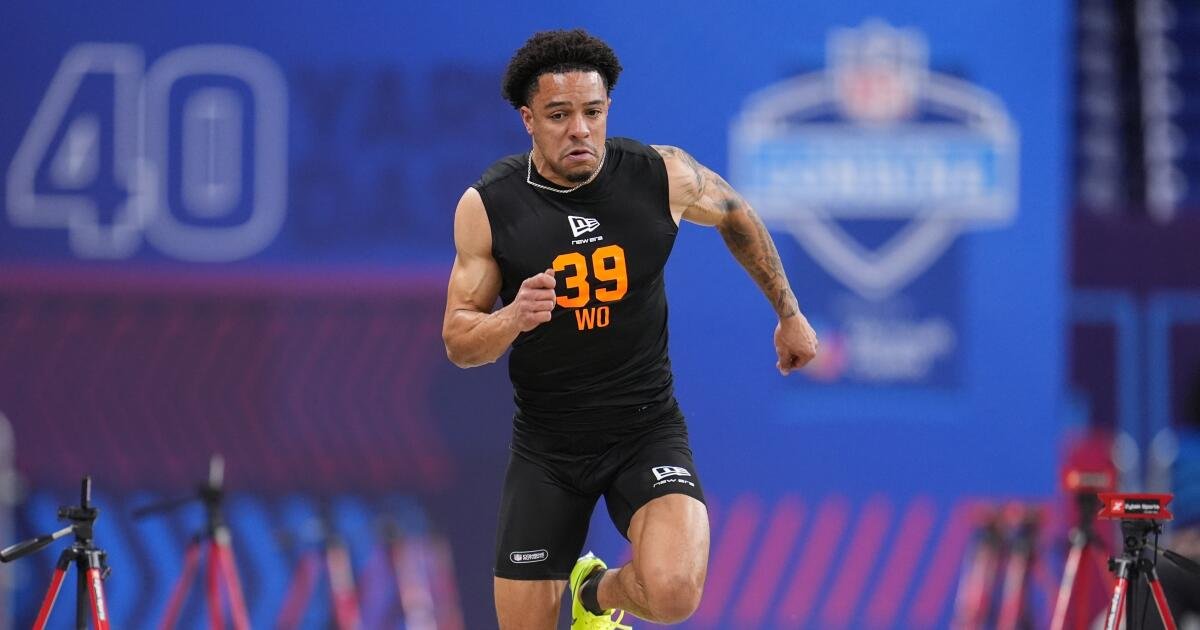
Brenen Thompson is from Spearman, Texas, at the top of the panhandle, where the gusts are constant and the only tourist attraction is a collection of old windmills.
Have you checked out Thompson’s speed numbers?
Prepare to be blown away.
Thompson, newest receiver for the Chargers, ran the 40-yard dash in a forehead-slapping 4.26 seconds — a mere .04 off the NFL combine record. What the former Mississippi State star lacks in size — he’s a shade under 5 feet 10 and 164 pounds — he makes up for in an ability to almost teleport from one spot to another.
Not the biggest position of need for the Chargers, who took him in the fourth round, but a nifty weapon for new offensive coordinator Mike McDaniel, who in the past has drawn up schemes for such scorchers as Jaylen Waddle, Travis Benjamin and Tyreek Hill.
Now, for the plodding part. OK, the Chargers didn’t race to the podium to select offensive linemen — their undoing last season — but they have remade their offensive line anyway.
First, they’re getting back Pro Bowl tackles Rashawn Slater and Joe Alt, who missed all or most of last season with leg injuries; signed center Tyler Biadasz and guard Cole Strange in free agency; and drafted Florida center Jake Slaughter in the second round, with the idea of him playing guard.
So if the plan works out, the Chargers will start five linemen who weren’t even in uniform for them for the January playoff loss to New England. Good thing, because that injury-ravaged line was a fire-drill mess last season.
In years before the Jim Harbaugh regime, the Chargers didn’t embrace the notion of trading down for more picks. But general manager Joe Hortiz likes doing that, and turned what would have been a quiet weekend — two selections on Day 3 — into a six-pick bonanza.
The club took Memphis tackle Travis Burke in the fourth round, presumably adding depth at the position because he’s not the type of player who is going to move inside to guard (and he’s almost certainly not going to unseat Slater or Alt). Depth is good at that spot, because as the Chargers were reminded last season, you’ll sooner find a stray $100 bill on the street than a capable NFL tackle.
The Chargers rounded out the draft by selecting a pair of guards in the sixth round, Logan Taylor of Boston College and Alex Harkey of Oregon. Whereas Taylor was a four-year starter, Harkey started one season at right tackle for the Ducks — he bounced from Colorado to Texas State to Oregon — and projects as an interior lineman in the pros.
Oregon’s Alex Harkey is among the four offensive linemen the Chargers selected in the 2026 NFL draft.
(Mark Ylen / Associated Press)
With the third of their four fourth-rounders, the Chargers took Arizona safety Genesis Smith. He has the cover skills and range to play the deep part of the field, and he’ll be learning from the best in All-Pro Derwin James Jr. Harbaugh is constantly saying, “Competitors welcome,” and Smith figures to be just that. If there’s trust on the back end, James can move up closer to the line of scrimmage to make plays and wreak havoc.
If a player is especially tough and violent on the field, the Chargers will affix a magnetic hammer sticker next to his name on the draft board. That’s what they did with South Carolina defensive tackle Nick Barrett, their final pick of the fourth round. The team typically carries five or six defensive linemen, and Barrett joins a group that includes Teair Tart, Jamaree Caldwell and Dalvin Tomlinson.
The Chargers already ramped up their pass rush by selecting Miami’s Akheem Mesidor at No. 22, a player widely projected to be off the board by then. Doesn’t matter the division, a strong pass rush is always essential. But having that in the AFC West, with Kansas City’s Patrick Mahomes, Denver’s Bo Nix and No. 1 pick Fernando Mendoza heading to Las Vegas, turning up the heat on quarterbacks is especially important.
Mesidor, who began his career at West Virginia and finished at Miami, was among the oldest players in the draft at 25. Some saw his age as a negative.
“I’ve been doubted my whole life. I’m ready to come in and earn the respect of my teammates and my coaches and compete,” he told reporters. “The age stuff, any of the negativity that people push into the media about me, is all out the window. It does not faze me, I’m here to play football.”
In the NFL, you can never have enough good pass rushers, and the team that winds up winning the Super Bowl is often the one at or near the top in getting to the quarterback. But first things first. The Chargers have to win a playoff game, something they haven’t done in two seasons under Harbaugh and six with Justin Herbert at quarterback.
Thompson could help in that regard. The Clarion Ledger in Jackson, Miss., told this story last year: When the future Chargers wideoout was 6, his mother signed him up for flag football in Texas.
She told her young son that she would reward him with $1 for every flag he grabbed, and $5 for every touchdown he scored. After the first game, the two had to make a trip to the ATM.
After all, who has $65 at the ready?