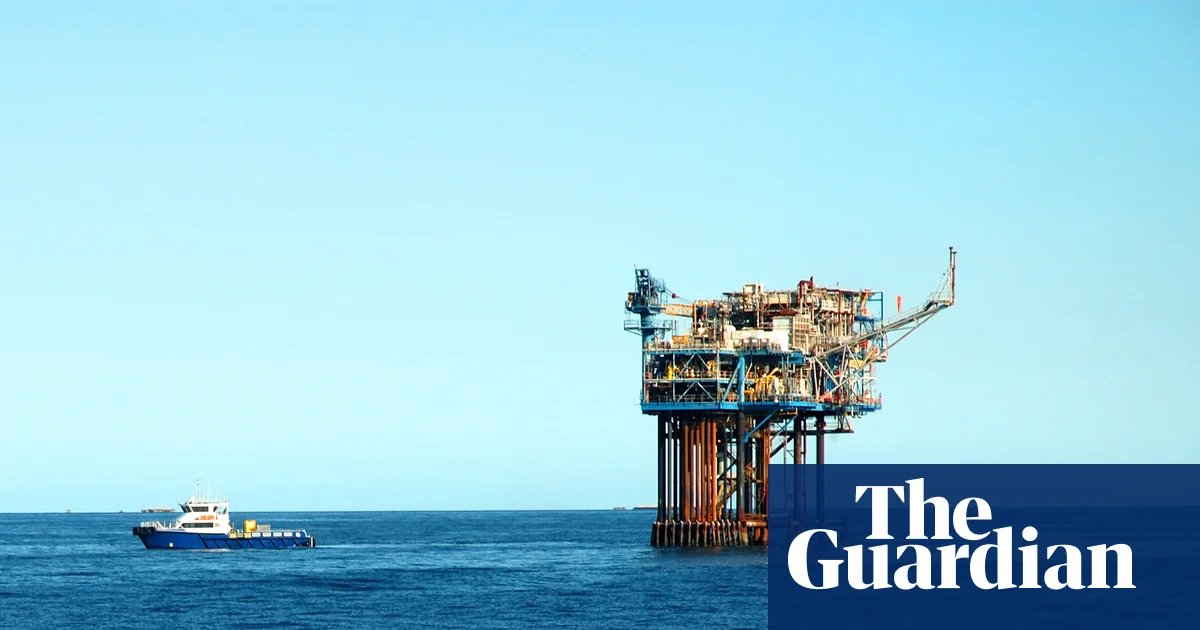
A new gas drilling project approved for Victoria’s Otway basin will make “the path to a safe climate harder” and put a “pristine ocean environment” at risk, environment groups have warned.
The federal and Victorian governments on Thursday announced they had greenlit the production licence for Amplitude Energy’s Annie gasfield project in the Otway basin, which expects to start producing gas by 2028.
The project is located about 9km off the shores of Peterborough and Port Campbell, on the Great Ocean Road, which is about 12km west of the Twelve Apostles, a popular tourist attraction.
The state’s energy and resources minister, Lily D’Ambrosio, said the project had the potential to provide up to 65 petajoules of gas – or more than a third of Victoria’s annual gas use.
She said while demand for the fossil fuel is “decreasing as people move towards electrification”, the gasfield would ensure there was “enough gas in the system for those industries that can’t electrify”.
It is the second major gas project Labor has approved this term and follows the 2022 election where then-premier Daniel Andrews campaigned heavily on reviving the State Electricity Commission to accelerate the renewable energy transition and achieve a target of 95% renewable energy by 2035.
Greenpeace Australia Pacific’s head of climate and energy, Joe Rafalowicz, said the Otway project “risks our pristine ocean environment and climate”, while Environment Victoria’s climate campaign manager, Joy Toose said it would “only set back progress on the clean energy transition under way” in the state.
“Projected emissions from existing and planned fossil fuel developments have already used up the carbon budget to limit global heating to 2C,” Toose said.
“Every new gasfield approved makes the path to a safe climate harder and more expensive”.
Alison Reeve, energy and climate program director at the Grattan Institute, said shifting away from gas made sense, but that there was “also an industrial base in Victoria that will have a harder job moving away from gas”.
Victoria is Australia’s largest user of gas, which is used heavily in the manufacturing sector and for heat generation in industrial processes.
The Australian Energy Market Operator in March pushed back its peak-day gas shortfall forecast a year to 2029, citing new infrastructure, increased supply and reduced consumption had helped to bolster supplies.
Thursday’s announcement comes as the Victorian Coalition said that if elected in November it would pause and review all major transmission line projects – which connect renewable energy to the grid – as well as the state’s renewable energy zones – six areas identified as ideal for hosting projects.
The opposition’s pause would include both the VNI West, a proposed 240km transmission line linking Victoria to New South Wales, and the Western Renewables Link it will eventually connect to, which links Bulgana in western Victoria to Sydenham in Melbourne’s north-west.
Nationals leader Danny O’Brien told reporters on Thursday VNI west had “completely lost social licence”, thanks in part to “draconian laws” passed by the government last year to allow government agency VicGrid and its contractors access to private land – without a landholder’s consent.
Instead, the opposition are proposing creating “urban solar parks” to encourage solar and battery installations on commercial and industrial rooftops in greater Melbourne.
“There are thousands of hectares of roof space on warehouses, factories, buildings in urban areas where we can be putting up solar farms with battery power and using the energy closer to where it’s stored. That also reduces the need for additional transmission lines,” O’Brien said.
But Reeve said increasing rooftop solar wasn’t a viable replacement for building transmission lines and that adding solar to commercial buildings and warehouses was often impractical because “a lot of the time those buildings were not engineered to have a lot of weight on the roof”.
“A system that is resilient has a mix of everything – you have wind, you have large-scale solar, you have small-scale solar, you have batteries, you have pumped hydro, you have a little bit of gas as well,” she said. “The thing that hooks all of those things together is transmission.”
Building new transmission lines from renewable energy sources – the cheapest electricity generation alternative to ageing coal-fired power stations – were critical “so that electricity can get to where the users actually are,” Reeve said.
Toose criticised the opposition’s plan, saying it would “strangle Victoria’s renewable energy industry and drive up power bills for every household and business in the state”.
Victorian Greens leader Ellen Sandell, commenting on both Labor’s new gas field and the Coalition’s transmission lines plan, accused the major parties of choosing “their fossil fuel corporation mates over the future of Victorian people and our environment”.