The mother of Kumanjayi Little Baby has directly asked politicians not to use the death of her daughter for “reasons that do not honour and respect my baby girl”.
In a statement read out by the minister for Indigenous Australians, Malarndirri McCarthy, in a condolence motion for the five-year-old Warlpiri girl in the Senate on Tuesday, the girl’s mother, who has not been named for her own safety, asked that her child not be used for political gain.
“I want you all to know that my heart is broken into a million pieces, and I want you to know that I am having trouble knowing how I can repair it and how I can live without my baby girl,” the statement said. “She loved cuddling puppies, she loved watching Bluey and Masha and the Bear.
“She was my little princess. My princess, who loved the colour pink. She also loved the colours of the rainbow.
“For all these reasons I ask that her short life not be used by any politician for reasons that do not honour and respect my baby girl.”
Kumanjayi Little Baby was found dead in Alice Springs last month, after a five-day search. A 47-year-old man has been charged with her alleged murder and two other offences that cannot be disclosed for legal reasons.
Her family has repeatedly asked for privacy while they conduct sorry business. In the meantime, the Northern Territory government has announced plans for an inquiry into the child protection system, while conservative politicians, including former prime minister Tony Abbott, have called for an inquiry into the conditions at the town camps and Indigenous-owned public housing in Alice Springs.
McCarthy, who joined hundreds of community volunteers in the search for the child, introduced the condolence motion and paid tribute to Kumanjayi Little Baby and her family.
The prime minister, Anthony Albanese, also made a statement in the lower house about the death, saying Kumanjayi Little Baby was “profoundly and deeply loved” by her family and her death had “shattered a family and shaken a community”.
“The simple truth is that all governments of all persuasions over generations, have not done enough to deal with what are generational challenges,” Albanese said.
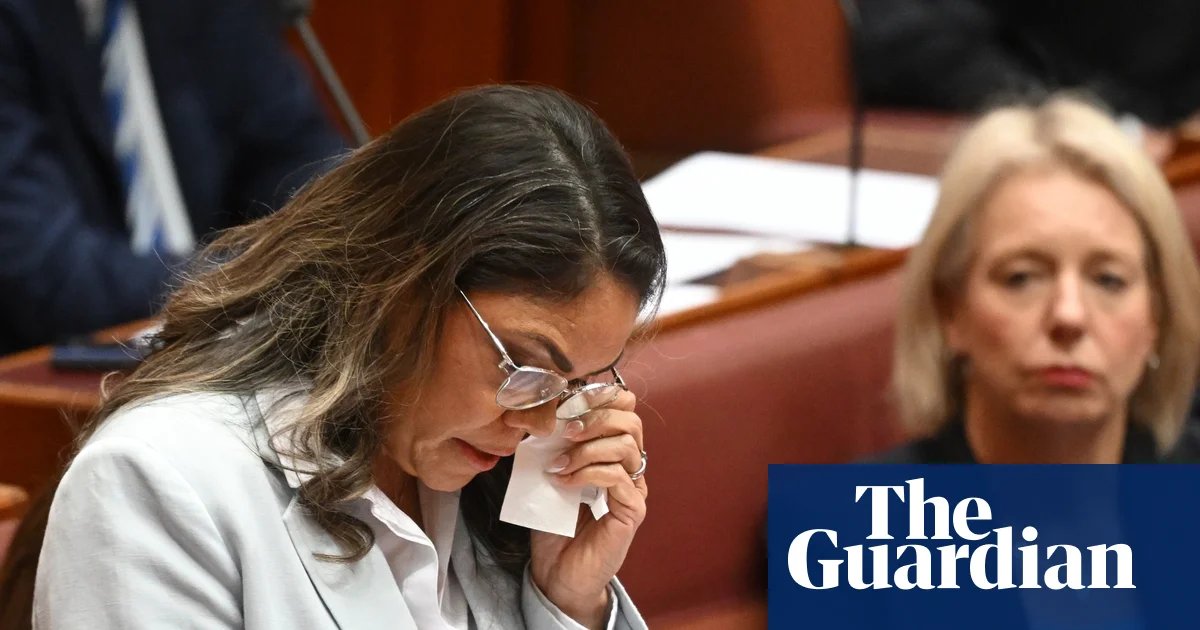
Liberal senator for the NT, Jacinta Nampijinpa Price, a Warlpiri woman and relative to Kumanjayi Little Baby, began crying as she addressed the Senate and said she was “tired of excuses” from the successive governments in addressing the “entrenched dysfunction” in town camps.
“Fear of speaking honestly about dysfunction, violence, alcohol abuse, neglect and conditions vulnerable children are growing up in,” Price said. “Let me say clearly that this is not an isolated case. For years I have raised concerns about the failures in child protection.
“I’m no longer interested in protecting adults who feel uncomfortable about truths while children are being buried.
“Every time these concerns are raised, those who attempt to shut down the conversation, they say ‘now is not the time’, they say we should ‘not politicise tragedy’, but as my niece’s aunt I have an obligation to fight for justice in her honour.”
Independent Victorian senator Lidia Thorpe, speaking after Price, reiterated the family’s wishes that her death not be politicised.
“The family asked for their child not to be made a political football, not everyone has respected those wishes,” she said. “And we have seen damaging commentary and calls for reform that would further harm our people.
“This is a time of deep grief and sorry business for our people. We must respect the family, as any of us would expect for our own families.”
Meanwhile, the National commissioner for Aboriginal and Torres Strait Islander children and young people, Sue-Anne Hunter, and NT children’s commissioner, Shahleena Musk, issued a joint statement calling for the Territory to immediately halt proposed reforms to the child protection system, and instead let them jointly co-chair an inquiry into the troubled sector.
The NT government is proposing legislative reforms that will impact the Aboriginal child placement principal, which was introduced in response to the stolen generations, and aims to keep Indigenous children who have been removed from their parents connected to their family, community and culture.
The pair said the Territory had a “strong history” of failing to implement recommendations from past inquiries on protecting children, and that a well-resourced and community-led independent board of inquiry was necessary to address the root issues.
“Weakening the child placement principles through rushed legislation, without a completed review foundation or genuine engagement with Aboriginal leaders, risks repeating the very harms it was designed to prevent,” Hunter said.