
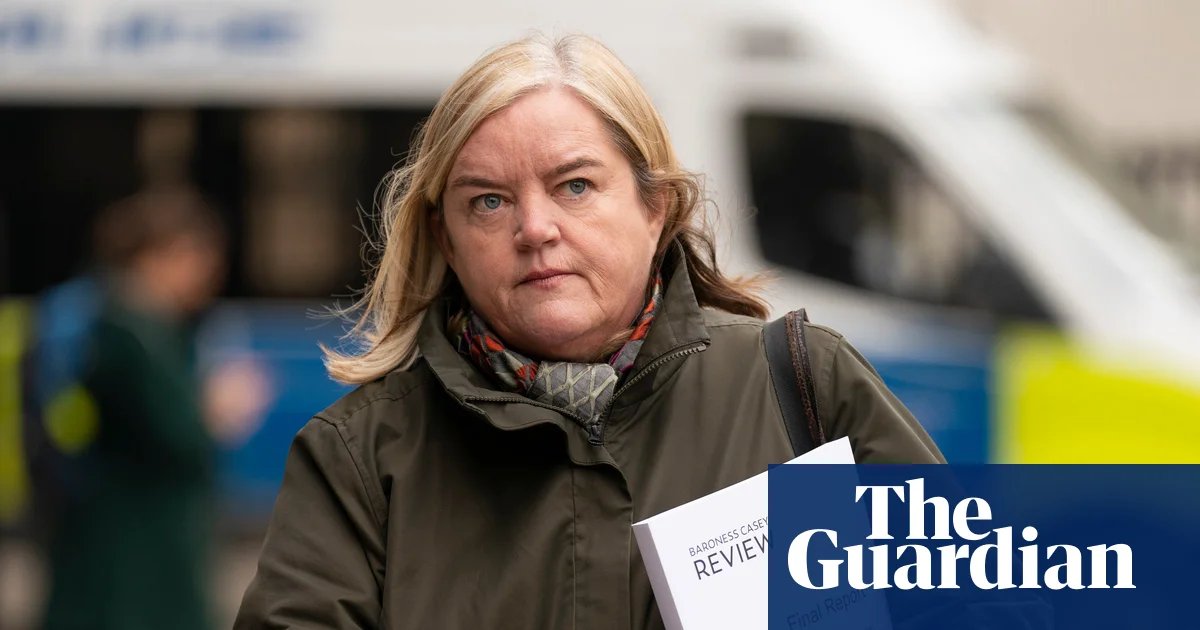
Millions of unpaid carers in the UK are “living an agony” while propping up an outdated, fragmented and confusing social care system, Louise Casey, the head of the government’s adult social care commission, has said.
Lady Casey, who is leading an independent review of adult social care, criticised a system that “still behaves as if we are living in 1948 and not 2026” by relying on female carers to plug gaps in services.
She said it was no longer sustainable to depend on predominantly female unpaid carers and poorly paid care workers to hold the system together until they hit crisis point.
Speaking at a Carers UK conference in London on Thursday, Casey said caring placed an enormous emotional burden on unpaid carers, who were primarily women “expected to absorb risk, stress and responsibility so the system doesn’t have to … This can’t go on any longer,” she said.
Casey was commissioned by the government in January 2025 to lead a two-stage review of adult social care aimed at delivering Labour’s manifesto commitment to create a national care service. The first report is expected this year.
She has previously warned that the adult social care system faces a “moment of reckoning” as it struggles to meet the needs of an ageing population and rising numbers of people living with chronic conditions such as dementia.
Casey is a former social campaigner and senior civil servant best known for chairing national inquiries ordered by a succession of governments into issues such as homelessness, the Metropolitan police, troubled families, and grooming gangs.
Carers were given no reassurance or continuity, with little clarity about the level of support on offer, how to access it, who provides it or pays for it, she said.
The system made things “far harder than it needs to be. We end up in a position where elderly parents in their 70s are still carrying their 40-year-old disabled son upstairs to bed every night, worried that if they ask for help the consequences of asking for that help will make their lives worse and not better.”
Carers frequently had to “fight every step of the way” for state support, Casey said, adding: “Carers spend more time sorting out problems out with the health and social care system, I think sometimes, than spending time with their loved ones.”
She said carers had told her they felt like “unpaid project managers”, trying to navigate a confusing system and figure out “what the bloody hell is going on most of the time”.
Every agency had its own rules and interpretations, she said, and “these variations are put on the public’s plate and, frankly often it is is made their problem, not our problem to solve. And I think that’s indicative of a system that isn’t putting the public first.”
The system can make the carer feel like they are “living an agony. And, frankly, I think we should be able to take the agony out of care.”
There are an estimated 5.8 million unpaid carers in the UK, with 1.7 million providing 50 or more hours of care a week. The economic value of unpaid care is roughly £184m, and about 60% of unpaid carers are women.
“The experience of being a carer can be … one of the most important and indeed uplifting things someone can do for the people they love and the people in their community,” Casey said. “But the reality is that it is tiring, uncomfortable, repetitive, distressing and downright frustrating.”


