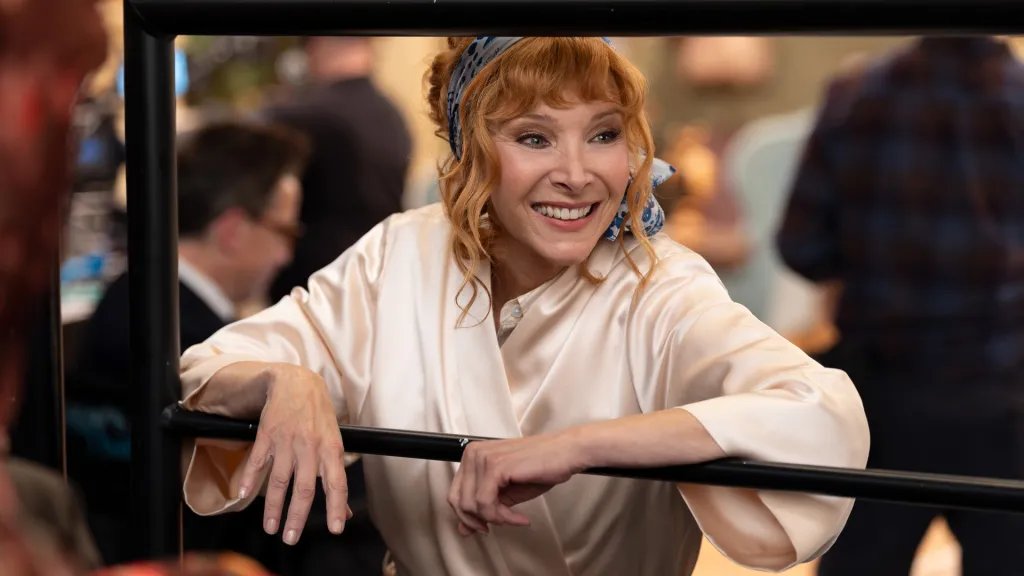
SPOILERS: This post contains details about The Comeback series finale ‘Valerie Cherish’
After Valerie Cherish gave her final bow in The Comeback finale, Michael Patrick King doesn’t plan on bringing the fictional diva out of retirement again.
The co-creator of the HBO mockumentary reality show told Deadline he feels “very happy about this being the finale of the series,” and despite the unintentional decade-long break between each three seasons, he and co-creator/star Lisa Kudrow have no plans to return to the show in the distant future.
“And it took us a very long time to come up with the right machine to risk building a show around,” he said of Season 3’s AI focus. “So, hopefully there won’t be any apocalyptic unknown things appearing in the next 10 years that would warrant us to come back.”
King explained that Season 3 came about as a “fear-based comedy” about the looming threat of AI in Hollywood and the anxieties “of where we are now—not even the reality of where we are, because we’re still in that moment before any studio actually admits they’re using AI, which was our main goal to get on television before that moment happened.”
“The original thought was taking the most human person we could think of and putting her up against a machine, which is AI, and Valerie really has so many very human attributes,” he noted of Kudrow’s iconic character. “She’s smart, she’s flawed, she’s strong, she’s weak, she’s obsessive, she’s egotistical. She’s all of us on any minute of the day. She’s human.”
Lisa Kudrow as Valerie Cherish in ‘The Comeback’
With an epilogue in the credits that teases the future of the show’s satirical alternate universe, in which AI is used to churn out shows that people “like to leave on while they do – whatever,” King added a disclaimer that “no AI was used in the writing of this series.”
“It’s kind of emotional to say something is handmade. When you look at a garment and it says ‘handmade,’ it means something, in a weird way,” said King, adding: “And we can only really concentrate on writing because we don’t know where everything else is going. But our show’s always been about writing and television, and we addressed as much as we could without giving a moral of the story, because no one knows what it is. We’re still wondering.”
Read on about Michael Patrick King’s farewell to Valerie Cherish and his parting thoughts on AI in Hollywood in The Comeback series finale.
DEADLINE: I really loved this finale and the way Val takes a stand against the studio and AI in general. Tell me about bringing her to that moment.
MICHAEL PATRICK KING: The whole season really was about us wondering what would happen if Valerie got the spotlight that she’d been craving so desperately in the first two seasons. What happens if she suddenly is the one in the middle of the spotlight and she doesn’t have to beg for stuff, but almost too much is thrown at her? And so what I’m sort of hearing from people and what I’m happy about, one of the things, is that people started to see her strength and her caring about other people and her ability to function as the wheels were coming off the car. So for us, Lisa and I were kind of reporting a show about the fear of where we are now—not even the reality of where we are, because we’re still in that moment before any studio actually admits they’re using AI, which was our main goal to get on television before that moment happened. That was why we worked so hard to get the show out so it could feel still a little bit ahead of whenever that news is gonna come. So, everything we wrote and everything we felt is based on the idea that people will have to deal with whatever it is. So, it was almost a fear-based comedy about how people can choose to move through this world, and didn’t wanna take Valerie this entire way and not have her succeed. The original thought was taking the most human person we could think of and putting her up against a machine, which is AI, and Valerie really has so many very human attributes. She’s smart, she’s flawed, she’s strong, she’s weak, she’s obsessive, she’s egotistical. She’s all of us on any minute of the day. She’s human. She has great flaws, and what we tried to do with the very, very end, especially the last moment of Valerie talking to the camera, was sort of reframe how people had seen her. And she says, “You have to agree to be humiliated, and I never signed up.” That was one of the things that spun my head around when we were in the writing room, was Lisa saying, “I want people to have a new version of everything they’ve seen. I want them to be able to look at the first two seasons like, ‘Oh, she’s a survivor,’ which is the truth.” I mean, we ended the pilot of the very first season with Destiny’s Child ‘Survivor’, so we’ve been telling people [she’s a] survivor, but the odds against her have been so stacked that people only saw the tragedies rather than the victories, I think.

Laura Silverman as Jane Benson and Lisa Kudrow as Valerie Cherish in ‘The Comeback’
DEADLINE: Yeah, I loved that final monologue that you’re talking about, especially how you faded to color, and she’s wearing the same color from the pilot. That was perfect.
KING: I’m glad you got that. The idea of, sometimes when we see people, we see them as only one thing, we see them as black-and-white, and what we wanted to do in that fade was not only take Valerie from a black-and-white image to a fully vibrant color of who she could really be and has always been. The other thing we were trying to do in that last image was really evoke all of filmmaking. We have Jane’s old camera, old film, old black-and-white, right? And the evolution of Hollywood, we’ve gone from that shot on film—we had limited roles of it that we could use, and we went all the way through that—into what we’re doing now, which is very advanced HD stuff. So, in that one choice, we take Valerie from black-and-white to color, but we’re also winking and acknowledging how the industry has gone from black-and-white to color and it’s still here.
DEADLINE: And I love the part where you see Valerie’s reflection in Jane’s lens, and just the whole relationship between the two of them, like seeing Jane defend Val on TV. Can you tell me about lhow much has changed between those two since the first season?
KING: Oh my God, the entire fun thing about doing a series, if you get to do more than one season, is the evolution of the characters. Where are they going? How can you evolve them if you have more time with them? And one of the main drumbeats of the show was evolving the relationship of Valerie and Jane to get to the point where it started, where Jane was in the shadows and sort of just putting the bullseye on Valerie because that was her job. And one of the most thrilling things for me in the second to last episode is when Valerie and Mark are having a private moment in the laundry room. And the reality show producer who used to be a Jane, that used to be Jane’s job, says, “go to the other door,” and Jane gets in the way and just locks it and won’t let them intrude, and she just goes really nicely, “hi.” And that shows how somebody has fallen into deep protective mode with their friends. And the last moment that you’re talking about is when Jane says, “I feel like I’m seeing you for the first time.” No matter how long we sometimes know people, they’ll do something or say something and you feel like, “Oh wow, I’ve never seen them that way.” And that shot, Elie Smolkin, our DP, created that shot. That is not an effect shot. That’s actually an in-camera shot. The reflection was the reflection in the lens of the old camera. I mean, when you look at it, you think, “Oh, that’s a drop-in.” It’s not. They sprayed the lens with a mist, and it lasted for a minute, and that’s how long it captured. We got the shot of Valerie. That’s real. That’s not a trick. That’s old filmmaking. That’s not new filmmaking. Yeah, we love the fact that Jane became a protector. We love that. We love that they actually became friends, or clearly in each other’s lives in a different way than they started. We tried to do with that with all the characters, and a lot of the characters went into an evolution where they became the most desperate parts of Valerie. Billy became the most try-hard, the most needing the spotlight, and Jane became the opposite. She became the most grounded, sort of soft, comfortable place for for Valerie to land.
DEADLINE: I also loved in the penultimate, seeing Juna return. Tell me why that was so important to have that moment between them.
KING: Because that was the darkest moment in the series, really, when Valerie feels responsible, and all those people that she’s been doing the show with don’t approve of her suddenly and turn against her. It’s the only time in the show where she says to Jane as she’s walking away, “No camera, just walk.” So, she’s really feeling like she doesn’t wanna be seen, and then Juna shows up and sees her and reminds Valerie who she is, who she’s been. Because she’s so clearly telling her, “you did all these good things for me,” and we wanted to point out that Valerie has never ever been about ego. She’s always against anybody else getting less, she just wanted more. She never wanted Juna to get less or any of the other actors to get less. She always just wanted more for herself. But at that moment when Juna replays her memory of Valerie to Valerie and then says, “you’re it,” which is a deliberate reference to I’m It, which was when Valerie was in I’m It. That was her sweet spot when she was the star of I’m It. So when Juna says, “Valerie, to me, you’re it,” it brings back a lot of emotion and energy. And what it does is it almost restarts Valerie so that she walks into the next scene with Mark and The Finance Dudes, and she’s all, “Hello, I’m Valerie Cherish.” She’s all pumped up again, and then she helps Mark. People can help each other by seeing each other in a good way, so Juna is a very important character because she’s literally the most pure character on the show. She’s always been one of those people who just moves through the world, things kind of go her way. So, for her to see Valerie is great, and it also reflected the last 21 years of the history of these characters in people’s minds. But the showdown in the, in the office with Andrew Scott, there are things that Lisa does in that scene that I’ve never seen, and I think I’ve seen a lot of things that she can do as an actor, but there are moments of her when he tells her, “you can be replaced.” She’s actually grown in such a big way, but I love how she stands up to him, and that is really the human against the machine. And then she quits, but in true Valerie [fashion], comes walking right back in and says, “I’ll call you tomorrow and tell you whether I quit.” She can’t really let go. And what’s really interesting is that last moment where she walks back, that happened on the set, because I realized, “Oh, if she leaves, the audience will think the show’s over. We don’t have any tension.” So, I said to Lisa, “I think we need to come back,” and she said, “Yep, great.” So that was in the moment just because I wanted the tension of what’s she gonna do to keep going. And then the other fun thing, which I want to point out, the scene after that in the bedroom with Mark, that’s the only time in the series we’ve been in their bedroom that wasn’t a ceiling cam, the only time you’ve actually seen them in the real world of their bedroom. Because we think we’re past it. Valerie’s now moved on from hearing what other people think, she’s sort of just living her life.
Damian Young as Mark Berman and Lisa Kudrow as Valerie Cherish in ‘The Comeback’
DEADLINE: I didn’t realize that. But I also loved that in the monologue at the end, when she walks away all stoically and then she comes back and she’s like, “A callback is…” That was funny.
KING: Yes, she comes back. It’s so Valerie. She literally comes back in The Comeback, and then she wants to tell people about a sitcom writing term for comedy, you know what I mean? It just goes from the sublime to the ridiculous, which is kind of what she is. She can be ridiculous, and then every now and then, she can be sublime. And I think that’s kind of what people have responded to about that third season, is that Valerie has moments of great depth, and people are very touched that their comic hero can also move them to crying for a minute and then make them laugh right again. It’s a very rare character and an even rarer actress that can do that.
DEADLINE: At the very end, there is the disclaimer that no AI was used in the writing of this series. Do you think that’s gonna be a standard disclaimer soon that people are gonna start using?
KING: I don’t know. I think what’s interesting about the epilogue, writing the story is, we say that Valerie went on to do a show that received a lot of attention. The next thing we say is that How’s That is entering its third season with a fully digital cast. And I think that what we’re trying to maybe postulate a little bit is that … the show started based on the threat of reality TV back in the first season. It was, “Reality TV is taking away our jobs, and it’s going to destroy narrative TV.” Well, it didn’t, and in fact, since reality TV’s birth, we had that whole second wave of the Golden Age of Television. And so now, reality TV is kind of just a wing on the house of television, a different kind of a wing, but it’s there if you wanna go into it. And so, what we were trying to say at the end there was, maybe this excellent work will continue, and then there’ll be a wing for shows that people “leave on while they do whatever,” as we say. And the final thing is, it’s kind of emotional to say something is handmade. When you look at a garment and it says “handmade,” it means something, in a weird way. And so, if television is handmade, it that’s what that tag at the end means, it’s like it means, “This is handmade by people, so if you care about that, then that should lift you up a little bit.” And we can only really concentrate on writing because we don’t know where everything else is going. But our show’s always been about writing and television, and we addressed as much as we could without giving a moral of the story, because no one knows what it is. We’re still wondering.
Lisa Kudrow as Valerie Cherish in ‘The Comeback’
DEADLINE: Well, I am a huge fan of the show. I’ve watched it since the first season, and I know this is billed as the last season, but do you think in another 10 years, if there’s a new reality TV or a new AI that Hollywood is up against, that you and Lisa might get the inspiration to come back for Season 4?
KING: This is the finale of the series. It feels like the trilogy. Lisa keeps saying it’s a trilogy because it has three pieces, and it feels like beginning, middle and end for us. We never intended to have our brand be, every 10 years, we come back. But now to come back in two years would be ridiculous. So, I don’t foresee that far in the future, but we really, really feel very happy about this being the finale of the series. We’ve been very blessed that people really like it, and they really liked that first season, which is the only reason we came back, because of DVD and energy from the audience created an interest. And then the second season, people said was great, and some people said, “That’s great, you’re done.” And it took us a very long time to come up with the right machine to risk building a show around. So, hopefully there won’t be any apocalyptic unknown things appearing in the next 10 years that would warrant us to come back. But we’re very happy. That’s not a marketing ploy, that is a reality.