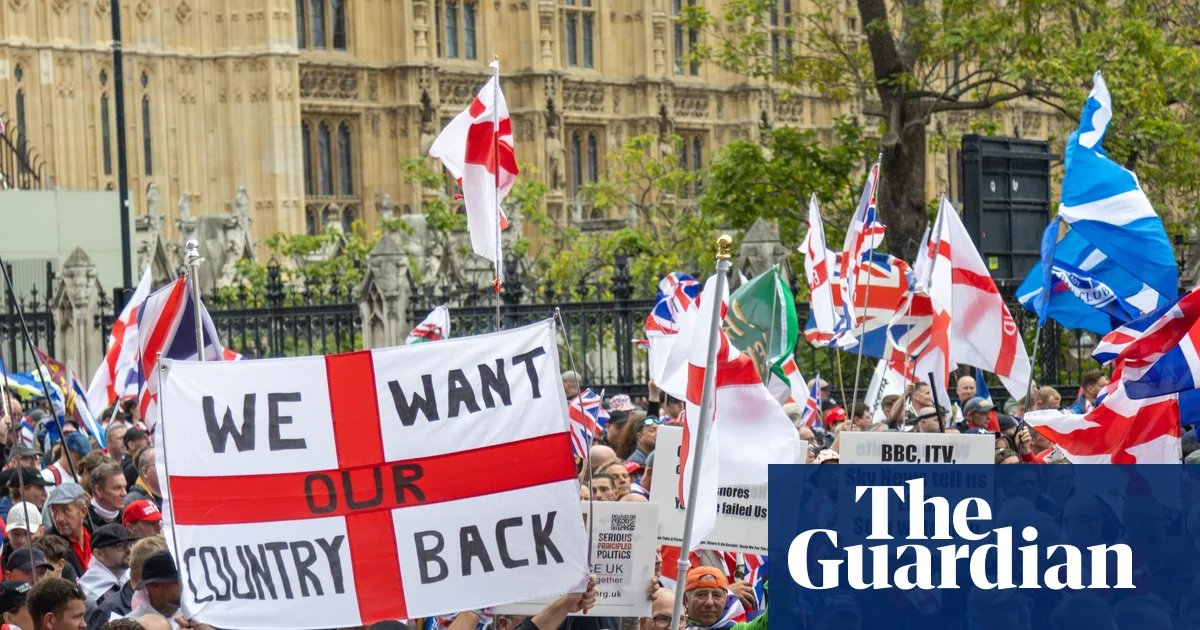
The Metropolitan police have said organisers of this weekend’s Unite the Kingdom and March for Palestine demonstrations will be held responsible for any hate speech connected with the events, in what they expect to be “one of the busiest days for policing in London in recent years”.
Tens of thousands of people are expected to march in the capital for the Unite the Kingdom event in central London and the Nakba: 78 March for Palestine from south Kensington to central London. Senior officers said protesters would face “the highest degree of control”. The FA Cup final is also due to be held at Wembley on Saturday.
In a briefing, James Harman, a deputy assistant commissioner, said a “zero tolerance” operation of “unprecedented” scale would include 4,000 officers, at a cost of £4.5m, and “swift and decisive” action against disorder and hate speech.
Live facial recognition will be used in an area of Camden where Unite the Kingdom attenders are expected to gather outside the event itself, “comparing the faces of those walking past, with the faces of those on a specific watchlist”, Harman added.
It is not expected that facial recognition will be used on pro-Palestine marchers.
Harman said: “For the first time, we’ve also imposed conditions relating to the speakers at these protests.
“These conditions make the organisers responsible for ensuring that speakers they invite don’t break the law by using these events to platform from unlawful extremism to … hate speech.
“Both the speakers and the organisers will face consequences if that happens.”
He added: “If hate speech is used at the rally, we, the police will intervene, then and there with the speaker. Our condition places the responsibility on the organiser as well as the speaker to stay within the law.”
Harman said armed police were “available for use” in an operation involving dispersal powers, enhanced powers to search and remove face coverings, “helicopters, drones, dog units, police horses, armoured vehicles, if we need them, and dedicated investigative teams … at a time of continued global instability and tension, which we know has the potential to play out on the streets of London”.
People who call for “intifada” or “death to the IDF” face being arrested and charged.
Harman said the day “has the potential to be one of the busiest days for policing in London in recent years” and followed “a sustained campaign of arson targeting Jewish Londoners” and “increased concern more broadly, including in Muslim communities”.
The senior officer said while many came with “good and lawful intentions” to Palestine protests, “we’ve routinely seen arrests for stirring up racial hatred and for supporting terrorist organisations … many Jewish Londoners feel intimidated and afraid of these protests”.
Speaking of Unite the Kingdom, Harman added: “Among the crowds we have seen, of course, many peaceful attendees. But we have also seen anti-Muslim chanting, and incidents where people have been arrested for religiously and racially aggravated offences.”
“At the Unite the Kingdom protest in September last year, there was violence in multiple locations as protesters attacked police officers and tried to reach opposing groups,” he added, saying there were arrests throughout and “more than 50 outstanding and unidentified suspects for offences from that day”.
He said: “The nature and scale of these protests has left Muslim communities and those from other ethnic minority groups, feeling scared … they avoid central London, they avoid transport hubs, and they change their plans because they are worried about crossing paths with the Unite the Kingdom supporters.”
Harman said the FA Cup final brought an “additional challenge”, with officers mindful of the history of football hooligan groups supporting causes fronted by the organiser of the Unite the Kingdom events, Stephen Yaxley-Lennon, known as Tommy Robinson.
He added: “The scale of the operation is unprecedented in recent years. The plan for it has been ongoing for months … and we have been clear since the outset that we would not accept routes that would increase the risk of intimidation to any particular community, or that would risk the two protests coming together.
“Given the context we’re operating in, the public expects our officers to act wherever they see or hear antisemitism, anti-Muslim abuse, incitements of violence or language that points to support for terrorists … our specialist investigators will be working through the night if they have to.”
On the question of the events being allowed to go ahead, he said: “The threshold for a ban is very tightly and precisely prescribed in law … and we don’t feel that that specific criteria, has been met on this occasion.”