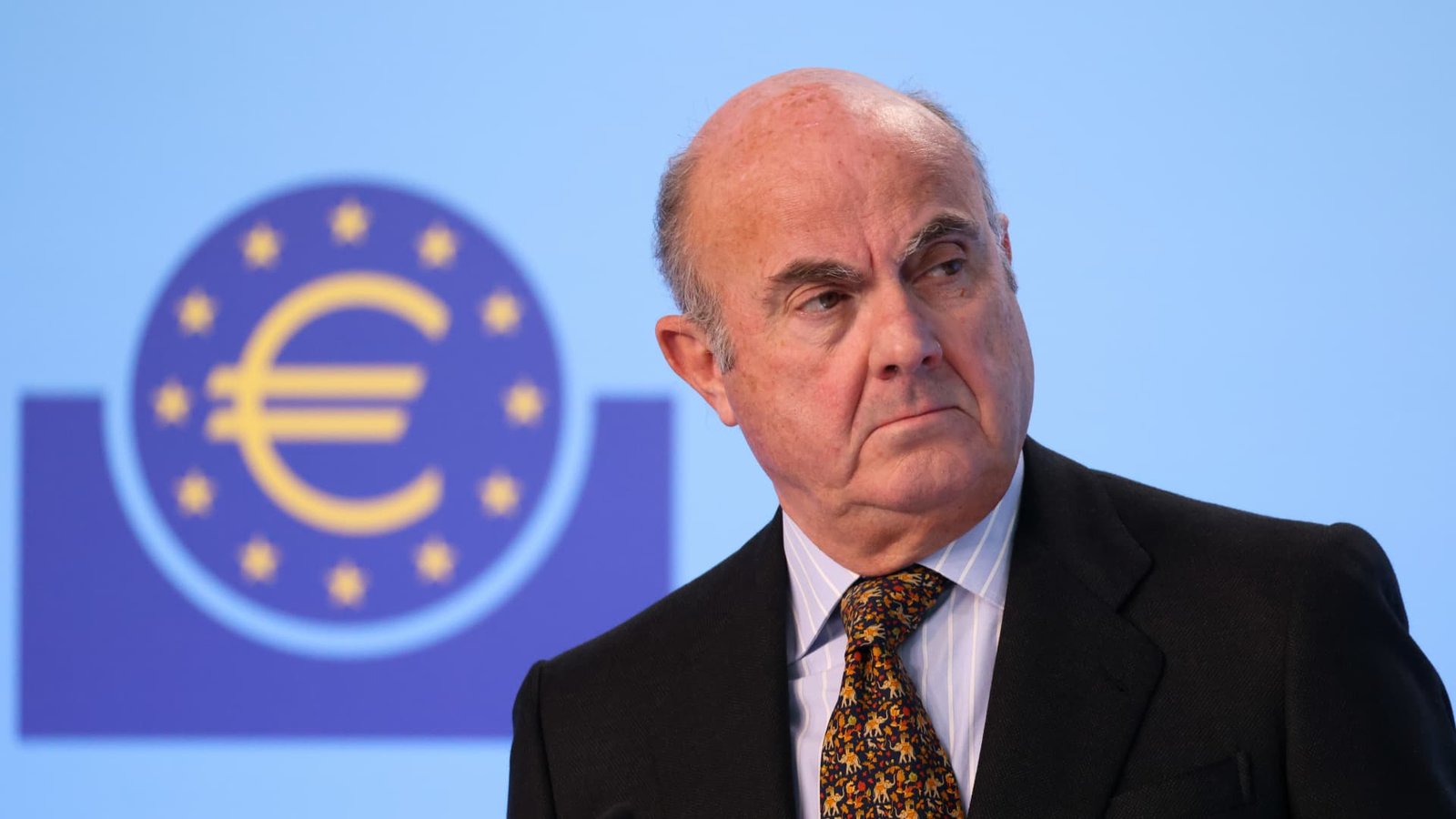
Luis de Guindos, vice president of the European Central Bank (ECB), at a rates decision news conference in Frankfurt, Germany, on Thursday, Jan. 30, 2025.
Alex Kraus/Bloomberg via Getty Images
There is an “elevated” risk of a market correction, European Central Bank vice president Luis De Guindos told CNBC on Wednesday, as stock indices notch fresh record highs despite a combination of geopolitical turmoil, fiscal challenges and outsized valuations.
“There is a risk of a correction because valuations in markets are quite high, quite elevated and … the main element of concern, from our standpoint, is geopolitical risk,” the senior ECB official told CNBC’s Annette Weisbach.
“On top of that, we have the fiscal situation in Europe, we have the situation of non-banks, mainly private credit and private equity institutions, and the interconnection of these non-banks with the banking system. So it’s a combination of elements,” he noted.
The duration of the war in Iran could prove pivotal to the degree of risk markets face, De Guindos said, amid continued market confidence in a quick resolution.
“Markets discount that the conflict will be over shortly and if that’s not the situation, that could trigger a modification in the perception of markets. That, in combination with other elements … might trigger a correction in markets,” he said.
‘Geoeconomic stress’
The ECB’s latest Financial Stability Review, also published on Wednesday, assessed that the outlook for euro area financial stability was “being shaped by geoeconomic stress and energy supply disruptions.”
“Prolonged geopolitical stress and lingering fiscal challenges could test financial market sentiment,” the review noted, warning that this could deteriorate “as downside risks related to geopolitical, fiscal and macro-financial developments appear underestimated.”
“Fiscal expansion in a challenging geoeconomic environment could strain public finances further in some highly indebted euro area countries and lead to a repricing of sovereign risk,” it said.
The ECB also highlighted vulnerabilities among non-bank institutions, including those active in private markets, as posing a further stability risk.
“Non-banks have remained largely resilient to the war in the Middle East but face risks from broad-based market downturns. In particular, the combination of low liquidity buffers, high portfolio valuations
and concentrated exposures on their balance sheets raises the risk of forced asset sales that could amplify market stress,” the review said.
“While not a systemic concern per se in the euro area, opaque and interconnected private markets warrant close monitoring owing to spillover risks, especially from the United States.”
ECB outlook
The ECB has so far kept its key interest rate on hold at 2% even as price pressures have driven euro area inflation to 3% as of April.
ECB President Christine Lagarde has repeatedly insisted that the central bank is ready to hike rates even if the inflation surge proves temporary. However, she has said the bank would take a data-dependent approach; the next inflation print is due on June 2, while the next ECB meeting takes place on June 10-11.
De Guindos said weighing up the risks of inflation and those to economic growth put central banks in a “difficult situation.”
“I think there is not any sort of fait accompli with respect to the evolution of rates. The discussion will be open and all the elements will be balanced and taken into consideration.”
Bank of France Governor Francois Villeroy de Galhau, who is also on the ECB’s Governing Council, told CNBC Tuesday that European policymakers “will do what is necessary as an independent central bank to bring inflation back to target.”
“If I speak on behalf of the ECB, this means do what is necessary to bring inflation back to 2% in the medium term. Markets can be assured of that,” Villeroy de Galhau told CNBC’s Lisa Kim.
— CNBC’s Chloe Taylor contributed reporting to this story.