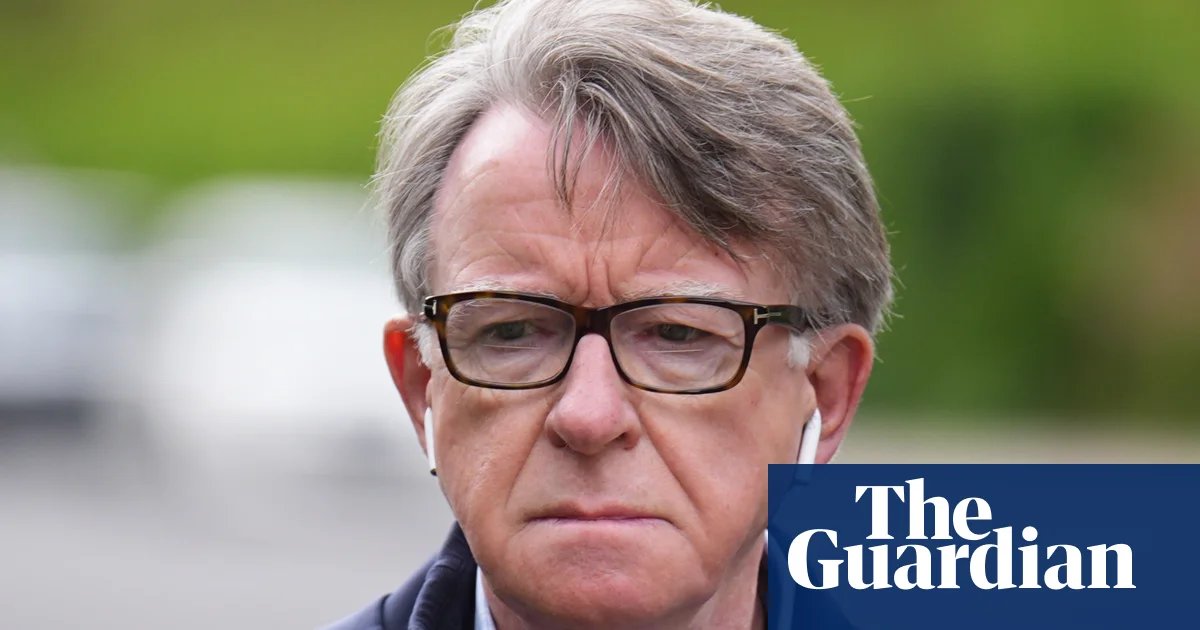
Peter Mandelson wrote to David Lammy on 18 November 2024, making a simple promise to the foreign secretary.
“If you were minded to appoint me [as ambassador to Washington],” he said, “I would make sure you never regret it.”
Since then, senior government figures, including Lammy and the prime minister, Keir Starmer, have had reason to look back at that appointment with almost nothing but regret.
With Starmer’s authority already in pieces, Monday’s publication of more than 1,000 pages of documents relating to Mandelson’s appointment only served to underline why many of his own MPs have lost confidence in his government.
Kemi Badenoch, the Conservative leader, originally demanded the documents be published to find out what ministers and officials knew about Mandelson’s links to the paedophile Jeffrey Epstein, as well as any other security concerns that were raised during his appointment.
In the end though, it is not the rather limited information about the security process which has been so damagingly revealed in the files, but rather what everyone in the Labour government thinks of each other.
Many of the most withering assessments have come from Mandelson himself.
“Keir is not leading from the front and Morgan [McSweeney, his chief of staff] is not organising the centre as it needs to be,” he wrote to Pat McFadden, a Cabinet Office minister, last May.
“It stems from the top and Keir lacks verve as does the Cabinet as a whole,” he added.
“People’s heads are broadly in the right place but you need more people who can execute.”
No 10 was “beleaguered and bereft”, he said on a later occasion.
And he credited others with similarly critical views of the prime minister, even his then chief of staff Morgan McSweeney, who had lobbied hard for Mandelson to be given his post.
“[McSweeney’s] view from when Keir first stood is that the cycle has been the same, advance/buckle/advance/buckle,” he said.
Wes Streeting meanwhile, was “hysterical” and “experiencing an early mid-life crisis” about Gaza, he said.
He called criticism of the former prime minister Tony Blair by the energy secretary Ed Miliband “personal and stupid”. Rachel Reeves, he said, was “on a growth mission but without an argument about where the growth will come from or how”.
Mandelson is not the only person in the documents being rude about colleagues, however.
In one message that has already been seized on by the Conservatives, McFadden said about Labour MPs: “Every meeting I have is ‘who can we tax in order to pay benefits to others’. They’re asking the wrong questions.”
And in a veiled attack on his cabinet colleague Miliband, McFadden backed Blair’s criticisms of the government’s net zero strategy. “Tb content bang on,” he told Mandelson.
Torsten Bell, the pensions minister, meanwhile, complained in a message to Mandelson: “Everyone [in government] seems to think it’s someone else’s job to get the policy right … which is very odd.”
The messages also reveal how much government time could get sucked up by lengthy consideration of apparently minor matters.
In a long email chain last August, various senior officials debated how to procure a ministerial-style red box to give as a gift to US president Donald Trump – a tangle that Mandelson likened to the BBC satire The Thick of It.
What we learned relatively little about however was the vetting procedures behind Mandelson’s appointment.
At times the former ambassador seemed almost dismissive of attempts to make him declare his contacts with officials in foreign governments.
“Do you mean literally every foreign national I have ever met?” he asked one member of staff. “I assume not.”
He is not the only one who appeared to show disdain for the system.
One junior official, whose name has been redacted, reassured him: “I suggest you send over the handful of names you mentioned, even though you don’t consider them ‘close contacts’. That will reassure the vetting team that you’ve been comprehensive, even if it’s all quite artificial.”
What the documents do not include, but which was revealed by the Guardian on Monday, is any agreement that Mandelson would take steps to mitigate security concerns over his contacts with overseas governments.
Nor do they give any detail about why vetting officials initially recommended he be denied clearance. The document making it clear that there were concerns with Mandelson’s contacts in Israel, Russia and China – the details of which were revealed by the Guardian last week – has been withheld for now after the Metropolitan police advised it was part of a live investigation.
One name that rarely arises is that of Epstein. While his name was mentioned after Mandelson’s sacking, it is almost never referred to before that.
If Badenoch’s aim was to show the government appointed Mandelson despite knowing that he was much closer to Epstein than publicly admitted, she has failed.
But if her goal was to highlight a government riven by infighting, plagued by widespread doubts about the prime minister’s suitability for office, she has proved more successful than even she may have hoped.