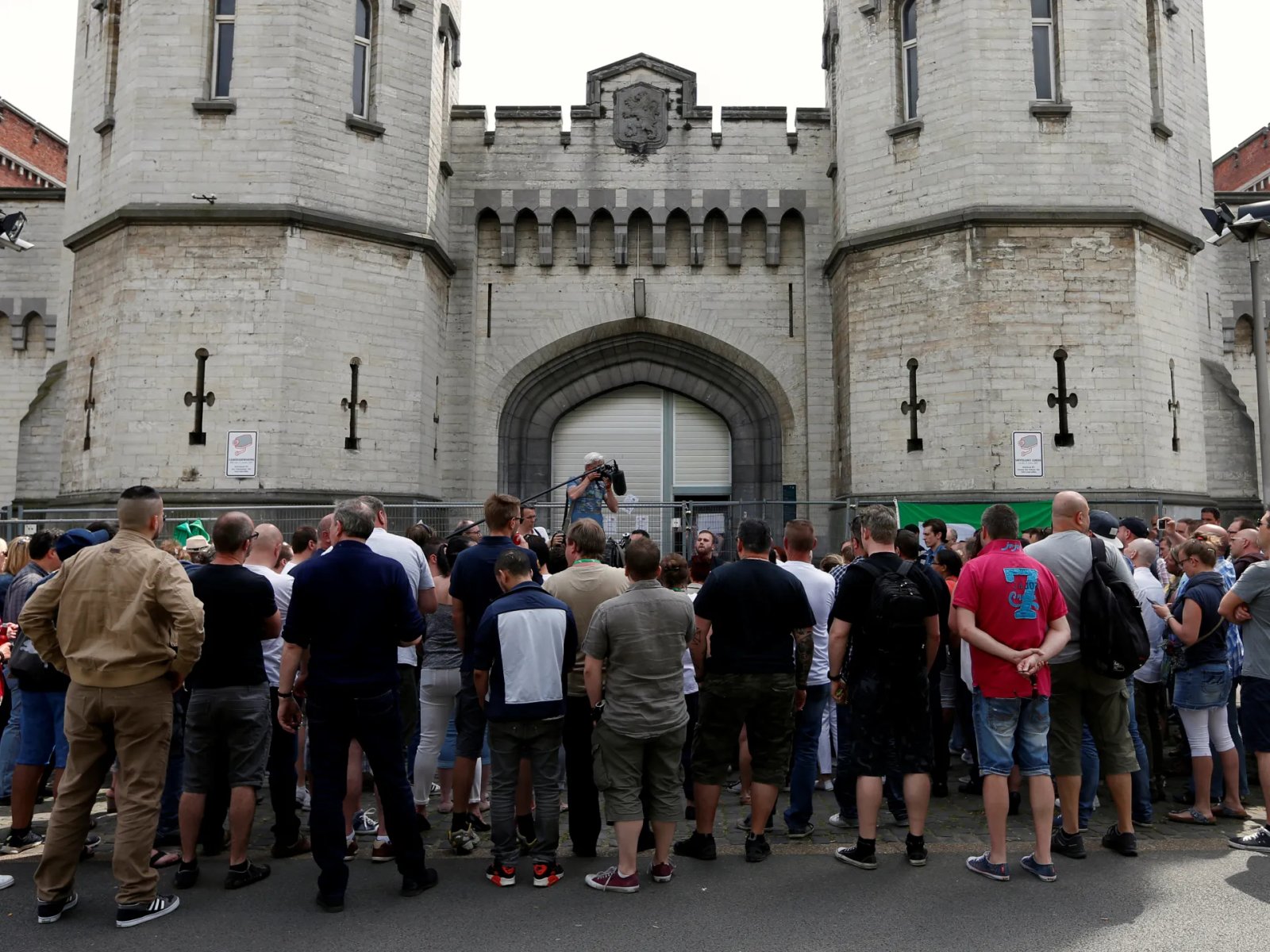
Brussels, Belgium – Bilal knows life behind bars.
Over the past 10 years, the 34-year-old has served a sentence in five prisons across Belgium. He most vividly recalls conditions in Mons, a 19th-century prison near the French border, where he said 9-square-metre (97-square-foot) cells housed three to four detainees. He remembers bouts of scabies, bed bugs and monkeypox spreading widely and guards who faced severe exhaustion.
“During my 10 years in prison, things only got worse,” Bilal told Al Jazeera on condition that we use only his first name. “They took away some of our time outside of our cells, various activities.”
Belgium, one of Europe’s richest countries, is grappling with a deepening prison overcrowding crisis.
In mid-May, its 39 prisons counted 13,733 inmates – significantly exceeding a capacity of 11,064, according to data provided by the directorate-general of prisons.
“The combination of ever-increasing overcrowding and staff shortages makes the situation very, very, very difficult,” warned Pieter Houbey, vice-chairman of the Central Prison Monitoring Council (CCSP), an independent watchdog.
“It’s become almost impossible to maintain a detention system … aimed at reintegrating people,” he said.
In mid-May, 754 detainees were sleeping on mattresses on the floor, up from 672 in December.
Across Europe, prison populations have increased dramatically since the COVID-19 pandemic, with overcrowding affecting one-third of prison administrations.
Occupancy rates are highest in Cyprus, followed by Slovenia, France, Croatia, Italy, Romania, Austria and Belgium.
As a result, governments find themselves under pressure, with experts and workers criticising common responses – from building more detention facilities to transferring prisoners abroad – as ineffective.
‘Mice in a cage’
“To ensure decent conditions, we must first respect their rights – that is, stop treating them like mice in a cage,” said Yasin Sarikaya, vice-president of Brussels’ prisons.
Prisoners, especially those on remand, are often left in their cells for 22 to 23 hours a day, exacerbating the lack of privacy, as well as potentially pre-existing health and substance abuse issues. Receiving medical support can take months.
Loic*, who is serving his third of seven years at Saint-Gilles Prison in Brussels – meant to shut down by 2028 – said that work or other activities are hardly offered at the facility. Most detainees do not have a residency permit, he said.
“It’ll be tough to get back into the workforce,” the 23-year-old told Al Jazeera, looking at the floor while he spoke.
Bilal, convicted of two bank robberies and attempted murder, said he experienced suicidal ideation during imprisonment.
In recent years, videos circulating online have shown drones smuggling goods into prisons. In 2024, a video went viral showing a prisoner being tortured by five fellow inmates in his cell while the guards, on a 48-hour strike, failed to notice for days.
Guard burnout
Those conditions reinforce existing staff shortages.
At Haren, the country’s largest jail complex, “some guards are injured and can’t come to work”, said Sarikaya, who works at the complex.
According to the directorate-general of prisons, critical incidents in prisons doubled within a year.
With general crime rates having fluctuated in past years, experts connect the situation to Belgium’s carceral policy and its attempts to crack down on drug-related crime. While the country has struggled with overpopulation for decades, its most recent increase is mainly linked to a decision in 2023 to enforce all sentences of up to three years, previously served primarily under electronic monitoring.
Belgium also detains people for ever longer periods. Currently, the average detention lasts 9.9 months – a 39.4 percent increase over five years. Belgium’s pretrial detention rate of 32 percent is well above the European average (24.7 percent in 2024).
Emergency measures
Last July, Belgium’s parliament passed an emergency bill. The law, drafted by Justice Minister Annelies Verlinden, encourages the use of alternative punishments for sentences under three years and allows directors to release inmates, sentenced to a maximum of 10 years, six months before the end of their sentences.
In the longer term, the government seeks to install modular units and to renovate existing prisons pending the construction of new facilities.
That, however, is unlikely to reduce overcrowding, warned An-Sofie Vanhouche, a professor in the criminology department of Vrije Universiteit Brussel.
“Research shows that the more [prison] space we have, the more people we usually send to prison,” she said.
Cells to rent
As part of a stricter migration policy, Belgium is also seeking ways to deport detainees without legal residency, who comprise about a third of the prison population.
Earlier this year, Verlinden visited Estonia to discuss renting cells there. The government has already eyed similar deals with Kosovo and Albania.
Belgium is not the only European country considering such agreements.
Sweden has struck a deal with Estonia to rent 400 prison cells. According to the Estonian Ministry of Justice, prisoners could start arriving by the end of the summer. In 2019, Denmark reached an agreement to rent 300 prison cells from Kosovo.
Vanhouche described the moves as “very populist and symbolic”.
While only having a “small impact”, they raise numerous ethical questions around the protection of prisoners’ rights and their wellbeing, she argued.
The Belgian Ministry of Justice, as well as the Swedish and Danish ministries, did not respond to requests for comment. The Estonian ministry said that “prisoners remain protected under European human rights standards and applicable international law”.
Ways forward
Critics are calling on Belgium to move towards a greater emphasis on societal reintegration rather than just security – also through alternative punishment.
“Prison leads to recidivism,” warned Tahar Elhamdaoui, the founder of NGO Collectif Desistance, which helps young former prisoners reintegrate into society.
According to Houbey, Belgium’s reoffending rate is 60-70 percent.
Thanks to Elhamdaoui’s NGO, Bilal is interning as a football coach. Meanwhile, Loic* is trying out different jobs on day release.
But that’s not the norm, Elhamdaoui warned.
“As long as there are no prisons that prepare people to succeed outside,” he said, “we will not only be producing more crime upon release, but also a sense of despair so deep that people will not be able to reintegrate into society.”