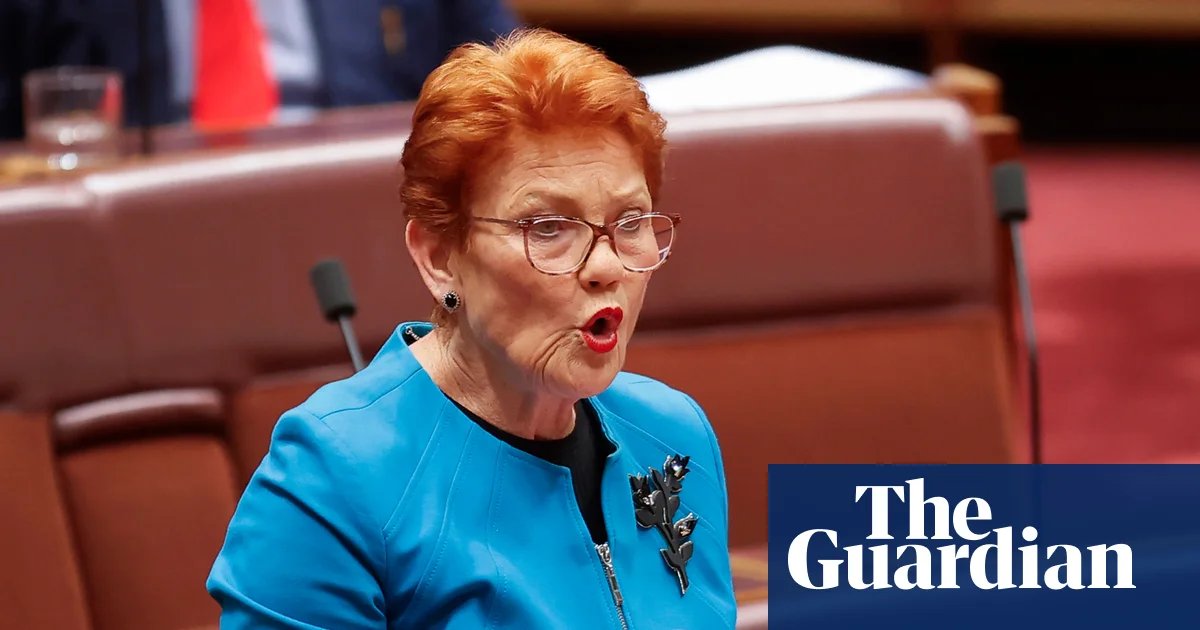
Labor will seek to highlight Pauline Hanson’s record of opposing cost-of-living relief for working people as it tries to prevent One Nation further eroding its voter base.
As the government grapples with how to deal with Hanson’s surge, one Labor MP predicted One Nation’s support had peaked and the rightwing populist party wouldn’t be able to replicate its polling success at a federal election.
But Labor MP Mike Freelander said his party must continue to examine options to help under-pressure workers, including further income tax cuts.
A new Redbridge Group/Accent Research poll published in the Australian Financial Review put One Nation ahead of Labor for the first time, making it the most popular political party in the country.
The result provides further evidence that while One Nation poses an existential threat to the Liberals and Nationals, it also represents an increasing danger for Labor.
On Monday, Hanson fielded media questions about the possibility of becoming the prime minister, despite One Nation holding just two of the 150 lower house seats.
“Do I have the ability to do it? You bet I have,” she told 2GB radio.
Hanson’s poll numbers have continued to rise despite a string of controversies that would ordinarily damage a politician’s standing, forcing the major parties to reassess their approach to combatting One Nation.
Labor is attempting to apply greater scrutiny to Hanson’s record opposing cost-of-living relief for the same working-class voters she claims to champion.
The One Nation leader has signalled she would not support a real increase to the minimum wage when the independent Fair Work Commission hands down its annual decision on Tuesday.
The Albanese government has backed a wage rise that is “economically sustainable” but above the rate of inflation, which was running at 4.2% in the 12 months to March.
Appearing on morning television with One Nation MP Barnaby Joyce, the social services minister, Tanya Plibersek, called out his party’s opposition to support for workers.
“Every opportunity they’ve had, they’ve actually voted against things that would make it easier, make life easier for Australians,” Plibersek said on Channel 7’s Sunrise program.
Other senior Labor ministers played down the significance of the new opinion poll but acknowledged that voters were hurting.
The federal budget also appears to have damaged the government’s standing, with the health minister, Mark Butler, admitting it would “take some time” to explain its contentious changes to negative gearing and the capital gains tax discount.
A senior government source said Labor’s challenge was to highlight the “risk” of One Nation and its policies, arguing Hanson was currently perceived as a “risk-free” option for angry voters.
Freelander said while the opinion polls couldn’t be ignored he was confident support for One Nation had peaked.
“A lot of things have gone in their favour. There’s a budget that’s created some controversy. People are in the middle of a cost-of-living crisis, and you know they [One Nation] had a bit of wind put in their sails from the Farrer byelection,” he said.
The Macarthur MP said personal attacks on Hanson were “wrong” and counterproductive”, insisting the focus must be on One Nation’s policy positions.
The backbencher said the government must “stick to its guns” with its agenda but should remain open to more cost-of-living relief.
The government is spruiking five separate changes to lower income tax that will deliver the average worker a benefit of up to $2,800 a year when fully implemented.
But Freelander said Labor should be prepared to go further.
“I think around taxation we do need to be looking at how we can improve people’s take-home pay, looking at how we can modify the tax system,” he said.
“I think that we need to continue to look at how we can make it better. We shouldn’t rest on our laurels by any means.”