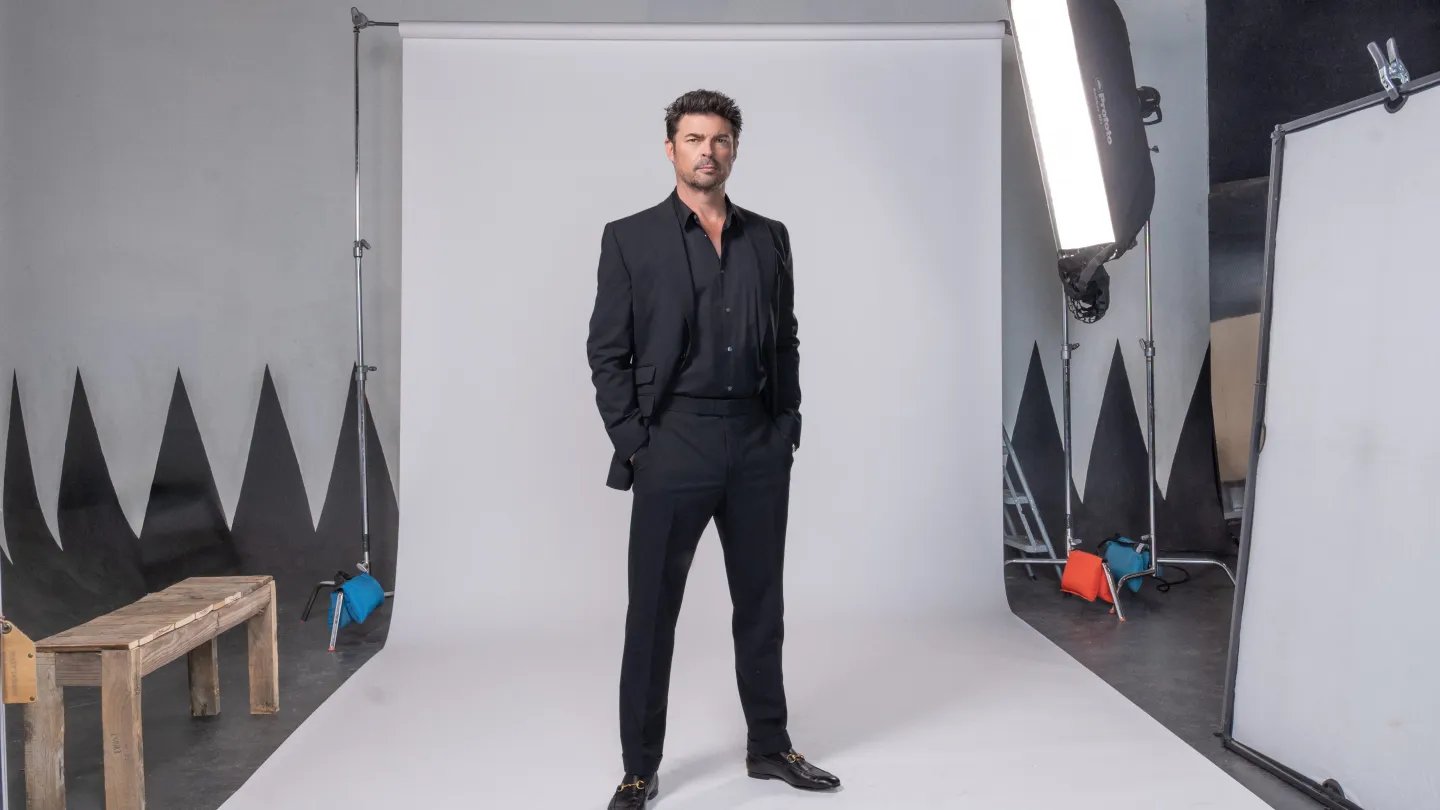
Few actors want to show up to an night shoot during their off hours. But during an all-nighter a few years ago, the Mortal Kombat II cast arrived at an Australian warehouse to watch Karl Urban tussle with a team of stuntmen as he shot a scene from Uncaged Fury, a cheesy, ‘90s action movie-within-a-movie starring Urban’s Kombat character, washed-up actor Johnny Cage.
“Karl’s down there in this pretty preposterous outfit, doing all these ridiculous action moves. And then up to the side, in a little grandstand, were all the actors, watching and cheering him on,” recalls Moral Kombat II director Simon McQuoid.
Such was their affection for their leading man, whose Johnny Cage nut-punches into theaters today, just as audiences are inhaling the final few episodes of The Boys, Urban’s zeitgeisty show he leads as the Machiavellian (or should we say, fuckin’ diabolical?), supe-hating protagonist, Billy Butcher.
It’s a pop culture hurricane of a moment for Urban, who over the past 25 years has become one of Hollywood’s most prolific and varied genre actors. If older legends Patrick Stewart and Ian McKellan are the older kings thanks to Picard, Prof. X, Gandalf and Magneto, then Urban is the prince.
He helped revamp Star Trek as Bones in the JJ Abrams reboot, crushed bones as the lead of cult favorite Dredd, and had memorable turns in Lord of the Rings trilogy as Éomer and in Thor: Ragnarok as the bombastic Skurge. Then there’s turns in Doom, Riddick, Red, The Bourne Supremacy, Priest and many others.
Though he varies his accents and looks, Urban isn’t a total chameleon on screen — there’s something comfortingly familiar when he shows up. But he doesn’t want the audience to know what they are going to get, either.
“I think that that’s a dangerous territory, because you start to pander to your audience. That then denies you the ability to discover fresh ground,” he says during a recent visit to The Hollywood Reporter‘s Los Angeles offices.
Colleagues describe Urban as having a blue-collar ethos, caring more about doing the job right than the usual status indicators of Hollywood, like who is top of the callsheet.
Chalk it up to his upbringing as an only child in New Zealand, where his mother worked at a facility that rented film equipment for the country’s burgeoning film scene. A young Urban attended crew screenings, with local films projected onto the garage of his mother’s workplace. “The way they were giving each other shit and laughing and drinking beers and smoking. I just thought, ‘Oh, this is family. I want to be a part of this,’” recalls Urban.
He grew up watching Star Trek with his dad, an immigrant from Germany, and writing and directing children’s productions he and classmates would take old folks homes around town.
He got his break in on the Sam Raimi-produced Xena: Warrior Princess in 1996, which filmed in New Zealand. That got him to Los Angeles to pursue work in the states. He’d drive around the city with a big foldout map on his dashboard. “I was nine times out of 10 impossibly late,” he says of that pre-GPS era.
Brad Dourif and Karl Urban in The Lord Of The Rings: Two Towers.
New Line/Courtesy Everett Collection
A few years later, he landed a lead role in a small New Zealand feature The Price of Milk, directed by Harry Sinclair, who showed a rough cut to friend Peter Jackson just as he was looking to cast Éomer in Lord of the Rings: The Two Towers. Playing the leader of the Riders of Rohan would be Urban’s big break, but it was easy for the young actor to feel impostor syndrome around greats like McKellen and Christopher Lee. That changed when he shot a scene in which the Riders surround Aragorn, Legolas and Gimley.
“We were a couple of takes in, and Peter called us over to his monitor. The first thing he said was, ‘We’re close to greatness here.’ And I was like, ‘Oh, that’s a good sign,’” recalls Urban.
Lord of the Rings became a cultural touchstone, with Urban’s second outing, Return of the King, winning 11 Oscars, including best picture. The work movie credits were steady after, with a stream of features for Universal, including The Bourne Supremacy.

Karl Urban in Star Trek Beyond.
Kimberley French/Paramount Pictures/Courtesy Everett Collection
2009’s Star Trek was a turning point, showing the serious actor with the face of a Lord of the Rings hero had major comedic chops. But didn’t begin smoothly.
“It was like a disaster, a train wreck,” says Urban with a laugh of his first meeting with filmmaker JJ Abrams.
It started off well enough, as they spent a time joking about mutual friend Dom Monaghan, who appeared in both Lord of the Rings and Abrams’ Lost. “I think JJ just killed him off, so I congratulated them for that,” Urban says.
Then things turned south when the notoriously secretive Abrams asked if Urban had any questions.
“I’m like, ‘Yeah!’ really enthusiastically. ‘What’s the story?’ And he said, ‘I can’t tell you.’ And I sort of looked blankly and a little bit confused and went, ‘Oh, OK. ‘I guess I’ve got no questions then,’” recalls Urban. “And he’s staring at me and he goes, ‘Oh, well thanks.’ And I walk out of there going, ‘I’m never going to hear from that man again.’”
A few weeks later, Urban got the call that Abrams wanted him to test for McCoy. “Not even halfway through the take, I hear this laughter,” says Urban. “I’m really struggling to remember the dialogue, and there’s this fucking laughing going on. And then also in an instant I’m thinking, ‘Oh, he’s laughing at me. He likes what I’m doing.’”
In an extreme rarity in Hollywood casting, he overheard Abrams telling his colleagues “that’s Bones.” He got the call on the drive home that the role was his. He found a keen collaborator in Abrams, who allowed him to insert a piece of Bones canon in to the movie. “I suggested that when he’s talking about his ex-wife, he mentions that all he got left in divorce was his bones,” recalls Urban. Abrams said to try it, and put it in the movie.
The film was a hit, revitalizing the franchise for a new era, with two sequels following. Urban heard from the wife of Leonard Nimoy, the original Spock who was also in the 2009 movie, that Nimoy was brought to tears watching Urban, because he reminded him of the late Deforrest Kelley, the original Bones.
Karl Urban in Dredd.
Joe Alblas/Lionsgate/Courtesy Everett Collection
Despite making a career as a genre icon, Urban wasn’t a comic book geek growing up. The one book he did devour? 2000 AD, the pulpy, British sci-fi comic that featured Judge Dredd. It was already made into the 1995 Sylvester Stallone bomb, and was re-invented for the early 2010s.
Dredd screenwriter Alex Garland met with Urban about starring in the revamp.
“Sometimes when you meet an actor, on some level they want the part, so they’ll tell you what they might imagine you want to hear,” says Garland. Not so with Urban. “What he did was essentially say, ‘I wouldn’t be able to do this unless certain rules were observed.’”
Urban’s rules? Dredd never takes off the helmet. He never smiles. He has no love interest. Luckily, they were all things the production was already planning on anyway.
Garland, who isn’t a fan of table reads, still remembers this one. “Dredd just arrived in the room,” he says of Urban. “His voice changed. He also got the humor of the character, which another actor might not have picked up on. I remember just sitting back in my chair thinking, ‘Oh, shit, this is gonna work.’”
“It was a difficult shoot,” says Urban, who dealt with a director being sidelined by producers, as well as constraints of the costume. He leaned hard on Garland for guidance.
“It was a challenge for me with regard to being pretty much completely concealed, denying the audience my eyes, which is one of the most effective tools an actor has,” he says.
The film wasn’t a box office hit. Unfortunately for Dredd, it arrived just months after the Indonesian action classic The Raid, which had a similar conceit of law enforcement fighting up the floors of a large building. Urban is quick to note Dredd actually filmed first, and made plenty of money on VOD. Says Urban: “If that movie were to get made today, I think that it would be a different story. I think the landscape would be a lot more amenable to it.”
Karl Urban and Antony Starr and The Boys.
Jan Thijs/Amazon/Courtesy Everett Collection
Enter a project that the world was very amenable to: The Boys.
Urban always felt a friendly rivalry with Antony Starr, the fellow Kiwi actor whom he often competed with for roles. The two first met at a barbecue and once attended a Meisner acting course together back home.
In 2018, Urban was sitting at a stoplight when he spotted a news article on his phone: Starr had been cast in The Boys. He read the synopsis and was intrigued. A few weeks later, his agent called out of the blue to say he had an offer to star as Butcher, the chief rival to Starr’s Homelander.
It’s a paring that has delivered many delicious scenes, but one stands out to Starr.
“The scene in which Homelander shows up at Butcher’s home. Feeling nobody understands him and that perhaps the only one that might….was Butcher,” Starr writes in an email. “It’s really unexpected, and shows that despite it all they are in fact more similar than either would care to admit. The scene was such a treat to play and Karl crushed it.” (Starr also shouts out Urban for being skilled at backgammon: “some might say that’s his true passion.”)
When looking for his Butcher, creator Eric Kripke already knew Urban could handle the action and the humor. But he had one question that needed answering.
“Is he going break your heart? I needed him to also be that kind of emotional character that, despite doing horrific things, that you could really get behind and your heart could break for,” says Kripke. “And, to me, he crushed that. My expectations were high, and he exceeded them.”
The Boys was an instant hit for Amazon, with President Barack Obama naming it one of his favorite shows. Kripke has been praised for seemingly predicting the future, with the show lining up with real life events — including the latest season arriving as ICE raids hit America, with Homelander ordering similar raids.
But Urban, who is guarded about his personal life, extends that thinking to his work as well.
“I often think the more that an audience knows about me, the more difficult it is for them to leave that baggage of the door and accept the character that I play,” says Urban of maintaining his privacy. “I believe in not over explaining the work. I think as soon as you say, ‘Oh, this character is Donald Trump or this character is Marjorie Taylor Greene,’ first of all, you’ve lost a third of your audience. And secondly, you’ve actually diminished the quality of the art, because you’re denying the audience the ability to process and interpret it as they see fit.”
Mortal Kombat II
Courtesy of Warner Bros.
As The Boys started to wind down, Mortal Kombat II became an unexpected turn for Urban. Normally after a season of The Boys, he goes home to New Zealand to spend times with family and recover from the action-heavy schedule. But Butcher spent much of season four confined to a hospital bed, and as the season neared its end, Urban wasn’t exhausted.
“I reached out to my agent and said, ‘Listen, I’m ready to go immediately. What do you got? I’d love to do something that was heavy on action. I’ve got fuel in the tank,’” he recalls.
At that very moment, the Mortal Kombat brain trust was looking for Johnny Cage, the fan-favorite character teased in the end of the previous movie, which was a hit on HBO Max, but left some things to be desired from fans.
“There was literally an incoming call, and we’re like, ‘What? No way, but yes!” recalls producer Todd Garner, who had never worked with Urban but is a massive Boys fan, and would go on to enjoy many a golf game during downtime in Australia with Urban. “It was that serendipitous.”
Urban trained in movement and martial arts for more than three months to play Cage, and added some of his own lines. A quip about Cage being a Saturn Award Winner was Urban’s, as was stuff like “That’s Hollywood 101, baby.” For research, Urban spent time observing families at youth martial art’s tournaments in New Zealand, seeing how fathers and sons dealt with disappointment and victory.
“It was, hands down the most difficult, physical challenge that I’ve ever encountered in my career,” he says of the training.
The film is eyeing a $50 million start this weekend at the box office, while The Boys concludes May 20. They are both the rare Urban projects his two 20-something sons from a previous marriage will watch. He tried showing them Lord of the Rings once, to an absolutely indifference.
He takes his son’s disinterest in his work so seriously that he once turned down a role over it. “It was one of my son’s favorite shows and I got offered a role in it and I didn’t want to fuck it up,” he says, declining to name the show out of respect for the actor who took the job, and who “fucking smashed it.”
But, his boys do like The Boys, something he’s proud of, and they played plenty of 2015’s Mortal Kombat X together, suggesting they’ll approve of Mortal Kombat II as well.
For the first time in eight years of working on The Boys show, Urban has a clear schedule ahead.
“I feel content to leave it in a good place. It’s not often that you get the opportunity to land the ship on your own terms, before it gets taken away from you,” Urban says of The Boys ending. “I’m not an actor who would comfortably sit on a show for 10 or 15 years. I would get bored. What interests me is the challenge of doing something that I haven’t done before.”
— James Hibberd contributed to this story.