The resemblance between Judith Godrèche and her daughter Tess Barthélemy — also the luminous lead of her mother’s debut feature “A Girl’s Life” — will be particularly powerful for anyone familiar with Godrèche’s teenage breakthrough role in the 1990 Jacques Doillon drama “The Disenchanted.” Watching the doe-eyed Barthélémy in this assured adaptation of Annie Ernaux’s novel of the same title, one can’t help but draw parallels between this bitter story of sexual initiation and the experiences of Godrèche’s own life, namely the accusations of sexual abuse she lodged against Doillon (and the director Bênoit Jacquot) as well as her standing, today, as one of the most notable champions of France’s #MeToo movement.
But in step with Ernaux’s vision, where extremely intimate, first-person narratives take on a collective, intentionally universalizing, sweep, “A Girl’s Life” succeeds not just as a haunting echo of Godrèche’s early years but as a moving, at times disturbing, meditation on the gender relations that normalize violence against women — specifically the kind of violence that’s hard to recognize until well after the damage is done.
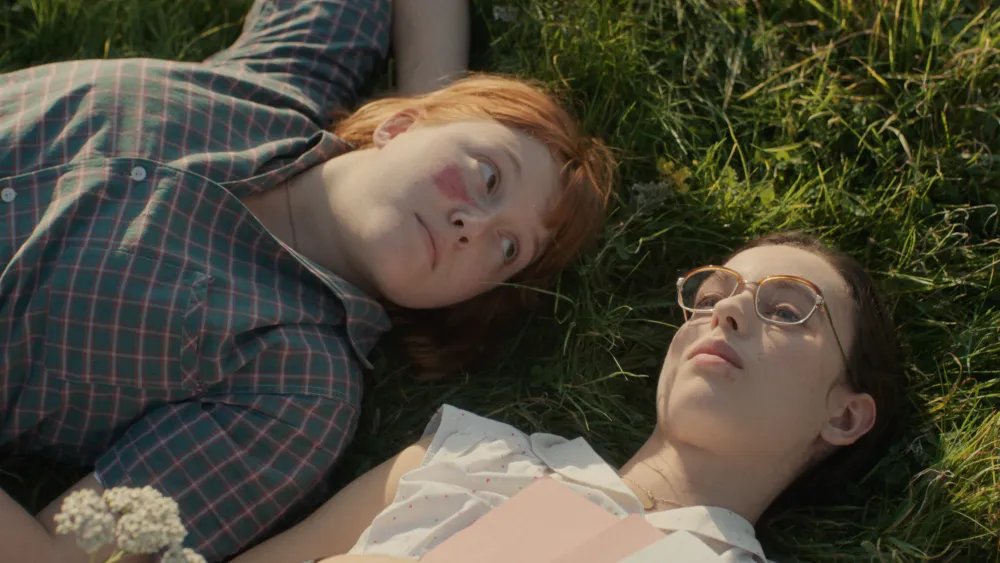
Bookended by voiceover narration drawn straight from Ernaux’s novel, delivered by a septuagenarian version of the writer performed by Valérie Dréville, the film primarily tells the story of Annie at 17 (Barthélemy) in the summer of 1958. With her fishbowl glasses and major sweet tooth, girlish Annie is a sheltered dreamer yearning to escape the Catholic restrictions of her smalltown existence and “find her people,” which she expects will happen in the sunny months away from home during her first stint as a camp counselor in training.
There, her enthusiasm is immediately met with hostility from the other counselors: mean girls in plaid skirts and lipstick and even crueler boys who think with their, uh, genitals. Their leader is a stocky, Brando-esque blond named ‘H’ (Victor Bonnel), who — as predicted, given his repeated preference for the ‘new girl’ each summer — sets his sights on our heroine. Annie is thrilled, but she doesn’t expect to strip off her clothes quite so quickly, in an uncomfortably blunt and almost wordless sequence that leads the couple from a cavern party to the twin bed in Annie’s shared dormitory. There is nothing romantic about her first time past first base, but Annie is blind to her own mistreatment, or at least convinced it’s part of the process.
“A Girl’s Life” joins a cluster of recent Ernaux-inspired works, among them Danielle Arbid’s “Simple Passion” (2020), an acclaimed stage rendering of “The Years” that premiered in 2022, and the home-video documentary “The Super 8 Years” (2022), written by Ernaux and directed by her son David Ernaux-Briot. But the Nobel Prize winner’s most auspicious adaptation to date is doubtless Audrey Diwan’s 2021 Venice Golden Lion winner “Happening” (2021): That film, a vérité-style account of a university student’s illegal abortion in 1960s France, takes place a few years after the events of “A Girl’s Story” in the timeline of Ernaux’s life mapped out by her books.
Barthélemy’s Annie may be younger than Anamaria Vartolomei’s protagonist Anne in “Happening,” but the stretch of time covered by Godrèche’s film offers the young actress a similarly robust opportunity to showcase her dramatic chops. Impressively, she goes from a dorky (but still quick-witted) innocent, à la Taylor Dearden in “The Pitt,” to damaged and delusional, with something of a young Winona Ryder’s manic glint in her eyes.
The cinematographer Joachim Philippe keeps his camera close to Annie’s face and captures, as if from her point of view, the drunken partying and canoodling that seems to happen every evening. Slow-motion and twilight neons initially give these scenes a romantic edge that turns deceptive and nefarious. One recurring image underscores the traumatic ugliness of Annie’s arguably consensual rendezvous with H: a buzzing, dangling lightbulb shot from her perspective, looking up from underneath his body. Meanwhile, Godrèche’s script offers a provocatively nuanced depiction of Annie’s mental decline: She is as much a victim of groupthink as she is brainwashed into self-harm by the fantasies sold to young women about belonging and romance.
Godrèche digs deep into these masochistic behaviors so common among heterosexual relationships of Ernaux’s generation; her layered, empathetic approach to these knotty feelings is the film’s greatest virtue. Other elements are half-baked: a nurse played by Guslagie Malanda (“Saint Omer,” “The Beast”) is introduced as a possible mentor figure, only to drift away inconsequentially. Annie, whom the cool-kid counselors dismiss as a country bumpkin, strikes up a friendship with another marginalized gal: a redhead (Maïwène Barthélémy) coded as a lesbian and also resigned to the background rather expediently.
A corny, self-aggrandizing coda — positioning the main events of the film within the context of Ernaux’s career and the feminist awakenings of the following century — feels stretched-out and, frankly, somewhat obligatory. Still, after sticking Annie so deeply in the psychological trenches, gesturing to the light at the end of the tunnel is also welcome. A girl not only tells her story, but she lives to learn from it, too.