
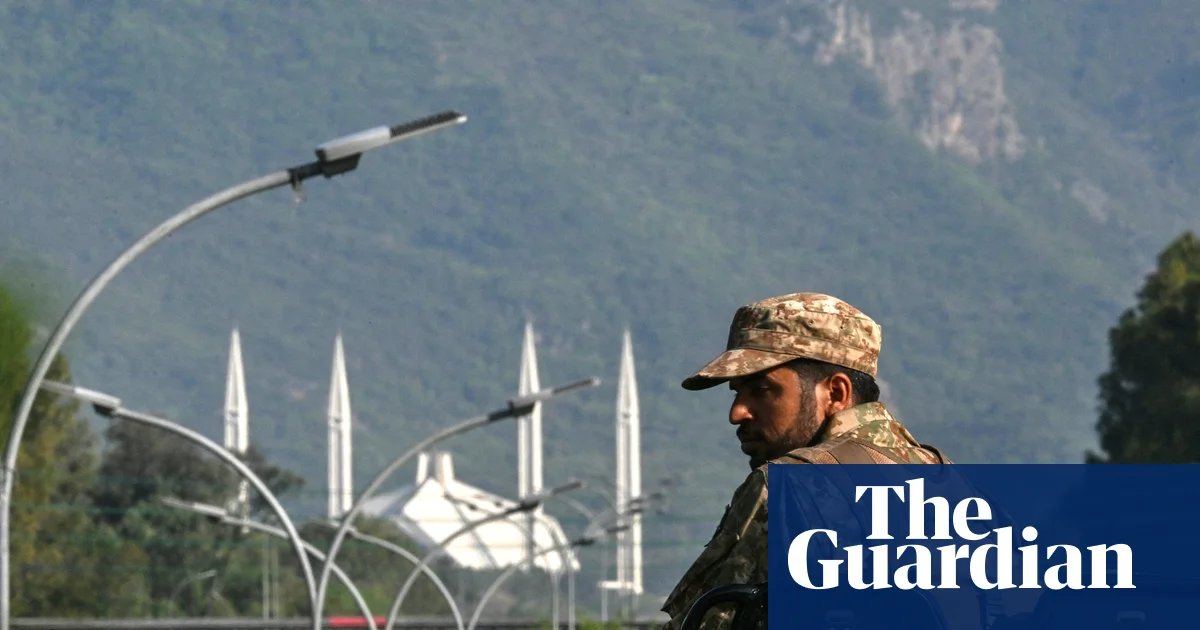
Iran has passed a new proposal to Pakistani mediators to end the war with the United States, in the latest effort to break the deadlock in negotiations.
Iranian state media reported that Tehran handed the offer to Pakistan on Thursday night, to pass on to Washington, though its contents were not immediately clear.
The new proposal was seen by Pakistan’s government as an outcome of its energetic back-channel diplomacy. Islamabad’s role switched in recent days to the lower-profile but urgent task of passing messages between the two sides after the momentum behind direct talks stalled.
Islamabad has said it believes a deal is within reach. But it faces an Iran that is in danger of overplaying its hand and a US administration that is seeking total victory rather than a compromise.
Pakistani officials say they are conscious that it is not only regional peace at stake, but the health of the global economy and the livelihoods of millions of the poorest people in the world – including in Pakistan, whose monthly energy import bill has almost tripled because of the war.
The decision to submit proposals to Pakistan followed a debate inside Iran on whether it should pursue the diplomatic path at all, or instead rely on the leverage provided by the ad hoc blockade of the strait of Hormuz. Iranian officials hope Trump will want to end the conflict before his summit with Xi Jinping, the Chinese president, on May 14-15.
Islamabad views the continuation of the ceasefire, in place for more than three weeks, as a major achievement. Tehran and Washington have said Pakistan remains the primary conduit for negotiation.
Both Iran and the US hardened their positions after the breakthrough of getting them into the same room in Islamabad for an all-night negotiation session in April, the highest-level engagement between the two sides since the 1979 revolution.
According to Tehran, those talks got close to a deal but the US abruptly walked out. Washington said Iran was not prepared to go far enough. An attempt to engineer a second round in Islamabad last weekend fell apart after the Iranian side refused to meet the US team, which was ready to fly in.
US officials briefed this week that Washington was considering returning to war. Some voices in Iran have expressed frustration that Pakistan has not been able to hold the US to commitments given in the negotiations.
Masood Khan, Pakistan’s former ambassador to the US, said Pakistan was not only transmitting messages between the two sides. He said Islamabad’s intervention had led to an initial two-week ceasefire and the US-Iran meeting with Pakistani officials as referees. Islamabad persuaded Trump to extend the ceasefire, he said, which now has no stated deadline.
The next task was to convince both sides to simultaneously lift their blockades on the strait of Hormuz, he said. But Trump this week said the blockade was more effective than bombing, while Iran’s supreme leader, Mojtaba Khamenei, hailed a “new chapter” for the strait, suggesting neither side was about to back down.
“Pakistan is playing a complex role as a mediator,” said Khan. “Iran is signalling that it is playing a long game, but America wants quick results.”
Pakistan’s military chief spent three days in Tehran in April, meeting Iran’s different power centres, while the prime minister worked on regional support for the peace process, visiting Saudi Arabia, Qatar and Turkey. Islamabad has enlisted countries as far afield as Japan to put their weight behind the diplomacy, and Pakistan’s foreign minister also spoke this week to Yvette Cooper, the UK foreign secretary.
“The clock on diplomacy has not stopped,” said Tahir Andrabi, the spokesperson for Pakistan’s foreign ministry, before the reports of the new Iranian proposal. “We remain hopeful of a negotiated settlement of this issue.”
The previous Iranian bid, also passed through Pakistan, offered to reopen the strait of Hormuz but defer resolving the issue of the country’s nuclear programme. Trump said Iran had to commit to not acquiring nuclear weapons, so Tehran would need to tackle this issue to satisfy Washington and set up the possibility of a new round of direct talks.
Two outstanding issues on the nuclear front are agreeing to a pause on Iran’s uranium enrichment, and coming up with an arrangement for its stockpile of highly enriched uranium.
Regional diplomats with knowledge of the discussions said it should be possible to agree on a moratorium on enrichment of about 10 years – roughly halfway between the negotiating positions of the two sides. In place of the US demand to hand over the highly enriched uranium, it could be sent to Iran’s ally Russia, a possibility discussed this week between Trump and the Russian leader, Vladimir Putin.
Tehran has not agreed to let go of the highly enriched uranium, or the right to enrich. Iran remains exasperated by the inability of the US to adopt a coherent public position after Trump said he opposed Iran being allowed to enrich uranium even for medical purposes, a concession Iran believed the US delegation had already made.
Jauhar Saleem, formerly Pakistan’s top diplomat, who is now president of the Institute of Regional Studies, a thinktank in Islamabad, said Iran’s apparent strategy of dragging out the negotiation in the expectation of getting a better deal was highly risky. But Washington also had to recognise that its pressure tactics had not worked on Iran over the years, he said.
“It is not realistic that Iran would give in to all demands,” said Saleem. “An agreement has to be a win-win situation for both sides.”


