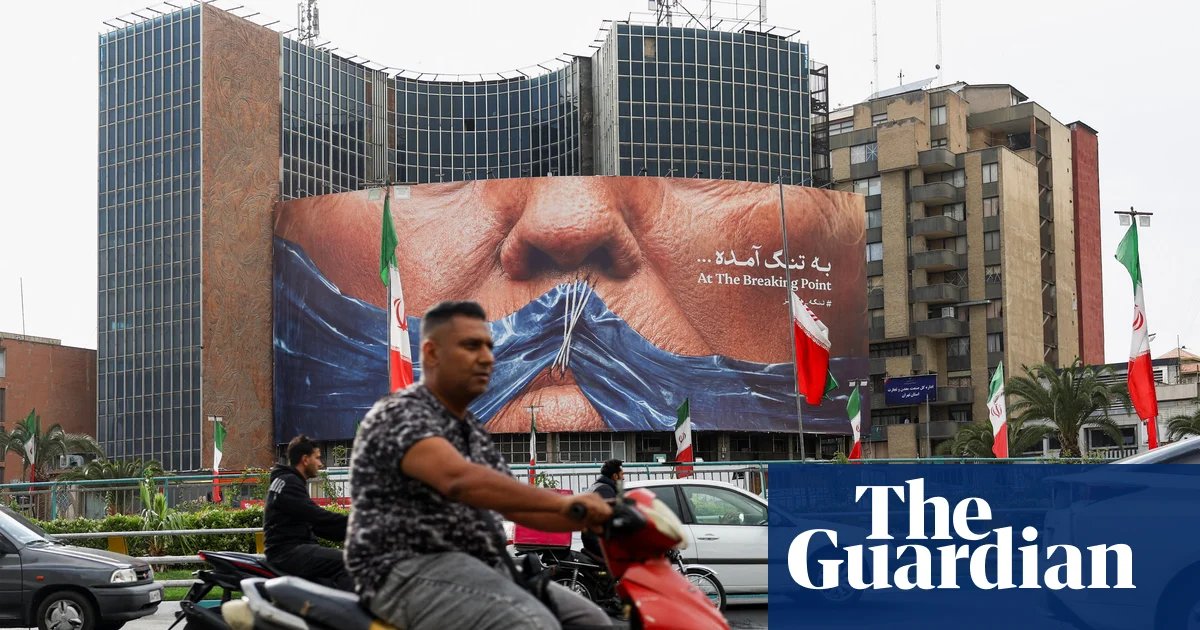
Iran has made a new proposal for a deal to definitively end the war in the Middle East, officials in the region said on Monday, though there was no sign of any immediate breakthrough in the stalled peace negotiations.
A ceasefire has paused most violence after six weeks of US-Israeli airstrikes and Iranian retaliation, but there has been little progress since Donald Trump said the ceasefire was “on life support”, and reports in Israeli media suggest a resumption of hostilities is imminent.
Pakistan, which has mediated the discussions since a ceasefire came into effect last month, has shared with the US the new Iranian proposal, Iran’s foreign ministry spokesperson Esmail Baghaei said, but he gave no details.
There were contradictory reports from Islamabad. A Pakistani source appeared pessimistic, telling Reuters that Washington and Tehran “keep changing their goalposts” and that time was running out to find agreement.
Other regional officials said Iran had made or reiterated some concessions, including a long-term suspension of its nuclear programme and transfer of its highly enriched uranium to Russia, and a phased reopening of the strait of Hormuz.
The semi-official Tasnim news agency, citing an unnamed source close to the country’s negotiation team, reported on Monday that the US had agreed to waive sanctions on Tehran’s oil exports during the negotiation period.
There was no independent confirmation of the claims, and the negotiations have been marked by a series of misleading statements made by Iran, the US and mediators to try to publicly frame the talks to their advantage.
Rhetoric on both sides has remained defiant in recent days. The Islamic Revolutionary Guard Corps (IRGC) threatened on Monday to impose permits on internet cables passing through the strait of Hormuz, while other officials have said the waterway would remain under Iranian “management”, implying Tehran would impose tolls on shipping, which Washington has said it cannot accept.
Axios reported that Trump was expected to meet national security advisers on Tuesday to discuss options for resuming military action. At the weekend, Trump said in a post on Truth Social “the Clock is Ticking” for Iran, adding: “They better get moving, FAST, or there won’t be anything left of them. TIME IS OF THE ESSENCE!”
Baghaei said Tehran was prepared for all scenarios. “As for their threats, rest assured that we are fully aware of how to respond appropriately to even the smallest mistake from the opposing side,” he told a televised weekly press conference.
Though US-Israeli airstrikes have ceased and Iranian retaliation has been scaled back, drones have been launched from Iran towards Gulf countries hosting US military bases. One drone strike caused a fire at a nuclear power plant in the United Arab Emirates, officials there said on Sunday, and Saudi Arabia reported intercepting three drones.
Iran stepped up attacks on the UAE this month after Trump announced a naval mission to try to open the strait of Hormuz, which he suspended after 48 hours.
Analysts say the conflict is now a stalemate, with both sides facing significant pressure to bring the war to an end but without sufficient incentives to make painful concessions necessary for a deal.
Trump, who faces midterm elections in November that could go badly for his Republican party, held talks with the Chinese president, Xi Jinping, last week in Beijing without securing an indication from China that it would help resolve the conflict.
White House officials worry that Trump’s foreign policy gamble in Iran and its effect on US fuel prices may derail Republican chances of keeping control of Congress at a time when voters are more concerned with the cost of living than conflicts abroad.
Iran faces a deepening economic crisis and potential damage to its oil infrastructure. Inflation is soaring and some officials fear a surge in popular discontent with the radical regime.
The Human Rights Activists News Agency (HRANA), a US-and Netherlands-based monitoring group, said it had documented at least 4,023 arrests in Iran between 28 February 28, when the war started, and 9 May. Charges included espionage, threats to national security and communicating or sharing content related to the conflict with foreign media, it said.
Ahmad Reza Radan, Iran’s national police chief, said on Sunday that more than “6,500 traitors and spies” linked with the “enemy” had been arrested since anti-government protests peaked in January. The authorities described those demonstrations as riots and put them down with a crackdown that left many thousands dead, according to rights groups.
Radan was quoted by the Irna news agency as saying: “The process of identifying and arresting elements associated with the enemy continues, and the police have not stopped their actions in the field of confronting rioters.”
There has been growing alarm over executions in Iran. Rights groups have said that since the start of the war, Iran has executed 26 men seen as “political prisoners” – 14 charged over January protests, one over 2022 demonstrations and 11 accused of links to banned opposition groups.
Six men have been hanged by Iran on charges of spying for Israel since the war began, according to reports in Iranian official media.
HRANA said it had documented at least 3,636 fatalities, including 1,701 civilians, due to US-Israeli attacks on Iran in the war.
Israel carried out new airstrikes in southern Lebanon on Monday, Lebanese security sources and the state news agency said, while Hezbollah announced new attacks on Israeli forces, continuing the war in Lebanon despite the extension of a US-backed truce first announced by Trump on 16 April.
A 45-day ceasefire extension announced after a third round of US-hosted talks between Lebanon and Israel on Friday began at midnight.
With Reuters and AFP