
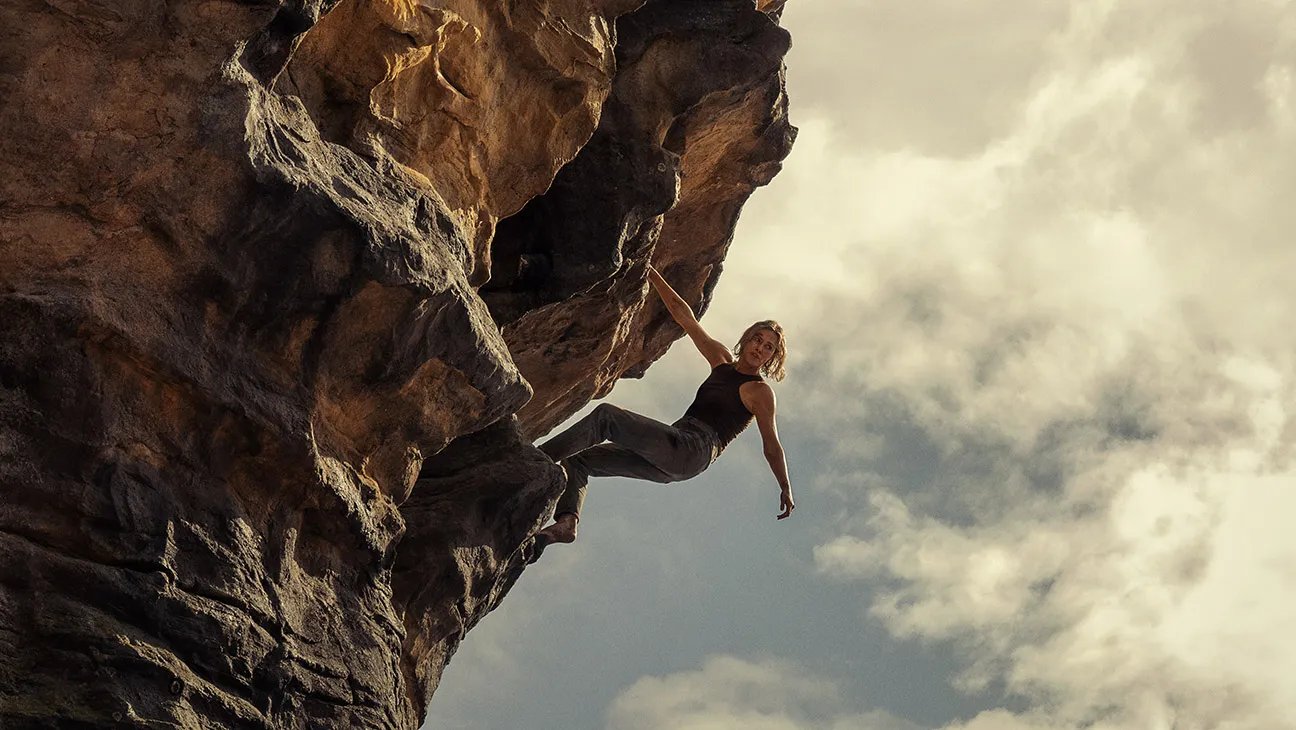
[This story contains spoilers for Apex.]
Silver linings during the pandemic were few and far between. But in the case of screenwriter Jeremy Robbins, receiving an involuntary breather from the breakneck pace of TV writers’ rooms provided him the runway to write a spec feature script called Apex. What also began as a way for the Washington D.C. native to not doomscroll social media all day is now Netflix’s newest chart-topper, starring Charlize Theron and Taron Egerton.
Set primarily in an Australian national park, the Baltasar “Balt” Kormákur-directed thriller chronicles a grieving adventurer named Sasha (Theron) as she explores the homeland terrain of her recently deceased partner, Tommy (Eric Bana). After the latter’s tragic accident during their climb of Norway’s Troll Wall, Sasha is focused more on kayaking than summiting, at least until she encounters a cannibalistic hunter named Ben (Egerton). Sasha is then forced to play a ritualistic cat-and-mouse game that Robbins considers to be his homage to Deliverance (1972) and The River Wild (1994).
Bookending the film’s opening tragedy on a mountainside, Sasha eventually comes face to face with another mountain she has to climb. The necessity of the moment is not only about fending off Ben, but also processing the grief and guilt she feels over Tommy. The metaphorical mountain is something Robbins also became deeply connected to throughout the career-elevating process of writing Apex.
“I found that my mountain was a career in Hollywood,” Robbins tells The Hollywood Reporter. “I was holding on with all of my strength as all the cracks to put your fingers in started to disappear. I was staring up at the sheer face of a cliff that felt impossible to climb, wondering, How am I going to find my way up?”
Robbins may have been inspired by the survival actioners he consumed during childhood, but it was Egerton’s involvement that added the right amount of creative fairy dust. He saw Ben as an unhinged Peter Pan who navigates the film’s national park like it’s his Neverland. Thus, the film evolves into a twisted take on the maternal bond between Peter and Wendy Darling, especially when Ben can’t bring himself to strangle Sasha to death during the film’s climax.
“In every version of the script, that was always the hardest moment for me to write. Any viewer is going to see it differently, but I do think [Ben] sees his mother in Sasha,” Robbins says. “There’s this moment of fragility in cradling her that I think is really beautiful. I also think he realizes that if he kills her like this, it goes against the ritualistic aspect that he’s built his entire identity around.”
Below, during a spoiler conversation with THR, Robbins also discusses his rewrites once Theron signed on, as well as the story behind the film’s memorable beef jerky. Then he offers up the properties he’d love to take a crack at in the wake of Apex’s success.
***
Jeremy Robbins attends Netflix’s Apex Premiere on April 22, 2026 in New York City.
Jamie McCarthy/Getty Images
Last year, I covered a writer-director named Drew Hancock. He’d primarily written for television, and during the pandemic, he decided to recalibrate by writing his way into a feature career. That decision resulted in a script called Companion. So when I first glanced at your résumé, I got the impression that you might have a similar story. Is that the case with Apex?
You’re not far off. Coming out of film school, I was just looking to work. I loved TV and movies equally, and TV was where I found that first toe in the door. I was excited to go from room to room and set to set. You learn a ton about the process of making something from script to screen.
Then 2020 rolled around, and the writers room that I was in closed and didn’t reopen. So I stood in the room I’m in now, thinking, What do I want to write that’s going to get me out of bed so I don’t doomscroll the news for several hours? The answer was to return to the kinds of movies and stories that I’ve loved since I was a kid, and those are largely survival-action thrillers.
So this was an opportunity to write something that I loved and wanted to see as an audience member. Everything that has happened with it since then has been unexpected and surprising in the best possible way.
Hollywood loves reductive comparisons: It’s Sicario meets Steel Magnolias. It’s Die Hard meets Mystic Pizza. I pegged Apex as Deliverance meets The River Wild. Did you ever pre-define it in those terms?
I didn’t, but you just named the two movies that I would have referenced as this meets that. Once it started to be read by producers, my agents and managers, they found that Free Solo meets Silence of the Lambs was also an apt comparison. But Deliverance and The River Wild were such touchstones in my childhood and high school life that I was absolutely writing towards them. So I very proudly embrace those comparisons to two movies I’ve loved immensely for most of my life.

(L-R) Taron Egerton as Ben and Charlize Theron as Sasha in Apex.
Kane Skennar/Netflix
Scripts always evolve as different producers and companies join the fold. How would you compare and contrast the earlier versions of Apex to what it is now?
The first and most obvious difference is that I had originally written it for the United States [the Pacific Northwest and Southwest]. I was drawing on the places that I have hiked and camped — the Southwest, Yosemite, Zion, the Narrows. But as soon as Netflix, Charlize [Theron] and Balt [Kormákur] came aboard, we talked about where and when to shoot it. Charlize wanted the water to be warm, so we knew that we had to scout somewhere in the Southern Hemisphere at the time of our winter. So the big production rewrite was embracing Australia, not as some post-apocalyptic Mad Max hellscape, but Australia for Australia. That had to inform why Sasha and Ben are there.
The other big one is that Taron [Egerton] had a really specific idea of what he wanted to bring to Ben. He saw him as a feral Peter Pan stuck in Neverland, and that was different from what he was on the page. If Charlize was going for a more stoic, more interior character, then he tried to balance that out by going 110 percent in the other direction. He was going to go big as this high-frequency, all-external, charismatic kid having a bakanal, and it ended up being so perfect. So once he said yes, that energy and backstory was another big rewrite.
I was going to ask you about the fact that he’s basically playing a psychotic Peter Pan, and he even crows like Peter. He often lets out these screeches and raptor calls. Was that a Taron invention?
Man, I wish I could take credit for it, but I absolutely cannot. I remember hearing that for the first time in the dailies and just getting chills. That’s when I knew that the story was becoming truly collaborative and better than I could have ever expected. It was taking on a shape. You just hope that actors like Taron and Charlize are going to see something in their characters and want to bring something that they’re excited about. I don’t even know how I would’ve written in the bird squawks and raptor calls and screeches and howls. That was totally him. I hadn’t seen anything quite like it. He really embraced the primal, beastly, terrifying part of nature that Ben represents, and he took a big swing. I love it.
Taron Egerton’s Ben and Charlize Theron’s Sasha in Apex.
Kane Skennar/Netflix
I appreciate how lean and mean the movie is. How many pages did you hover around considering the minimal dialogue?
I think most of those scripts hovered around 95 pages. I was always interested in seeing how much story I could tell through action, set piece and physicality. When you have these two performers who are going to tell the story through their movements, it was exciting to see that so much of what I had written was being translated onto screen. I really wrote out a lot of action, even if it changed during the actual orchestration by the stunt teams, Balt and the actors. I really tried to write the script so you could feel the same kind of time and flow and rhythm that you would hopefully feel in the eventual movie. So every draft really did hover around that range of 90 and 100 pages.
Comparable films would have a detective or park ranger operating in the background to eventually aid the hero, but you put the onus on Sasha to save herself. Was there ever a version where she had her version of Al Powell [from Die Hard]?
Yeah, there was an early draft where she was eventually rescued by a ranger who was doing almost like a C-plot investigation. But as soon as Balt and Charlize came aboard, they were all about stripping away anything that could help Sasha in any way. That included things like removing her climbing shoes. I had written her in climbing shoes, and Balt was like, “No, let’s go full John McClane. Let’s have her go barefoot up the mountain.” So we tried to strip away her harness and a lot of her gear — anything that could remotely be a piece of helpful apparatus.
At a certain point, I did wonder if those belligerent hunters were going to return and fight Ben for Sasha’s sake. It would’ve been a reversal of their previous function in the story. Did you ever have them come back for a valiant death?
They never did. At one point, there was a suggestion that they should be the ones to rescue her in the car at the end, but we ultimately decided that it would start to make the story feel a little too insular or small. One of the things that I love about the movie is that even though it’s got two characters, you feel the scope of the wilderness. So it just felt like the hunters served their purpose early on as something of a red herring misdirect, and there was no real serious conversation of bringing them back in any meaningful way.
Had they picked her up at the end, they would’ve said, “We told you we were just trying to be nice.”
(Laughs.) Exactly. And the moral of the story is to be nice to the creepy guys in the gas station.
Speaking of the gas station, Ben’s “beef” jerky was a master stroke. What’s the origin of that twist?
The very first draft of the script had Ben as a cannibal, and I kind of deviated from it in some subsequent drafts. I don’t think I had fully figured out how to make it work. It felt a little bit too much like an idea and not tied to character. But when Netflix came aboard, I was doing the first rewrite with them, and we really started to talk about Ben as this enlightened hunter who’s going to use every part of the kill. There’s this idea that the best hunters respect their prey by using everything. So once we landed on that philosophy, I came back to the idea of Ben as a cannibal and thought, Wouldn’t it be interesting if that’s what he’s doing with his victims? What if he’s using them as sustenance for more people? I thought that was a really twisted MO for a killer.
It also allowed us to introduce him early on as this bumbling salesman in the gas station. He’s hawking his wares as this Willy Loman-type salesman. But I think the viewers know that there’s something probably up with the jerky. So it really started from just figuring out how to stay true to the character of Ben. He would treat his victims with what he thinks is the utmost respect, and by providing sustenance to other people, he’s honoring his kill.
As soon as the gas station cashier cheekily said that she wouldn’t feed it to her dog, I made a mental note.
Yeah, if it was selling like hotcakes and flying off the shelves, maybe that would’ve been another way to go to where you might not have known there was something up with the jerky. But I certainly never thought that it would be called Jenno’s Jerky after [producer] Jenno Topping. I threw that in as an Easter egg to make the Chernin [Entertainment] producers and Netflix execs laugh, and she was cool with it. It got through clearances to make the movie. It was just one of those Easter eggs that was meant to be an inside joke, and now it’s a much bigger joke than I ever thought possible. Jenno Topping wrote me an email, saying, “I am so glad to be the inspiration for Ben’s mother and the jerky that has become such an integral part of the story.”
As a jerky snob myself, I must say that it looked pretty good.
I think so too. I wish it was at the premiere. I would’ve loved to have had some Jenno’s Jerky while watching the movie.
Yeah, there should’ve been a gift bag.
And it would’ve led to an audible stomach drop as everyone realizes what it actually is. It would’ve been really funny.
At the Oscars, Conan O’Brien joked about the longstanding rumor that Netflix encourages their writers to write for a passive audience. Apex is already such a straightforward narrative that this would seem unlikely, but were you ever given a note to account for the viewer who’s folding laundry at the same time?
I heard those jokes too. It’s easy to take potshots, and while I can understand where that talk is coming from, that was definitely not my experience. The notes that I got from the Netflix execs came from an engaged audience’s perspective. They genuinely enjoy this kind of movie, and they pushed me to write an even better script than the one they originally came on board to make. That previous script was not as good as the script that they ended up shooting, and I’m really grateful that I was pushed to make it better. So I never felt like I was being asked to water something down or overexplain or simplify. They just wanted to make the best movie possible, and they put so much muscle behind it. Charlize climbed a billboard in Times Square to promote it. So they let Balt, the producers and the actors make that lean mean movie that it always was.
(L-R) Charlize Theron as Sasha and Taron Egerton as Ben in Apex.
Kane Skennar/Netflix
Late in the film, Ben has the upper hand, but he lets go instead of strangling Sasha to death. She then proceeds to break his leg, paving the way for her triumph on the mountain. So why did he pull back? Did she remind him of his mom?
In every version of the script, that was always the hardest moment for me to write. I kept trying to figure out how to make that moment work, logistically, emotionally and structurally. Any viewer is going to see it differently, but I think you’re right. I do think he sees his mother in Sasha. There’s this moment of fragility in cradling her that I think is really beautiful. I also think he realizes that if he kills her like this, it goes against the ritualistic aspect that he’s built his entire identity around. This isn’t the pure, sacrificial kill that he needs to have. This is more reactive rather than ritualistic.
After her two most recent disasters, do you think Sasha’s adventures have come to an end? Or do you expect her to keep chasing the thrill of it all?
That’s such a good question. What she needed to learn was how to chase the thrill in a mindful and conscious way. She was seeking something external, and I hope that what she found at the end of the story was an internal validation that isn’t about proving something to anybody, even including herself. There’s nothing wrong with chasing an adrenaline rush. It’s very admirable. But I think you can do it in an incredibly safe and careful and considered way.
So I don’t think the adventures are over for her. I wouldn’t want them to be because they are integral to her psyche and character. I just hope that when she goes out into the wilderness again, she feels even more resilient than she did when she started the story — and without feeling like she needs to push beyond her limit.
Charlize Theron as Sasha in Apex.
Kane Skennar/Netflix
I’m sure there’s an enormous sense of accomplishment among the people who summit mountains, but there are many other things you can do to achieve that feeling without risking your life to that degree. Did you ever get a handle on the psychology of the people who do this? Is it ego like Tommy (Eric Bana) says? Or is it faulty wiring like Ben posits?
I actually don’t think it’s either. I’m not a climber myself, but I did a ton of research to just try to understand what draws someone to the mountain. I think some are drawn for either of those reasons, but those fall on the extreme ends of the spectrum. I think most climbers come to it because it’s the purest expression of the most athletic achievement and being in your body moment to moment.
The mountain becomes a metaphor for summiting whatever you need. It is so unchanging and so unforgiving that each person who decides to climb one — whether they’re a professional or a recreational climber — has the ability to project whatever they want onto it. For Sasha, it’s about pulling herself out of the depths of grief and guilt. But most climbers treat it the way an NBA player would treat their basketball game.
There’s a real respect for the sport and the craft and the practice that is very similar to writing. For me, I found that my mountain was a career in Hollywood. I was holding on with all of my strength as all the cracks to put your fingers in started to disappear. I was staring up at the sheer face of a cliff that felt impossible to climb, wondering, How am I going to find my way up? So I just fell in love with what the mountain could represent for a character.
You previously wrote for The Purge TV show. Have you heard about the upcoming Universal romcom called One Night Only? Instead of murder being legal for one night per year, it’s premarital sex.
No, I have not heard of this, but that sounds really funny. The Purge is such a juicy idea that it’s fun to see it permeate all of the different genres.
If a development executive happens to read this interview, what IP would you love to come in and pitch?
I know that this one probably won’t be done, but I’ll still stake my claim to it. I’m the biggest Indiana Jones fan of all time. I have loved him my whole life. That was always the pinnacle achievement of what one man’s wits and a whip could do. He’s the ultimate superhero human being. Also, The Amazing Adventures of Kavalier & Clay would be another one, as would James Bond, Metal Gear Solid and [the 1987 novel] Hatchet.
James Bond is one of those iconic characters that my dad introduced me to, and I remember watching all of the movies together, in order, over a summer. The challenge of telling a new grounded globe-trotting spy story, and one with real geopolitical stakes, would be a dream — especially as the suave super-spy enters his next chapter.
Metal Gear Solid was the video game of my childhood. There’s cinematic storytelling, a rich mythology and some of the best action sequences I’ve ever played. There’s something I loved about it being one guy who relies on his wits and stealth-skills to navigate complex missions. Solid Snake inspired many made-up adventures in the basement with my brothers.
And Hatchet was such a seminal survival story growing up. I found it so inspiring to read about a kid my age surviving on his own. I know I read it countless times in middle school, but I think there’s a way to make the story feel grown-up for all audiences. It has the potential to be a prestige popcorn flick that launches a new movie star.
***
Apex is now streaming on Netflix.


