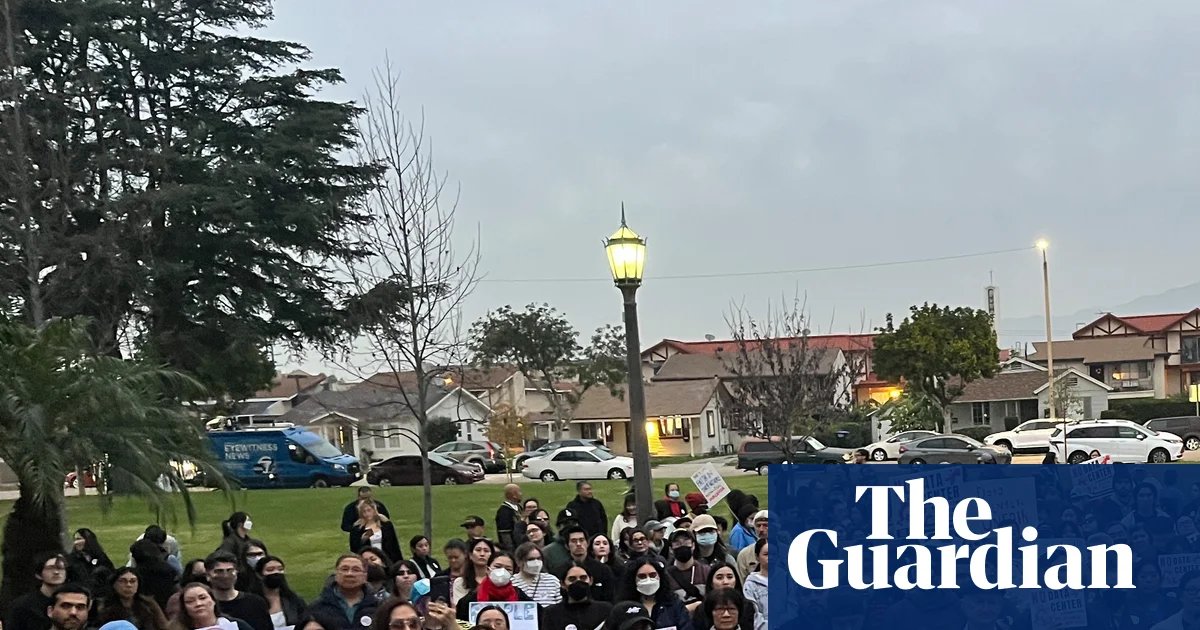
Residents in Monterey Park, California, became the first in the US to vote on a permanent ban on datacenters on Tuesday, and early results indicate a resounding victory for the prohibition.
While many cities and counties have already passed temporary or indefinite moratoriums via their local governments, Monterey Park would be the first to do so through a ballot initiative.
The ballot measure needs a majority vote – at least 51% – to win. As of 2am Pacific Time, 86.3% of the more than 7,000 votes counted so far were in favor of banning datacenters. While it can take days to finalize election results, the stark gap was enough evidence for Jose Sanchez, a city councilmember, to claim a “landslide victory” for residents who don’t want to live near datacenters.
“[This] shows unequivocally that residents in Monterey Park do not want datacenters in their community,” Sanchez said. “We hope that other communities will use the model set by residents here in Monterey Park as inspiration to stop data centers from encroaching in their backyard.”
Monterey Park’s city council had already passed an indefinite moratorium on datacenters in April, after growing anger towards HMC StratCap, an investment company that was pushing to put one in the city, located in the Los Angeles region. (Developers have since withdrawn the application; the project would have covered nearly 250,000 sq ft.)
Residents worried about negative environmental effects, increasing utility prices and the proximity to homes.
There are a few instances of municipalities turning to ballot measures to fight back against datacenters, although Monterey county appears to be the most forceful so far. In Port Washington, Wisconsin, voters approved a measure that requires local officials get voters’ approval before offering datacenter developers tax incentives. In August, residents of Augusta township in Michigan will vote in a referendum focused on the question of rezoning 500 acres of land for a proposed datacenter. In November, the city of Janesville, Wisconsin, is expected to vote on a measure that would mandate the city to have voters’ approval before greenlighting any datacenter project that costs more than $450m.
Nationally, seven in 10 Americans oppose the construction of AI datacenters in their local areas, according to a new Gallup poll.
Councilmember Jose Sanchez says city council members in Monterey Park pursued a ballot measure to “make the ban on datacenters a lot more permanent” and that it would hold more weight in court, as HMC Stratcap had threatened to sue over a potential extension of the moratorium and the ballot measure. (Developers have since indicated they won’t be pursuing legal action.)
The ballot measure asked voters to weigh in on banning “data centers citywide to protect air quality, drinking water resources and public health; prevent impacts to electricity and water rates”. The rule will stay in place “until ended by voters”.
HMC Stratcap previously called the ballot measure’s language biased. “The proposition is written in a manner that would greatly prejudice voters in favor of the measure,” they wrote in a 4 March letter to city council.
“Being able to go to court and say the residents of Monterey Park voted to ban datacenters is a much better gauge of where our residents are versus, only five city council members voted for an ordinance,” said Sanchez.
The Data Center Coalition (DCC), a trade association that tracks development of these facilities across the country, notes they are not aware of any other datacenter-related ballot measures that have been approved beyond the Monterey Park and Port Washington proposals. (Neither is Sanchez.) The DCC has championed the expansion of datacenters and is against Monterey Park’s ballot measure, saying it sends a “signal that the area is closed for business”.
“It would deprive local residents of the opportunity to compete for jobs and investment, while also causing the area to relinquish substantial long-term economic investment, high-wage jobs, and critical tax revenue to neighboring areas or other states,” said Khara Boender, DCC’s director of state policy.
Local organizers pushing for a ban on datacenters say the city council has been receptive to their concerns – and that the ballot measure was elected officials’ idea. “They took [our concerns] seriously, which not a lot of city councils do,” said Amy J Wong, co-founder of San Gabriel Valley Progressive Action – a key partner of the group No Data Center in Monterey Park. Wong has been involved in grassroots actions tied to the moratorium that city council already passed and Tuesday’s ballot measure. She said grassroots groups put helpful pressure on the council to ban datacenters: “They recognized so many residents are angry, and, if they move forward with the datacenter, they could possibly be voted out.”
She said organizers had to be quick in advance of the vote. Typically, she said, ballot measure campaigns have at least a few months to get started, but they only really had two months. In that time, they printed 10,000 flyers and sent out mailers in English, Chinese and Spanish. While many residents Wong spoke to were already skeptical of datacenters – and suggested a ban was a “no-brainer” – there was confusion around how to vote for their desired outcome. Some didn’t know whether a vote of “yes”’ or ‘“no”’ would affirm a ban on datacenters, she said: “We had to educate some people who thought supporting a ban means you’re supposed to vote ‘no’.”
“I’m feeling fairly confident,” she said, a few hours before polls closed.
Sanchez, the city council member, used to be the city’s mayor and is now a high school civics teacher. The kids are paying attention, he noted. His students are always grilling him about datacenters. So is his nine-year-old daughter. He feels he’s representing them too, even if they can’t vote yet. “They give me an earful,” he said.
Nationwide backlash
As anger towards the facilities powering the AI boom sweeps the country, communities are turning to political pressure to stop their spread. They are demanding local officials pass protective ordinances and block datacenter developers’ proposals. Residents often feel steamrolled by developers, prompting calls for statewide moratoriums. At least a dozen states are considering them this legislative session, although none have been signed into law. The moratorium question has also become a flashpoint in some governors’ races; in Pennsylvania and Georgia, challengers to incumbent governors have staked out a more extreme position on regulating AI than their opponents by pushing for temporary bans.
California is not currently considering a statewide moratorium on datacenters, and the Democratic gubernatorial candidate Tom Steyer has walked back his support for one. The cities of El Monte, Baldwin Park and Montebello are among some communities that have approved temporary bans.